


An ancient text may preserve a first-century written account of Jesus’s resurrection, according to an analysis of competing versions of a passage attributed to the Jewish historian Flavius Josephus.
Independent researcher Jesús Fernández-Pedrera Correa, from Spain, argues that the wording could record what Jesus’s followers said they had seen after his crucifixion, rather than directly asserting that he rose from the dead.
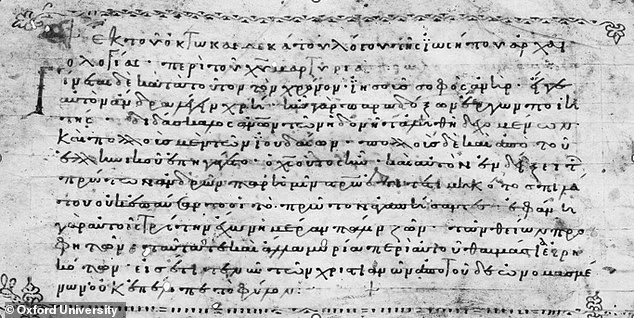
The disputed passage, known as the Testimonium Flavianum, appears in Jewish Antiquities, Josephus’s history of the Jewish people written around AD 93 to 94. It survived through Greek, Latin, Arabic and Syriac versions copied, translated and retold over the centuries.
Fernández-Pedrera Correa’s preprint study compares those versions to assess which elements may have formed part of the original account. The Latin, Arabic and Syriac texts all describe Jesus appearing alive to his followers after his crucifixion.
The surviving Greek version says Jesus appeared alive on the third day and connects the event with biblical prophecy. The Latin version states: “he appeared to them the third day alive.” The Arabic account presents the appearance specifically as something reported by the disciples.
Questions over Christian wording
The researcher argues that this difference may point to an earlier passage in which Josephus recorded the claims made by Jesus’s followers. Later Christian copying, he suggests, could have expanded that report into a more direct statement that Jesus had risen and fulfilled biblical prophecy.
Fernández-Pedrera Correa highlights the Greek wording: “He appeared to them alive again on the third day, the divine prophets having foretold these and countless other wonders about him.”
He considers the reference to fulfilled prophecy particularly significant because it sounds more like Christian preaching than the account of a non-Christian historian. Josephus elsewhere recorded the beliefs and reports of Jewish religious groups without necessarily presenting them as his own convictions.
However, the proposed reconstruction remains uncertain. The surviving versions are later copies and translations, rather than a manuscript from Josephus’s lifetime, and cannot establish precisely how much of the resurrection reference appeared in the original text.
Scholars have also long questioned other passages that appear to express Christian beliefs. The clearest example is the declaration that Jesus “was the Christ”.
In the Latin version, Jesus is described as having been believed to be the Messiah. The Syriac says he was thought to be the Messiah, while the Arabic more cautiously suggests he was “perhaps” the Messiah.
Fernández-Pedrera Correa also points to the early Christian writer Origen, who said Josephus did not accept Jesus as the Messiah. He argues that these differences provide strong evidence that the direct declaration was not part of the passage’s original wording.
Another disputed phrase questions whether Jesus should be called a man, implying that he was more than human. It is absent from the Arabic account but survives in the Latin and Syriac versions.
The researcher suggests its absence may reflect Agapius shortening the passage, meaning it does not by itself prove that the phrase was added later. He is more confident about the closing statement that Jesus’s followers continued to exist in Josephus’s own day, arguing that its wording fits the historian’s style and is consistent across the surviving versions.
