


Melbourne arts reviews this week highlight a visiting European ballet company, a pianist making her Australian debut and a lively collaboration between the Australian Chamber Orchestra and Finnish violinist Pekka Kuusisto.
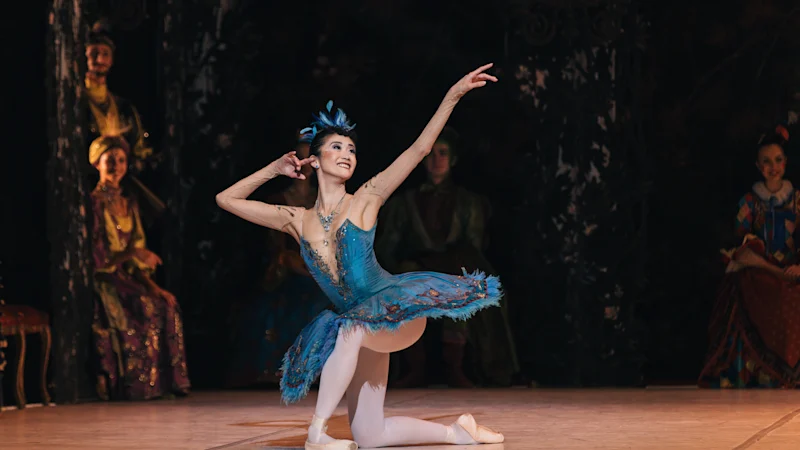
The Stuttgart Ballet’s production of The Sleeping Beauty is at the Regent Theatre until October 18, offering audiences the chance to see one of the company’s signature story ballets alongside several international stars.
Elisa Badenes brought poise and technical control to the role of Aurora, while Henrik Erikson was a polished and assured Prince Désiré. Their partnership reached its peak in the wedding pas de deux, where supported turns and plunging fish dives created an impression of complete unity.
Jason Reilly gave Carabosse a vivid dramatic presence, balancing mockery and menace. In Marcia Haydée’s 1987 staging, the character has a more substantial role than in some versions, representing one side of an expansive struggle between good and evil alongside the Lilac Fairy.
The production’s Cold War-era sensibility can occasionally make its heightened drama feel disproportionate to the fairy-tale story. Abigail Willson-Heisel provided calm authority as the Lilac Fairy, while Adhonay Soares stood out for the power and scale of his leaps as Ali Baba.
Isata Kanneh-Mason’s recital at the Melbourne Recital Centre on October 9 also pursued a journey from darkness towards light. Beethoven’s “Moonlight” and “Waldstein” sonatas framed a programme that included Ravel’s demanding Gaspard de la nuit and two contrasting works by Bulgarian-English composer Dobrinka Tabakova.
Kanneh-Mason’s finely controlled dynamics gave the opening Beethoven sonata a restrained intensity, although the drama did not fully develop before the technically formidable finale. Her performance of Ravel’s triptych was more assured, capturing the watery shimmer of “Ondine”, the unease of “Le Gibet” and the mischievous menace of “Scarbo”.
Tabakova’s Nocturne and Halo formed the programme’s contemporary centre, with repeated notes and harmonics creating a sense of night and then a gradually brightening lunar glow. Kanneh-Mason played the “Waldstein” with evident commitment, though heavier pedalling sometimes obscured the clarity of its closing passages.
An exuberant arrangement of “I Say a Little Prayer” sent the recital to an upbeat conclusion, to the clear delight of the audience.
Pekka Kuusisto leads the Australian Chamber Orchestra
At the Melbourne Recital Centre on October 10, Pekka Kuusisto brought energy, colour and a playful spirit to his role as guest leader of the Australian Chamber Orchestra in a programme titled Legends and Luminaries.
His arrangement of excerpts from Mozart’s The Magic Flute moved at considerable speed, with some untidiness in the overture giving way to more carefully shaped lyrical passages before the Queen of the Night’s aria.
Nico Muhly’s Shrink: Concerto for Violin and Strings, written for Kuusisto and first performed with ACO Collective in 2019, provided the evening’s most demanding test. Over 22 minutes, the soloist negotiated a dense series of technical challenges with energy and a broad range of tone, while the score explored the narrowing intervals suggested by its title.
Ellen Reid’s West Coast Sky Eternal, receiving its first Australian performances on the tour, offered shifting textures inspired by the Californian landscape. Its extended pizzicato section, however, disturbed the balance of the work.
The concert ended with an animated account of Mendelssohn’s String Quintet No. 2, followed by Reger’s arrangement of Bach’s chorale prelude O Mensch, bewein’ as a reflective encore.
