


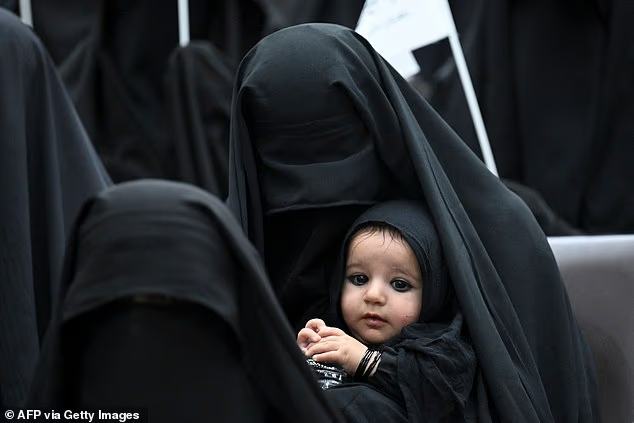
Afghan families facing drought and extreme poverty are selling their daughters into marriage to raise money, with some girls promised to men many decades older than them.
In Badghis province, where most people depend on rain-fed farming and livestock, repeated water shortages and failed harvests have left families struggling to feed themselves, repay debts and pay for medical care.
Gul Bobo, from the rural village of Tayz Nāwah, said she and her husband had arranged marriages for their daughters, aged two and five, because worsening drought had devastated his work as a farmer.
Her husband’s income is used to support the family, buy seeds and hire a tractor or donkey to work wealthier land. But increasingly unstable weather has made earning a living more difficult.
“As a mother, I cried a lot, but I knew my husband had no choice,” she said.
“I know they are too young to be engaged but we had no choice – otherwise we would have waited until after 18.”
Gul Bobo said her five-year-old daughter, Nazila, had been promised to a 15-year-old boy and was likely to leave home within two or three years.
She said she feared what awaited her children. “I expect them to be beaten, but there is nothing I can do about it. And at 14, they will be pregnant.”
Drought drives Afghan families to sell daughters into marriage
Badghis has endured years of poor weather. A historic drought struck in 2018, while water shortages since 2021 have damaged crops and left livestock without enough food.
Families have responded by abandoning rural homes for cities in search of work or humanitarian assistance. Tens of thousands of displaced people from across Afghanistan are living in the Shahrak-e-Sabz camp in Herat, but aid has since diminished.
The United Nations says Afghanistan now receives less than 70 per cent of the aid it did last year. The United States, once the country’s largest donor, has cut nearly all aid, while other countries including the UK have also reduced their support.
Mark Calder, advocacy director for Afghanistan at World Vision International, said early marriage exposed girls to serious health dangers as medical clinics disappeared amid cuts to aid.
Bana, the mother of 11-year-old Gulalai, said she had been forced to promise her daughter to a shopkeeper in his late 40s after the family fell into debt.
“I would have preferred for her to be dead rather than be married off to such an old man,” she said.
Her husband, Niaz Mohammad, defended the decision by saying: “We have to sacrifice a family member to save the others.”
Darellah was 15 and pregnant when she spoke about living with her 30-year-old husband after her family left their village in 2018.
“I am still a child … it cannot be a good decision to be married at that age,” she said. Her sisters, Bibi Zat, nine, and Rahimah, 11, have also been engaged but remain with their parents.
In Khoshkian, eight years of poor harvests led Abdul Aziz to arrange marriages for five of his daughters. He received between 90,000 and 150,000 afghanis for each, money used to settle debts.
One daughter, Mazari, left home at 12 or 13. She is now 16 or 17, living with her husband, who is in his 40s, and caring for their two-year-old son and newborn baby.
“Getting married at 12 was really hard; when I came to his home, I wasn’t able to cook, but my husband and in-laws have been really kind,” she said.
Her younger sisters, aged between three and 13, are expected to remain at home until their bride prices have been paid in full.
Some parents delay collecting the money owed to them in an attempt to keep their daughters at home for as long as possible.
Sara, who fled drought and moved to Qala-e-Naw in 2021, arranged the marriage of her 12-year-old daughter Aisha to a 20-year-old man to help repay debts. But the payment did not resolve the family’s financial problems.
The family had not paid its rent for two months and was eventually evicted. When Sara’s last baby was born, she could not afford transport to hospital and walked there before giving birth.
“I try not to contact the in-laws to ask them for the rest of the bride price, so that Aisha will not have to leave,” she said.
In another case, Khomakha said her husband agreed to marry off their daughter Fatemah when the girl was just two. The family could not afford the transport needed to take their eight-year-old son, Ehsanullah, to hospital for weekly blood transfusions.
Fatemah’s future home is a 15-hour drive away. “I will not be able to afford transport to visit my daughter once she leaves,” her mother said.
The raw material says there is no law dictating the age at which a girl can leave home for marriage, leaving families facing poverty to make decisions that can separate children from their parents and expose them to early pregnancy and abuse.
