


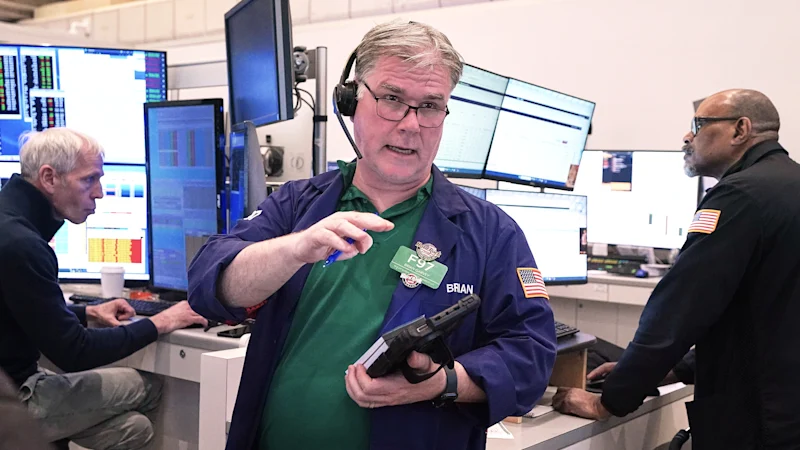
Wall Street steadied after a worldwide sell-off in artificial intelligence stocks, while futures pointed to a stronger opening for Australia’s sharemarket. ASX 200 futures indicated a rise of about 80 points, or 0.9 per cent, after the index slipped 0.1 per cent on Thursday.
The S&P 500 recovered from an early decline to gain 0.2 per cent, leaving it close to the record high reached last week. The Dow Jones Industrial Average rose by 470 points, or 0.9 per cent, while the technology-heavy Nasdaq Composite fell 0.2 per cent as AI-related shares continued to weaken.
The Australian dollar also lost ground, trading at US69.19¢.
Earlier, the sell-off had spread through Asian markets. South Korea’s Kospi index dropped 7.6 per cent, its worst performance since July, while Japan’s Nikkei 225 fell 4.9 per cent. The Kospi has fallen 39 per cent since reaching a record in June and is heavily influenced by chipmakers Samsung Electronics and SK Hynix.
The latest retreat has revived concerns over the scale and durability of investment in AI. Companies have been committing heavily to data centres and specialist chips in the hope of improving productivity and future profits, with some borrowing to fund that expansion.
Higher bond yields have made borrowing more expensive and prompted investors to question whether spending can continue at its current pace. The cost of debt has also weighed on the valuations of AI companies, which have become some of the most expensive parts of the stock market.
CoreWeave, which provides AI computing capacity through the cloud, initially fell before recovering to trade 1.4 per cent higher. Its shares had plunged 15.5 per cent in the previous session. The company has said it faces $US4.41 billion in principal payments during the second half of this year and a further $US6.18 billion in 2027, against more than $US5.5 billion in cash at the end of June.
Nvidia, the chipmaker that has benefited most from the AI boom and become Wall Street’s most valuable company, fell 1.6 per cent. It has nevertheless gained nearly 1,415 per cent since the end of 2022.
The easing of losses among AI stocks helped the wider US market regain its footing. Seven in 10 companies in the S&P 500 rose, although the sheer size of the leading technology companies means their movements have an outsized effect on the index.
Marsh & McLennan was among the strongest performers, climbing 5.5 per cent after reporting better-than-expected summer profits and revenue. The firm changed its brand name to Marsh earlier this year.
Investors are now looking to the US earnings season, which began in earnest this week. Expectations for corporate profits are high, meaning companies will need to outperform forecasts if share prices are to move higher.
In the bond market, the yield on the 10-year US Treasury fell to 5.09 per cent from 5.19 per cent late on Wednesday. It had risen above 5.30 per cent earlier this month, reaching its highest level since 2002, amid concerns over inflation and the strength of the US economy.
The decline came despite economic reports showing stronger-than-expected retail sales and fewer applications for unemployment benefits, alongside a separate report indicating that US inflation had worsened by more than economists had anticipated.
European markets were firmer, helped by their lower dependence on technology companies. London’s FTSE 100 rose 1.1 per cent, one of the strongest gains among major global indexes.
