


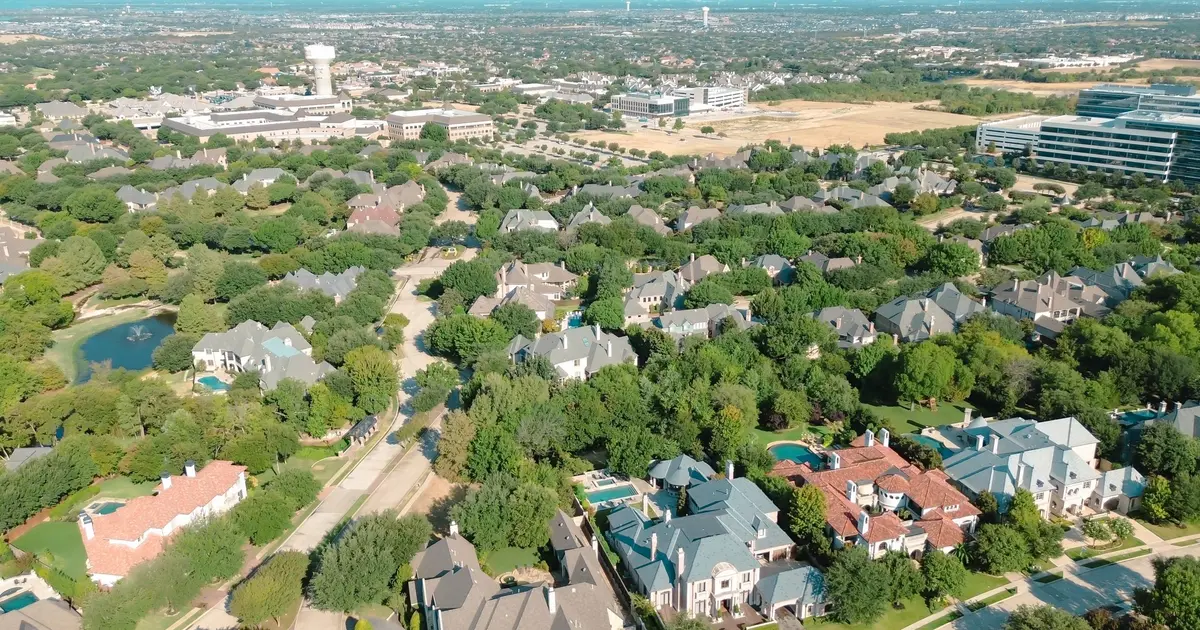
Frisco, Texas, has been named the best US city for children in a new national ranking, while Detroit was placed last after recording the highest child poverty and chronic absenteeism rates among the cities studied.
The 2026 America’s Childhood Well-Being Index, produced by ProCare Therapy, assessed 100 of the country’s largest cities against measures covering education, economic security, environmental health and access to green space.
Frisco achieved an overall score of 89.8 out of 100, narrowly ahead of fellow Texas city Plano on 89.6. Irvine, California, ranked third, followed by McKinney, Texas, in fourth place.
Texas cities dominate best US cities for children ranking
Frisco’s strong performance was driven by consistently high results across several categories. Just 3.9% of children were recorded as living below the federal poverty level, the lowest rate in the study.
The city also reported a chronic absenteeism rate of 5.6%, was placed in the lowest category for housing-related lead exposure risk and recorded the highest third-grade reading proficiency rate, at 89.4%.
However, Frisco did not lead every measure. Some 57.5% of residents were estimated to live within a ten-minute walk of publicly accessible green space, meaning its top position reflected a strong overall performance rather than first place in every category.
Plano recorded a child poverty rate of 8.7%, third-grade reading proficiency of 83.1% and a 75.1% park-access rate. McKinney, meanwhile, had a child poverty rate of 8.8% and reading proficiency of 85.1%.
Texas accounted for eight of the top 20 cities with complete observed data. Austin ranked 11th, Irving 12th, Arlington 15th, Corpus Christi 19th and Garland 20th.
The remainder of the top ten included Chandler in Arizona, Boise City in Idaho, San Jose in California, Chesapeake in Virginia, Henderson in Nevada and Chula Vista in California.
Austin was the highest-ranked city in the study with a population of more than one million, according to ProCare Therapy’s analysis.
Detroit ranks lowest for childhood well-being
Detroit received the lowest score in the index, with 15.6 out of 100. More than half of children in the city – 54.5% – were recorded as living below the federal poverty level.
The Michigan city also had the highest chronic absenteeism rate, at 45.1%, and the lowest third-grade reading proficiency rate, at 19.2%. It was additionally placed in the highest category for lead-exposure risk.
Despite those results, more than 81% of Detroit residents were estimated to live within a ten-minute walk of public green space, illustrating the study’s conclusion that no single measure provides a complete picture of children’s well-being.
Buffalo, Cleveland, Cincinnati and Columbus completed the five lowest-ranked cities. Three of them – Cleveland, Cincinnati and Columbus – are in Ohio.
Several major US cities also performed poorly overall. New York ranked 39th, Phoenix 76th, Los Angeles 82nd, Boston 88th, Chicago 89th and Philadelphia 94th.
Boston and San Francisco had the strongest park access in the study, with 99.5% of residents living within a ten-minute walk of publicly accessible green space. Boston’s low overall ranking showed how strong performance in one category did not necessarily translate into a high position across the wider index.
Each of the five indicators – chronic absenteeism, child poverty, lead-exposure risk, park access and third-grade reading performance – was given equal weighting in calculating the final score.
The researchers said the index was intended as a comparison of community conditions linked to childhood well-being, rather than a clinical assessment of children or proof that any individual factor directly caused a particular outcome.
