


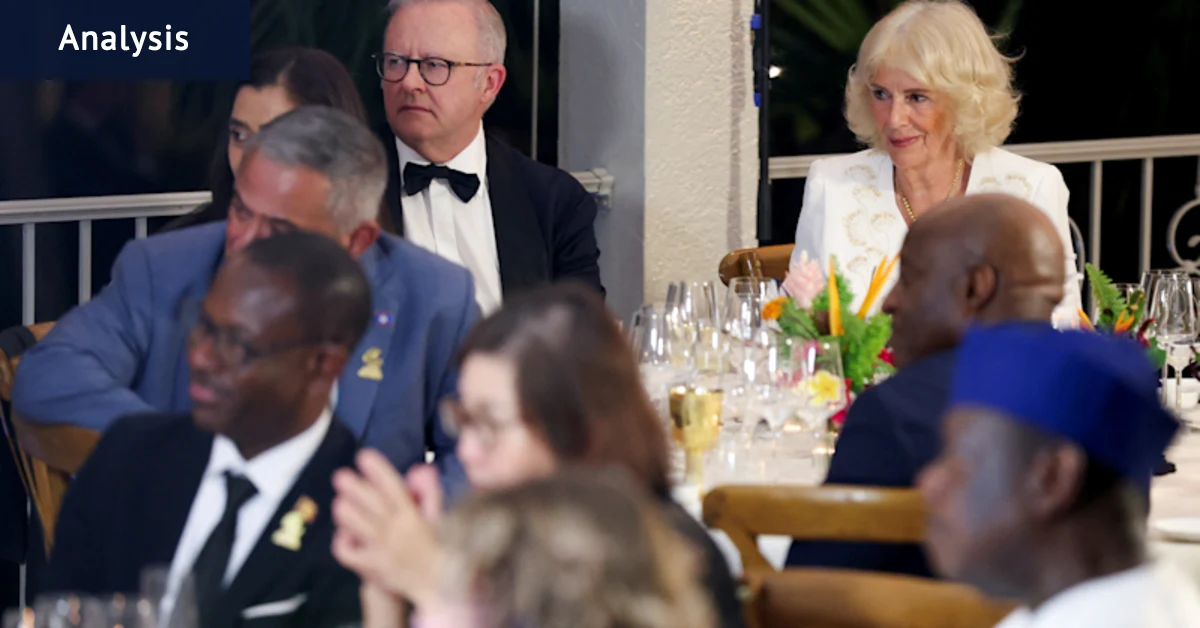
The Commonwealth summit in Antigua and Barbuda has drawn criticism over the decision to send leaders to a private Caribbean island retreat, as Australian prime minister Anthony Albanese faces growing scrutiny over the time he is spending abroad during a period of economic pressure at home.
On the final day of the Commonwealth Heads of Government Meeting, leaders travelled by chartered boats to Jumby Bay Island, where they held discussions at a luxury resort separated from the main gathering in St John’s.
Mr Albanese did not select the venue and was right to attend a forum Australia has supported for decades, but his presence at the retreat risked reinforcing perceptions that Commonwealth leaders were detached from households facing declining living standards.
The criticism comes after the Reserve Bank’s latest interest rate rise, which has been described as likely to feel like a recession for many families. Accommodation at Jumby Bay includes cottages costing about 8,200 US dollars a night, or roughly 11,700 Australian dollars, with private pools.
The gathering also exposed the contrast between the summit’s language on climate action and conditions in Antigua. The island’s national desalination plant is operated using an electricity grid powered by diesel generators, while the country continues to face demands for improved roads, schools and housing.
Hosting the meeting brought a significant influx of visitors and money to the small nation, although it remains uncertain how much of that benefit will reach poorer communities. New housing in the capital, St John’s, is being funded by China Aid.
The extravagance of the summit has prompted questions in Britain about whether Commonwealth meetings should continue in their current form. A Foreign Office review commissioned after the previous gathering in Samoa considered holding the meetings every four or five years, potentially alongside the Commonwealth Games.
Ben Judah, a senior UK adviser involved in that review, described the Commonwealth Secretariat as a “broken institution” and argued that it needed a new approach.
Anthony Albanese faces pressure over summit travel
Mr Albanese met British counterpart Andy Burnham and Canadian prime minister Mark Carney during the meeting. Mr Carney argued that middle powers needed to work together as the United States became an unpredictable ally and the established global order fractured.
“If we’re not at the table, we’re on the menu,” Mr Carney said earlier this year. However, he spent only one night in Antigua, skipping the retreat so he could return to Canada to oversee a budget.
Mr Albanese stayed from Saturday night until Wednesday night before leaving for home. In remarks captured on camera, he told King Charles that he had attended because the King had personally asked him to come.
Australia also has an interest in securing international support for its bid for a seat on the United Nations Security Council. But the summit’s closing statement produced little substantial change, containing revised language on slavery, stronger references to “reparatory justice” and statements on climate action.
Mr Burnham said he was open to discussing an apology over slavery, but the outcome was judged insufficient to justify the amount of time and money spent by so many leaders at resorts over several days.
The prime minister faces a demanding international schedule, including the UN Climate Change Conference in Turkey, the East Asia Summit in the Philippines, the Asia-Pacific Economic Cooperation meeting in China and the G20 summit in Miami with Donald Trump.
With low growth and high inflation weighing on the Australian government, further time overseas could intensify the domestic backlash over Mr Albanese’s travel and make it harder for him to persuade voters that he has an answer to the economy.
There is no time to alter the remaining plans for 2026, but the pressure on the prime minister is likely to encourage a more selective approach to his diary in 2027.
