


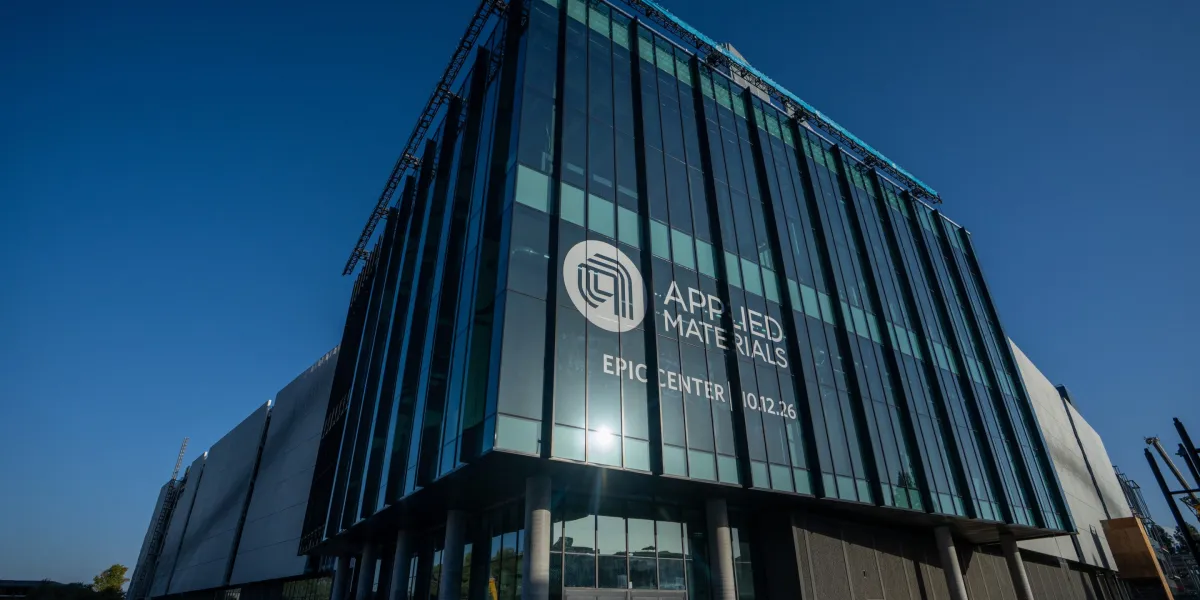
Applied Materials has unveiled a $5 billion semiconductor research facility in Sunnyvale, California, bringing together major chipmakers to develop processors and memory technology for the next generation of artificial intelligence systems.
The EPIC centre, built over two years beside the company’s headquarters, is the largest US investment in advanced semiconductor equipment research and development, Applied Materials said. The 600,000 sq ft building is the most prominent structure in its surrounding Silicon Valley landscape.
Intel, TSMC, Micron, SK Hynix and Samsung will have research teams working at the site alongside Applied Materials engineers. The companies will receive early access to new chipmaking equipment and operate private testing areas within the facility.
Applied Materials said the clean rooms, where researchers use specialist machinery to etch circuits on to silicon wafers, cover an area equivalent to three football pitches. The building contains about as much steel as two Eiffel Towers, according to the company.
EPIC centre aims to shorten chip development
The facility is intended to reduce the time needed to take a new chip architecture from an initial concept to commercialisation. Applied Materials said joint work at the site could cut the process from between 10 and 12 years to as little as six.
Gary Dickerson, the company’s chief executive, said locating researchers from different parts of the industry together would allow them to identify technical limitations earlier.
“Having innovators co-located together, having earlier access to the technologies that enable new AI architectures, is a complete game changer,” Mr Dickerson said.
He added that companies working separately often failed to understand the practical limits of a proposed design until much later in the development process.
EPIC is a research facility rather than a commercial chip factory, meaning it is not expected by itself to return large-scale semiconductor manufacturing to the United States. Its purpose is to help Silicon Valley and Applied Materials remain at the forefront of chip technology as companies compete to build more powerful AI systems.
The project comes amid intensifying competition in the memory chip market. CXMT, a Chinese memory chipmaker, announced a claimed advance in chip density on Monday that could enable more power-efficient products. The announcement was followed by falls of about 7% in Samsung’s shares and 10% in SK Hynix’s shares in South Korea.
The United States has restricted sales of advanced graphics processors and chipmaking equipment to China, seeking to limit the computing capacity available for developing AI systems. Applied Materials paid $252 million in February to settle a case brought by the US Department of Commerce over allegations that it had shipped equipment to China in breach of export restrictions.
Applied Materials, founded in 1967, has benefited from demand linked to the AI boom and a shortage of memory chips. It reported quarterly revenue of $9.12 billion in August, up 25% from a year earlier, and said it had visibility of customer demand through to 2030.
Some industry observers have warned that heavy investment by chipmakers and equipment suppliers could become a risk if demand weakens, particularly in a market known for sharp boom-and-bust cycles. Mr Dickerson said the development of new AI products and services would continue to drive demand for faster and more energy-efficient chips.
