


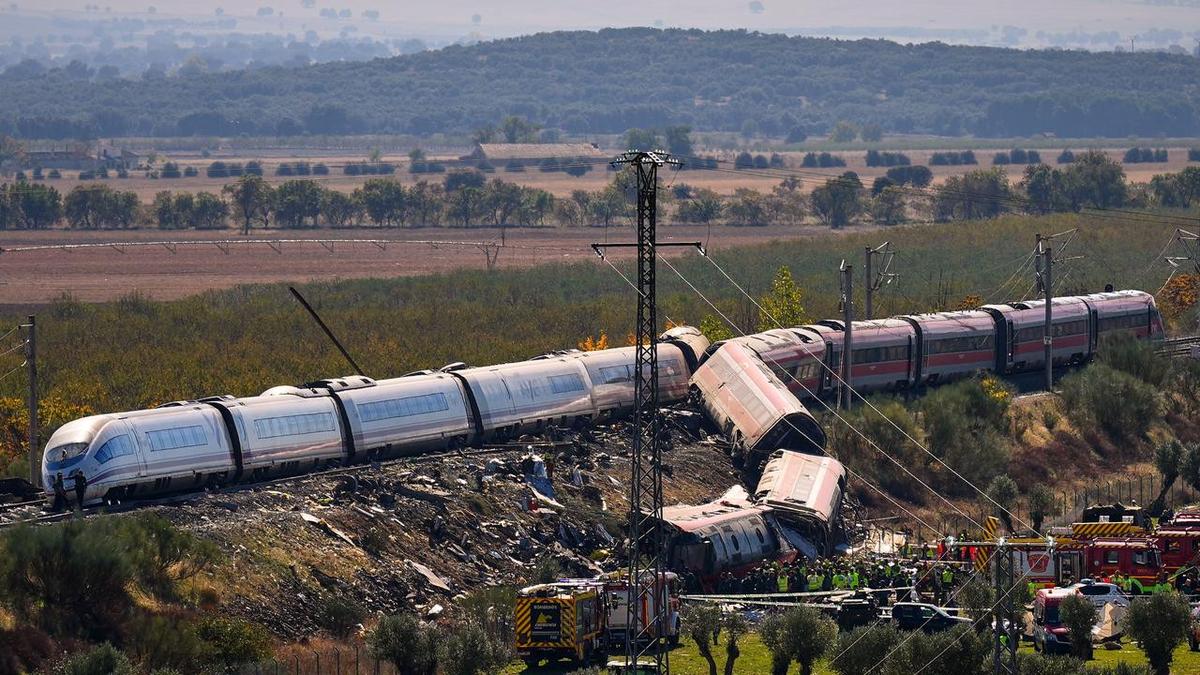
A Spanish high-speed train collision has killed at least 64 people after a Renfe service struck the rear of a stationary Iryo train in central Spain, authorities said.
The crash happened between the towns of Urda and Los Yebenes in Toledo province, as both trains travelled from Madrid towards Seville. At least 80 people were injured, according to Castilla-La Mancha’s regional president, Emiliano García-Page, who warned that the death toll was likely to rise.
Rescue teams worked through the wreckage on Wednesday, searching for survivors and bodies in the two most severely damaged carriages. Several cars were derailed, with at least three plunging down an embankment from an elevated section of track.
Images from the scene showed twisted metal, shattered panels and debris spread across the slope below the railway. Hundreds of ambulances, funeral vehicles and helicopters were stationed nearby as passengers made their way along a road, some covered in blood or with bandaged injuries.
Volunteers gave the evacuated passengers water donated by people in neighbouring towns. Some were seen pulling their suitcases away from the crash site.
The Renfe train was carrying 397 passengers, while the Iryo service had 147 people on board, including a baby, according to Esther Padilla, a spokeswoman for the Castilla-La Mancha region.
A person briefed on the disaster said the Iryo train had been stopped near Toledo on the instructions of infrastructure manager ADIF because of a signal fault. The Renfe service then collided with it at high speed, causing carriages on both trains to leave the tracks.
Renfe said its train had been authorised to continue before hitting the Iryo service, which had remained stationary “for reasons we don’t know”.
“The Renfe train continued on its way as instructed, and a collision occurred,” the company said. “The exact sequence of events, the traffic conditions and the circumstances of the impact will have to be established by the investigation.”
One passenger, identified as Miguel, said he had been travelling with colleagues in the rear carriage of one of the trains when they heard a violent impact.
“We heard a massive roar, a truly enormous thud that went on for 10 seconds, as if the train were about to derail. Through the right-hand window, we could see a wrecked train,” he told radio station COPE.
Health Minister Monica García said emergency workers were concentrating on reaching people trapped in the two most damaged carriages as the search operation continued.
