


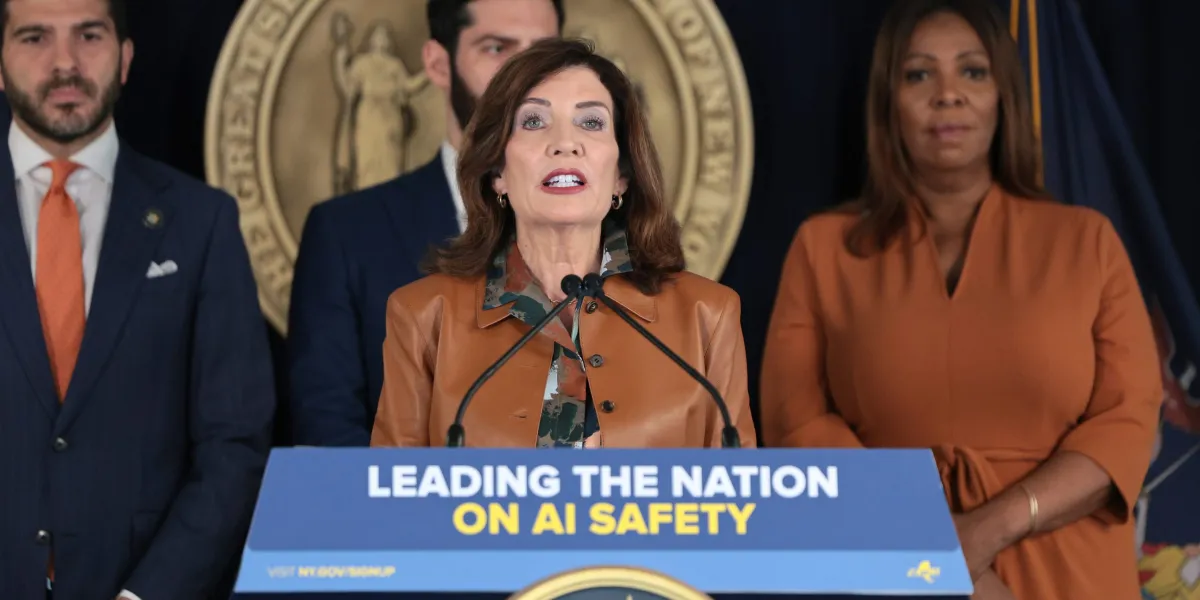
New York Governor Kathy Hochul has signed legislation restricting how AI chatbots can interact with children and requiring stronger security measures for internet-connected baby monitors.
The chatbot law applies to anyone under 18, as well as users whose age has not been confirmed. Companies must prevent their systems from presenting themselves as real people, claiming to be alive or saying they have human emotions.
Chatbots will also be prohibited from claiming romantic, personal, professional or authority-figure relationships with children. They cannot use flattery or “people-pleasing” responses designed to prolong engagement, ask unsolicited emotional questions or retrieve a child’s private health or personal information from earlier conversations.
The legislation bans systems from promoting suicide, self-harm, eating disorders, drugs or alcohol. They must not encourage children to keep secrets from parents or other trusted adults, avoid seeking help, or produce sexually explicit material.
“As artificial intelligence advances at a rapid pace, there’ve been too many tragic incidents that should have been stopped and as New York’s mom Governor, I’m taking action,” Hochul said.
“No company should be peddling chatbots to kids encouraging self-harm or pretending to be their friend or more.”
Companies will have to use more than one method to verify a user’s age, including at least one option that does not rely solely on government identification. Age data must be deleted once the check has been completed.
New York’s attorney general can seek civil penalties of up to $25,000 for each breach, as well as damages and restitution. The state can also order firms to destroy data collected unlawfully and any AI models trained using it.
The measure, sponsored by state Senator Kristen Gonzalez and Assembly Member Alex Bores, passed the state Senate in June before receiving unanimous approval in the Assembly.
Security rules for internet-connected baby monitors
A separate law signed by Hochul targets baby monitors that transmit audio or video over the internet. New devices sold in New York must include safeguards designed to stop unauthorised people watching or listening to families.
They must also carry a clear warning that they connect to the internet and advise families to use the available security settings. The requirements will take effect 90 days after the law was signed.
The state cited testing by security firm Rapid7 of nine internet-connected baby monitors made by eight companies. Eight devices received an “F” for security and the remaining monitor was given a “D”.
“No new parent should have to worry that predatory hackers are spying on their new family through their baby monitors,” Hochul said.
The governor’s office cited a Common Sense Media survey which found that 72 per cent of teenagers had used an AI companion, while 52 per cent used one at least several times a month.
The legislation comes as officials in other states pursue chatbot companies in court. At least eight states sued OpenAI earlier this month, with Iowa alleging that ChatGPT provided dangerous medical advice, encouraged paranoia and coached people to harm others or kill themselves.
Arizona’s lawsuit alleged that the chatbot encouraged teenagers to share personal information and sometimes discouraged them from speaking to parents, authorities or friends. OpenAI said it had already introduced safety protections for children and would continue improving the model.
The family of 16-year-old Adam Raine has also sued OpenAI. Their lawsuit alleges that ChatGPT mentioned suicide 12 times more often than he did and normalised his suicidal thoughts.
The measures were signed a week before Election Day, with Hochul making restrictions on Big Tech a central part of her re-election campaign. They add to New York laws introduced during her time in office, including the SAFE for Kids Act, which limits addictive social media feeds for minors, and the RAISE Act, which establishes safety and transparency requirements for frontier AI models.
New York has also banned AI-generated child sexual abuse material and introduced rules requiring AI companion apps to direct users who mention self-harm towards mental health resources.
