


The Australian Labor government is on course to oversee the highest-taxing administration in the country’s history, after tax receipts rose to 24.1 per cent of economic output in the latest budget figures.
The figure, recorded in the Final Budget Outcome for 2025-26, was above the 23.6 per cent forecast in May and exceeded the 23.9 per cent tax-to-GDP limit set by former Coalition finance minister Mathias Cormann.
It remains just below the modern record of 24.2 per cent, reached under the Howard government during the mining boom.
Government payments also remained high at 26.9 per cent of GDP, one of the highest levels recorded outside the pandemic.
The figures showed an underlying cash deficit of $22.3 billion, an improvement of $6 billion on the $28.3 billion forecast in May. Gross debt at the end of the financial year was $10.6 billion lower than expected.
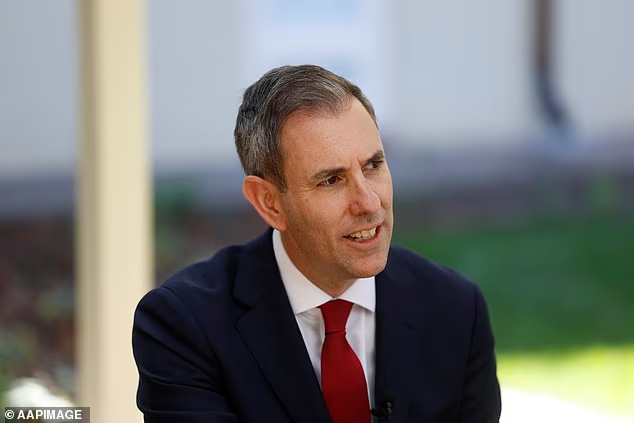
Treasurer Jim Chalmers defended the government’s fiscal record, saying the budget position had improved since Labor came to office.
“The bottom line is better than we inherited, better than it was at the election, and better than it was forecast to be in May,” he said on Monday.
“It is now around half the deficit for the year just finished compared to when we came to office.”
Chalmers said the overall budget position had improved by $230 billion during Labor’s time in government, while debt was $197 billion lower than projected when it was elected.
Higher tax receipts improve budget outcome
The stronger-than-expected result was driven largely by tax collections. Individual income tax receipts were $2.3 billion above forecast, while superannuation tax receipts exceeded expectations by $1.9 billion and company tax receipts were $700 million higher.
Chalmers rejected suggestions that the improvement had been caused by bracket creep or a windfall from the mining sector. He said mining profits had come in below expectations and argued that higher-than-forecast superannuation and investor income accounted for most of the increase.
“So to be really clear about that, this is not about wage and salary earners, it’s not about commodity prices, it’s about higher than expected super and investor income,” he said.
Finance Minister Katy Gallagher also defended Labor’s approach, saying it had exercised spending restraint while strengthening the budget.
“The deficit has come in lower. We’ve delivered a stronger budget than we inherited in every year since we’ve been in office,” she said.
Opposition Leader Angus Taylor said the figures showed the government was collecting more tax while increasing spending and debt.
“More spending, more taxation, more debt, rising interest payments and, of course, a government that has lost control of the economy,” Taylor said on Monday.
He said the 26.9 per cent spending figure was the highest outside the pandemic in four decades, while tax receipts had reached 24.1 per cent of GDP.
Taylor also blamed bracket creep for higher income tax receipts and said the government would have recorded a surplus if it had offset its spending. With markets expecting a Reserve Bank interest rate rise on Tuesday, he accused Labor of adding to inflation and warned that households would continue to bear the cost.
