


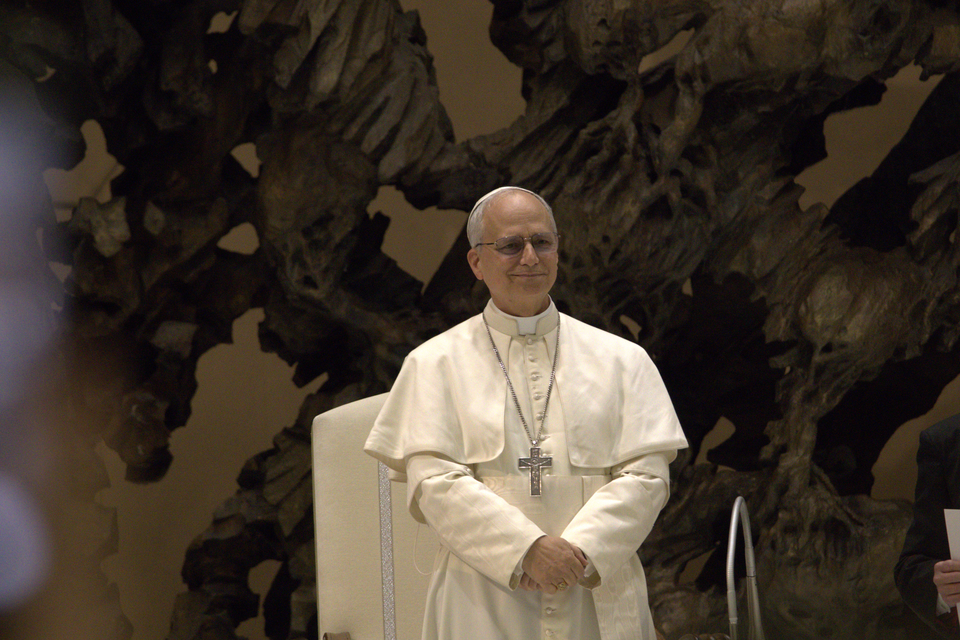
It was, by anyone’s standards, the world’s most unlikely customer service complaint. Pope Leo XIV — leader of 1.4 billion Catholics, sovereign of Vatican City and a man who recently took up arguably the most identifiable address on Earth — was hung up on by his Chicago bank after the employee on the line decided she was being pranked.
The story, which has now ricocheted around the world’s media, was first told publicly by the Pope’s longtime friend Rev Tom McCarthy at a Catholic gathering in Naperville, Illinois, on 2 May.
According to Fr McCarthy, the pontiff phoned his hometown bank around two months after his election, intending to do the most mundane of admin tasks: update the phone number and address on his personal account, given his recent change of residence. He identified himself by his birth name, Robert Francis Prevost, and worked his way patiently through the bank’s security questions.
Having answered each one correctly, he was nonetheless told the changes could not be made over the telephone. He would, the employee insisted, have to come into the branch in person.
“Well, I’m not going to be able to do that. I gave you all the security questions,” Fr McCarthy quoted the Pope as saying. With his options dwindling, the pontiff played his final and frankly unanswerable card.
“Would it matter to you if I told you I’m Pope Leo?” he asked.
It mattered, just not in the way he had hoped. Convinced the man on the line was a particularly bold prankster, the bank employee promptly ended the call.
“She hung up on him,” Fr McCarthy told his audience, to laughter. “Could you imagine being known as the woman who hung up on the Pope? ”
Dutch cruise ship hit by hantavirus outbreak heads for Canary Islands
The Pope’s elder brother, John Prevost, confirmed the gist of the story in an interview with CNN’s Erin Burnett, telling the broadcaster that he had tried to intervene during a separate phone call with the same bank. “It went on so long, I said, ‘You know, ma’am, it might be helpful for you to know you’re talking to my brother who’s in Rome right now. You’re speaking with the Pope.'” The response, he said, was the same: “She said, ‘Oh, really?’ And hung up. And that was the end of the call.”
The matter was eventually resolved through the time-honoured Chicago route of knowing the right people. A local church figure managed to reach the bank’s president, who initially defended the institution by stating that the in-person rule was simply “our policy”. Only when it was hinted that the pontiff might consider moving his account elsewhere did the bank agree to make an exception. The number was duly updated, with one final, slightly weary instruction from His Holiness: “And don’t give the phone number out.”
The anecdote has tickled audiences in part because it cuts so sharply against the pomp of papal life. Born and raised on Chicago’s South Side, the Augustinian priest and former missionary bishop in Peru became the first American pope when he was elected following the death of Pope Francis. Despite his historic elevation, those who know him say he has retained the unfussy temperament of a working-class Midwesterner.
According to the Daily Mail, which carried the bank story in detail, the lighter moment offers a rare break from a more turbulent stretch in the new pontiff’s relationship with American politics. Pope Leo has been openly at odds with President Donald Trump since taking office, particularly over the Middle East. The pontiff has called for peace in the region and described Mr Trump’s threat to destroy Iran as “unacceptable”.
The president has hit back on multiple fronts, branding Pope Leo “WEAK on Crime, and terrible for Foreign Policy” in a Truth Social post and, in a separate interview with the conservative broadcaster Hugh Hewitt, accusing the pontiff of believing it was acceptable for Iran to obtain a nuclear weapon — a position the Vatican has firmly denied. The Holy Father has spoken out against nuclear weapons for decades.
Asked about the latest barrage of presidential criticism, Pope Leo offered a notably measured response. “The Church’s mission is to preach the Gospel and to preach peace,” he said. “If anyone wishes to criticise me for proclaiming the Gospel, let them do so truthfully.” The Church, he added, had spoken against all nuclear weapons “for years, so there is no doubt about that.”
A brief thaw appeared to follow on Thursday, when the Pope met US Secretary of State Marco Rubio at the Vatican to discuss what both sides described as efforts to achieve “a durable peace in the Middle East”. The Vatican and the State Department both stressed the strength of bilateral ties.
Whether the Chicago bank teller has since been told the identity of the man she put down on remains, mercifully, unrecorded. What is certain is that Pope Leo’s papacy has produced one of the more unusual entries in the long history of celebrity customer-service stories — and a reminder that even the leader of the world’s largest Christian denomination is not immune to the modern indignity of failing identity verification.
