


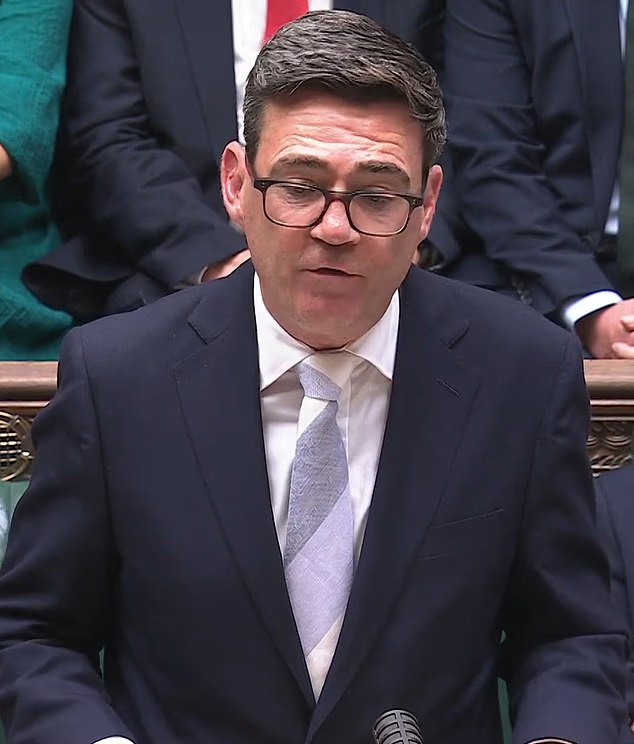
Andy Burnham’s first appearance in the House of Commons as prime minister failed to generate the sense of authority expected from a new leader, as he set out his plans for government in a subdued statement that left MPs struggling to follow his economic vision.
Mr Burnham entered the chamber shortly before 3.35pm on Tuesday, appearing hesitant as ministers gathered around the front bench. His arrival was greeted by Labour MPs, although the response was notably restrained.
He began by paying tribute to Sir Keir Starmer, whose decision to stand down as the MP for Holborn and St Pancras had been announced earlier in the day. Mr Burnham praised his predecessor’s “lifetime of public service”, before turning to Britain’s continuing support for Ukraine.
His voice briefly gained strength as he spoke about the war and the country’s commitment to Kyiv. But the momentum soon ebbed, with a halting delivery and an emphasis on individual words that made the speech sound more like a recorded announcement than a confident parliamentary address.
The prime minister’s central message was one of devolution and economic renewal. He said his new Number 10 North operation would help shift power away from Westminster and support growth across the regions, with mayors receiving new responsibilities including the ability to introduce visitor levies.
Downing Street said the levy would form part of the next stage of English devolution and could begin towards the end of the 2027-28 financial year. The Government has also said the new operation will focus on rebuilding resilience in communities and reindustrialising the regions. ([gov.uk](https://www.gov.uk/government/speeches/pm-statement-to-the-house-of-commons-1-september-2026?utm_source=openai))
But it was Mr Burnham’s description of a “triple helix approach to economic development” that appeared to cause the greatest confusion. He said business, universities and government needed to be brought together to create a more pro-business culture outside London.
The phrase prompted visible puzzlement around the chamber, with MPs squinting and shifting in their seats as the prime minister elaborated. Even supporters on the Labour benches appeared distracted, with several backbenchers seen chatting and laughing during parts of the statement.
Mr Burnham, who became prime minister on 20 July after returning to Parliament as the MP for Makerfield, was making his first Commons appearance in the role after six weeks in Downing Street. ([gov.uk](https://www.gov.uk/government/people/andy-burnham?utm_source=openai))
He also promised greater public control over essential services and argued that Britain needed to be honest about what he described as a series of wrong turns stretching back to the 1980s, including deindustrialisation, austerity and Brexit.
The intervention was later criticised by opposition MPs, who accused him of looking backwards rather than offering a sufficiently clear account of how his plans would improve living standards. The broader policy programme may have been ambitious, but its first presentation in the Commons was seen as cautious, technical and lacking in political spark.
Mr Burnham’s senior ministers appeared to reflect the unsettled mood on the front bench. Chancellor John Healey was seen with an injury on his head, while Deputy Prime Minister Louise Haigh watched intently beside her leader as he delivered the statement.
