


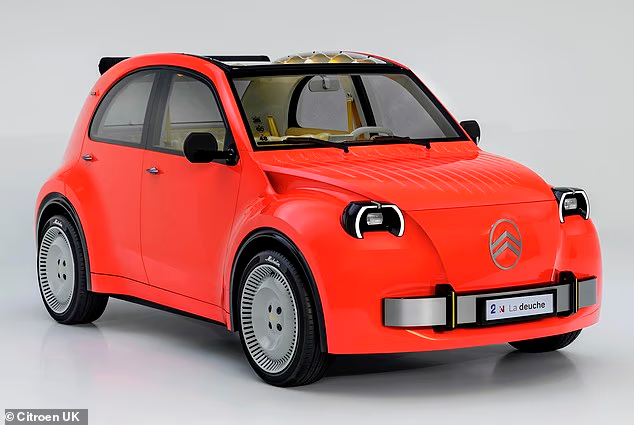
Citroen is bringing back the iconic 2CV as an electric car, with the new model expected to go on sale in 2028 at a starting price of less than €15,000 – potentially under £13,000 in Britain.
The revived French runabout was unveiled in concept form ahead of the Paris Motor Show. It is intended to retain the simplicity, affordability and distinctive character of the original, while switching its petrol engine for battery power.
Citroen has also retained one of the most enduring stories associated with the original 2CV. The electric version includes a storage compartment designed to carry eggs without breaking them.
The first 2CV was launched at the Paris Motor Show in 1948, although its origins stretch back to 1936. Citroen and Michelin had set out to create a small, inexpensive car capable of carrying a farmer and his family across freshly ploughed fields while keeping a basket of eggs intact.
Development was interrupted by the Second World War, when prototypes were hidden away. Production eventually continued for decades, with examples even built at Citroen’s former factory in Slough during the 1950s.
Known affectionately as the ‘tin snail’ because of its rounded shape and famously leisurely performance, the 2CV remained in production until 1990. More than 5.1 million cars and vans were sold, while production of related models including the Ami, Dyane and Mehari took the wider total beyond nine million vehicles.
The electric 2CV is expected in 2028
Citroen says the new model will be an ‘electric, minimalist, affordable, compact and ingenious’ car aimed at making everyday journeys more enjoyable.
Xavier Chardon, Citroen’s chief executive, said the project was not simply an attempt to recreate a classic car.
“It’s about reinventing what made it unique: its simplicity, its accessibility and the freedom it offered,” he said.
The company expects the vehicle to qualify for Europe’s proposed M1E category for electric cars measuring less than 4.2 metres long. The regulations are still being finalised, but cars in the class are expected to benefit from financial incentives.
At 3.76 metres, the concept is around 10 centimetres shorter than the original 2CV. Citroen says the compact dimensions are intended to restore the agility of small cars while making them easier to drive and park.
The car is expected to offer a usable range of around 150 miles rather than being treated as a light quadricycle like Citroen’s smaller Ami. Chardon said its battery range would almost match the distance covered by the original 2CV on a full tank, which was around 180 miles.
Keeping the electric 2CV affordable will be central to the project. The new car is expected to share its technology and underpinnings with a Fiat sister model, helping Citroen work towards its low-price target.
Classic design with modern electric technology
The concept closely follows the visual formula of the original. Rounded LED headlights sit above bulbous wheelarches, while creases in the bonnet recall the pre-war Toute Petite Voiture design from which the 2CV evolved.
A curved roofline, flat side windows and sculpted door handles are combined with chunky 19-inch steel wheels. Michelin tyres carry contrasting white branding, while Citroen’s chevrons feature prominently.
The car also includes manually operated air vents beneath the windscreen, controlled by a circular pulley handle on the dashboard – a direct reference to the original design.
At the back, a flat tailgate is set against contrasting black bodywork and has a traditional twist-handle release. The number plate displays several of the model’s nicknames from around the world.
Practicality has influenced other parts of the design. The bumpers can be removed and replaced after minor knocks, while the largely flat body panels are intended to help keep manufacturing and repair costs down.
A roll-back fabric roof is another clear nod to the classic car. The concept surrounds it with string lights, although that feature may not survive unchanged on the production version.
Gilles Vidal, head of design at Citroen parent company Stellantis, said the concept was “very close to production” and that the showroom car would “look even better than the concept car”.
A minimalist interior for the new Citroen 2CV
The pared-back approach continues inside. There is no conventional dashboard; instead, the single-spoke steering wheel is connected to a cylindrical housing containing an eight-inch infotainment screen.
The drive selector and starter button are mounted on a stalk, with the button marked ‘en avant!’ – French for ‘forward’ or ‘onwards’. Lighting and indicator controls are positioned on an antenna, while a small Smart Vision display behind the wheel acts as the instrument cluster.
There is no traditional centre console. A removable storage basket takes its place, and fabric straps are used instead of conventional door handles.
The concept also does away with integrated door speakers. In their place is a removable radio mounted beneath the dashboard, reinforcing the car’s deliberately simple character.
Citroen has added several smaller references to the original 2CV. The horn and electric motor start-up sounds draw inspiration from the classic model, while the figures 48, 90 and 26 etched into the windscreen mark its original launch, the end of production and the unveiling of the new concept.
A tortoise motif on the brake pedal and a rabbit on the accelerator provide another visual reminder of the original car’s unhurried reputation.
Citroen said the finished vehicle would be a “more accessible, lighter and more essential electric car that puts freedom and pleasure back at the heart of mobility”.
The company’s return to the 2CV comes as it seeks to make greater use of its heritage in the growing electric-car market. Renault has already attracted attention with retro-inspired models such as the award-winning 5 E-Tech, while Citroen faces increasing competition from newer Chinese manufacturers.
The company said the new 2CV would be “faithful to the spirit of the original but resolutely focused on the uses and challenges of tomorrow”.
