


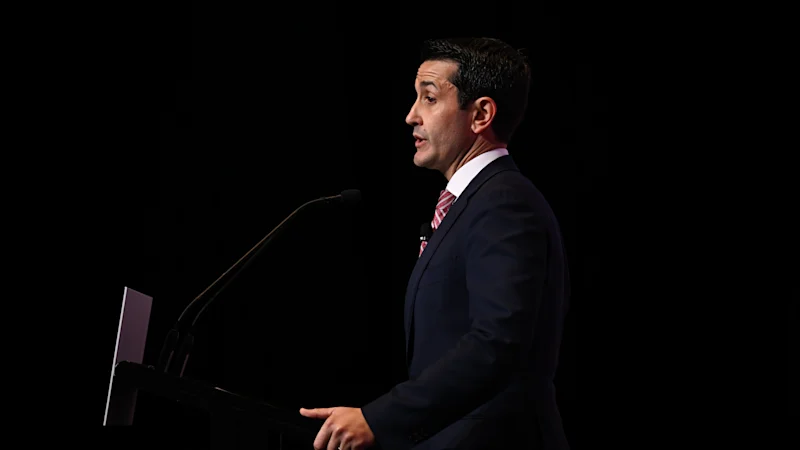
Queensland Premier David Crisafulli has dismissed calls for a special prosecutor to pursue alleged criminality uncovered by the state’s inquiry into the construction sector, saying the investigation had already proved its worth.
The 28-month, A$95 million inquiry is not due to deliver its final report until December next year. Suggestions that a prosecutor should work alongside the commission to ensure potential offences are pursued before then have been backed by senior union and anti-corruption figures, as well as barrister Geoffrey Watson SC.
Asked about the proposal at a Queensland Media Club event in Brisbane, Mr Crisafulli declined to give it explicit support, saying: “Let’s see where it goes, and let’s see what unfolds and where things head.”
The commission will hold its 17th block of public hearings next week. Evidence heard so far has involved allegations or questionable conduct relating to the police service, CFMEU figures, the former Labor government, the workplace safety regulator and major construction companies.
Mr Watson, whose 2025 report for the union’s administration helped prompt the inquiry, said last week: “I’m a great supporter of the idea … that a special prosecutor could be appointed right now. And I would ask the commissioner, Stuart Wood KC, to consider it.”
The head of Queensland’s peak union body and the Australian arm of Transparency International have also publicly supported the creation of such a role.
But Mr Crisafulli sought to emphasise that the inquiry was established after images emerged showing alleged violence, misogyny, intimidation, bullying and standover tactics on worksites, alongside allegations of criminal activity.
“I don’t underestimate the work of Mr Watson, who’s spoken out on things for many, many years, and should be respected and applauded for that,” the premier said.
He added that Deputy Premier and Industrial Relations Minister Jarrod Bleijie had been raising the issue “for 10 years relentlessly”, and said the government had not simply decided that an inquiry would be politically convenient.
“So, the commission in my mind has justified its existence already,” Mr Crisafulli said, pointing to his government’s opposition to a return to the former Labor government’s best-practice industry conditions policy.
“That’s my focus: on making sure we don’t drift back to an IR [industrial relations] space where one union can control effectively government policy. That’s my priority at the moment.”
Building and civil construction groups have described a special prosecutor as unnecessary or said the decision should rest with the government. The inquiry has similarly indicated that the appointment would be a matter for ministers.
Mr Crisafulli was also confronted by protests from the union movement over proposed changes to workplace laws, including legislation that would give Mr Bleijie powers to terminate protected industrial action by key state workforces.
The government has proposed further changes that would make it easier for employers to seek orders from the industrial commission pausing or stopping such action. Mr Crisafulli said the powers would be used sparingly and that the process was “very fair and very balanced”.
“But once there’s an impasse, there is an independent body – which is the [Queensland Industrial Relations] Commission, and that body should be able to hear it, free from political interference … and the sooner that body hears it, the better it is for everybody,” he said.
