


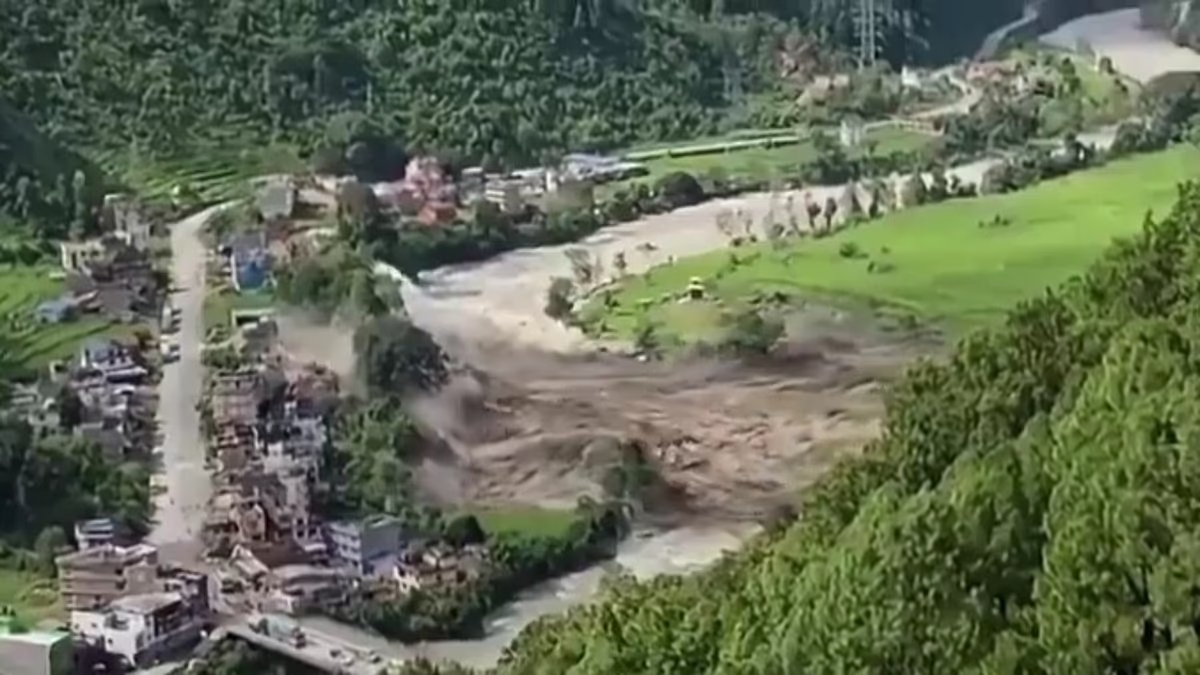
Harrowing footage has emerged of people frantically running for their lives as a huge torrent of floodwater engulfed a village near the Nepal-Tibet border following a catastrophic landslide.
At least 34 Australians are among hundreds feared missing after flash flooding triggered by an ice avalanche tore through the popular Himalayan region.
The office of Nepal’s Prime Minister has confirmed at least 160 people have died, with the death toll expected to rise as massive rescue efforts continue.
Of the 579 people unaccounted for, 466 are foreign nationals from 28 different countries.
At least one of the 34 missing Australians was travelling with Kathmandu Holiday Tours & Travel, the Nepal Tourist Board has confirmed.
A landslide struck the region on Wednesday morning, triggering the collapse of a colossal section of glacier and sending a devastating torrent of water, ice and debris into the valley below.
Terrifying footage showed a huge wave surging over the banks of the Bhote Koshi River and engulfing nearby trees and homes within seconds.
As the torrent surged around a bend in the river, huge clouds of mist and spray rose above the settlement.
The floodwater quickly covered a main road through the small town before surging across a field on the other side, where dozens of people were desperately trying to escape.
They ran for their lives through the fields as the wall of water and mud bulldozed its way through buildings.
A terrifying video showed the moment wave erupted up across the bank of the Bhote Koshi River in flash floods that have claimed the lives of dozens near the Nepal-Tibet border

Entire buildings became submerged by huge waves of floodwater and mud, decimating the settlement

As the wall of water and mud bulldozed its way through buildings, people were seen desperately running for their lives through fields

Rescuers use construction vehicles to carry a victim of the flash floods to safety along the Trishuli River in Nepal’s Nuwakot district
It was just one such example of total annihilation being experienced across the region, amid fears that more bodies will be found as search and rescue operations get underway.
Another video showed fast-flowing floodwater ripping through the streets and destroying everything, including homes and bridges, in its path.
Department of Foreign Affairs and Trade officials are now urgently working to verify the number of missing Australians.
‘We extend our deepest sympathies to those affected by the significant flooding in Nepal and Tibet, China,’ a DFAT spokeswoman told the Daily Mail on Thursday.
‘Australians in the affected area should follow the advice of local authorities.
‘We are aware of a number of Australians in the area and Australian officials are urgently working to confirm their welfare.
‘We are liaising with local authorities as well as tour operators.’
Foreign Minister Penny Wong added: ‘The loss of life and destruction caused by flash flooding in Nepal and China is devastating.

Footage shows people running away as a wall of mud and water destroys buildings in a valley at Nepal-China border, in Gyirong, Tibet region, China August 26, 2026

Several people have been killed by the flash floods, with many more casualties expected to be reported. Of the missing tourists, 466 are foreign nationals from 28 different countries

Houses lie partially submerged in muddy water along a riverside after flash floods at Trishuli Bazar in Nepal’s Nuwakot district on August 26, 2026
‘Our thoughts are with the loved ones of those killed or missing and all affected by this disaster.
‘DFAT officials are urgently working to confirm the welfare of Australians in the area.’
Australians in need of emergency consular assistance should contact the Department of Foreign Affairs and Trade’s 24-hour Consular Emergency Centre on 1300 555 135, or +61 2 6261 3305 (if calling from overseas).
Scientists initially believed an earthquake triggered the ice avalanche, but the seismic reading was later clarified as having been caused by a landslide.
Dr Daniel Shugar, an earth scientist and professor at the University of Calgary, said the disturbance caused a 2,000ft-wide chunk of ice to break clean off and fall more than a kilometre to the valley floor.
‘The bottom looks like a bomb exploded – it’s just deposits from the broken-up glacier,’ he told The New York Times.
But the ice fall alone doesn’t explain the ‘gargantuan volumes of water that we see in these, these absolutely horrific videos’, he said.
It is believed the glacier mixed with a landslide to create a rapidly moving mixture of water, ice and rock.

Scientists initially believed an earthquake triggered the ice avalanche, but the seismic reading was later clarified to have been caused by a landslide
Nepali labourer Bibek Kumal was digging a toilet pit outside a new house on Wednesday when a wall of water, mud and rock came roaring down, sweeping him and everything near him away.
Mr Kumal, 24, was downstream from the worst-hit Rasuwa district, near the Tibet border, when he heard a hissing sound.
His four co-workers, standing above the five-foot pit, shouted at him to get out and run, and had already fled by the time he scrambled out.
‘I started running. Then a wall of water came thundering down as if it was an earthquake,’ Mr Kumal said from his bed at Kathmandu’s National Trauma Centre.
The torrent swept him downstream amid mud and debris, but he ‘luckily was stuck up in a mango tree’. He added: ‘Had there been no mango tree, I would have been washed away to death.’

A combination of satellite images shows the valleys near the Nepal-China border on August 25, 2026, before the devastating floods (top), and on August 26, 2026, after the disaster (bottom)

A survivor is transported to a safer place in a JCB following a flash flood at Trishuli in Nuwakot district, Nepal
Keshav Prasad Baral, 68, being treated at a local hospital said: ‘It was a huge gush of mud coming straight towards us. As it got closer, it kept rising higher and higher.
‘When I saw it enter our home, I tried to grab my wife’s hand and take her to the terrace. But she was swept away by the mud.
‘Four or five hours later, a helicopter came to rescue me. My wife is still somewhere beneath the mud. She’s gone.’
A pilot told CNN he saw the flood from the air and witnessed waves that were up to 20ft tall.
Aman Budathoki said: ‘About five minutes before landing, we could see dust rising from the river.
‘At first instance it looked as if it was a landslide. We even guessed if it was the army using explosives for building roads.’
The Nepal Army said 14 helicopters and disaster response teams have been deployed for rescue and relief.
But officials said the waters were too high for helicopters to land in Nepal’s affected areas of Syapru Besi and Timure in the mountainous district of Rasuwa, with a population of about 50,000.
Nepal’s rescue helicopters would be unable to land in the affected areas until the waters recede, however, army spokesperson Raja Ram Basnet said.
Researchers at the Kathmandu research group found earlier this year that glaciers across the Hindu Kush Himalaya region are melting at an accelerating rate, with ice loss rates doubling since 2000 primarily due to rising global temperatures and climate change.
