


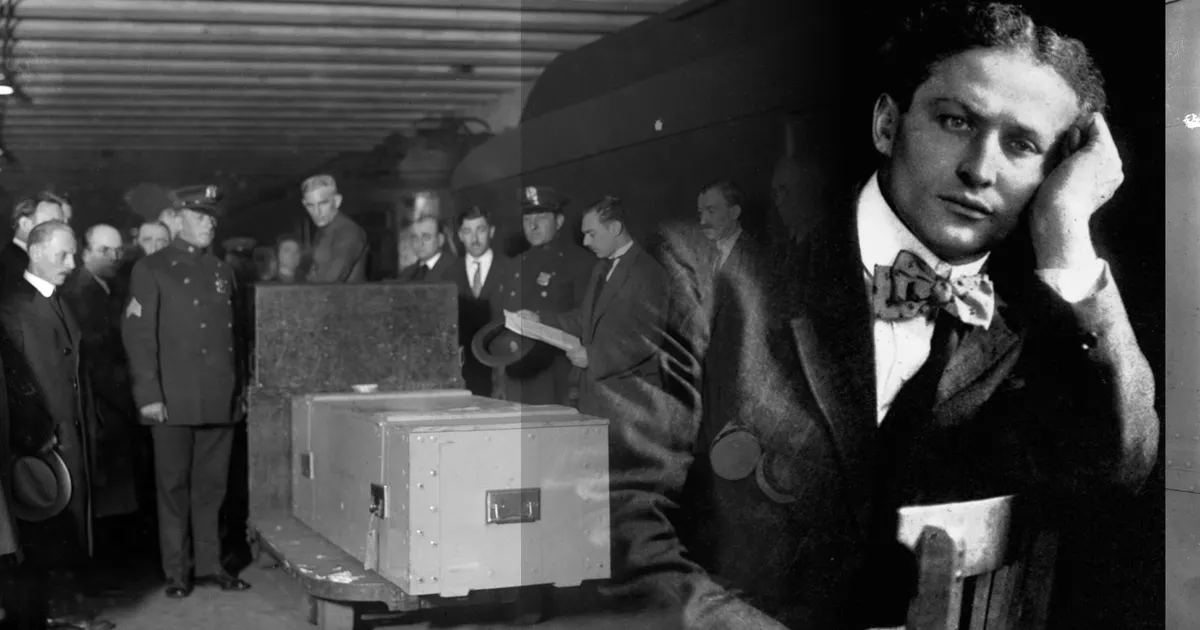
Harry Houdini died in Detroit on Halloween 1926, and the centenary of his death will bring renewed attention to the city where the legendary escape artist gave his final performance.
Houdini was 52 when he took to the stage at Detroit’s Garrick Theatre on October 24, despite suffering from severe abdominal pain and a reported fever of 104F. He completed the show, but collapsed after the curtain fell.
He was taken to Grace Hospital, where doctors found that his appendix had ruptured and that he had developed peritonitis, a serious infection of the abdominal lining. Houdini died at 1.26pm on October 31, 1926.
Harry Houdini’s final performance in Detroit
The performance on Griswold Street was billed as a “3 Shows In One” revue, combining illusions, card tricks, spiritualist exposés and escape stunts.
Among the advertised acts was Houdini’s famous Chinese Water Torture Cell, in which he was suspended upside down by his ankles inside a water-filled glass cabinet. Accounts of the night say the ordeal left him so weak that he needed help from his assistants to stand.
It was to be the only show he completed during a planned Detroit engagement. The Garrick Theatre, which could accommodate about 1,400 people, later closed in 1928 and was demolished the following year.
According to the Detroit Historical Museum, Houdini performed in the city 19 times during his career. Detroit’s thriving vaudeville circuit and its large theatres made it a regular stop for the magician, who had already staged a dramatic publicity stunt at Belle Isle in 1906.
His final journey to the city began in Montreal, where he had been struck in the abdomen by a medical student after a performance. The long-standing account is that Houdini was hit before he had time to tense his stomach muscles, although the precise connection between the incident and his ruptured appendix has remained the subject of debate.
After arriving in Detroit following a 15-hour train journey, Houdini was reportedly urged to seek medical treatment. He refused, determined to appear at the Garrick. He was also facing a financial penalty if the theatre was forced to cancel its shows.
After the performance, his condition worsened and he was eventually taken to Grace Hospital. He underwent surgery, but the infection had already become severe. He died in Room 401, and his death certificate is now held by the Archives of Michigan.
Why Houdini’s death remains part of Detroit’s history
Houdini’s death acquired an unusual afterlife because he had spent much of his career exposing fraudulent mediums and dismissing claims that the dead could communicate with the living.
His widow, Bess, nevertheless held annual Halloween séances for a decade in the hope that he would make contact from beyond the grave. The final official séance took place in 1936, when she reportedly ended the ritual with the words: “Ten years is long enough to wait for any man.”
Houdini was born Erik Weisz in Budapest and moved to the United States with his family as a child. He became one of the world’s most famous performers by refining escapes from handcuffs, straitjackets, trunks and water-filled tanks, while turning publicity and suspense into central parts of his act.
His body was taken from Detroit to New York, where he was buried at Machpelah Cemetery in Queens. A century after Harry Houdini died in Detroit, the city remains the final setting for the career of a man whose greatest reputation was built on escaping the impossible.
