


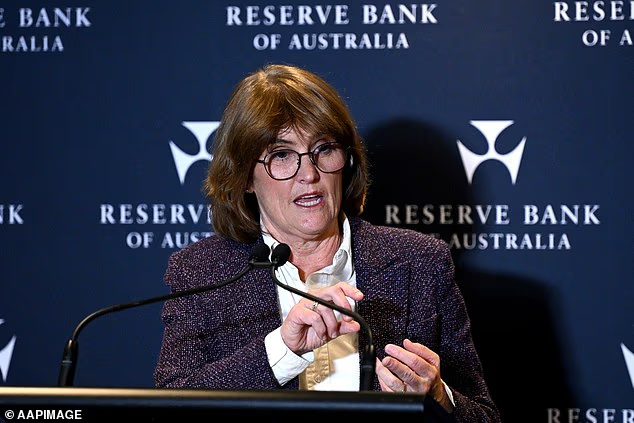
Australia’s Reserve Bank has warned that rising inflation risks are beginning to materialise, strengthening expectations that interest rates could be raised again at its meeting later this month.
Governor Michele Bullock told a parliamentary hearing that inflation remained too high and said the central question for the board would be whether its three increases so far would be enough to return price growth to target within a reasonable period.
The bank’s latest forecasts, published in August, suggested inflation would reach the middle of its target range by the end of 2027. However, the RBA said there was a greater risk of inflation exceeding its projections than falling below them.
“Developments since then suggest that, although growth in the Australian economy is slowing, some of these upside risks to inflation appear to be materialising,” Ms Bullock said.
She pointed to the conflict in the Middle East, the strength of the artificial intelligence boom and extreme weather as factors adding pressure to energy, food and technology prices.
“There is little sign of resolution in the Middle East conflict. Oil and related prices have increased sharply again and will add directly to inflation,” she said.
Brent crude remained above 104 US dollars a barrel despite a modest overnight decline after news that Saudi Arabia planned to restore part of its East-West pipeline following attacks by Iran-backed Houthi forces.
Ms Bullock said businesses were becoming more likely to pass higher costs on to consumers as they saw no clear end to the conflict or price increases. That risked making inflation more persistent.
Financial markets have lifted the probability of a September rate rise above 80 per cent after inflation came in higher than expected in July. Two further increases have been fully priced in by March 2027.
Higher borrowing costs and fuel prices would weigh on economic growth, but the impact has been offset by stronger-than-expected demand linked to the AI and technology boom, according to deputy governor Andrew Hauser.
“Just back from the US and in addition to … the upside risk of inflation from the Middle East, what is also very striking is how strong the AI and tech boom is and has been,” Mr Hauser said.
He said the strength of the technology sector was also evident across the Asia-Pacific region, adding that forecasts for global growth had repeatedly been exceeded.
Ms Bullock said Australia needed a period of slower growth to bring inflation down, particularly in light of the country’s weak productivity performance. A downturn in the housing market could also reduce pressure on the economy, although property prices remained about 50 per cent above early 2020 levels in most capital cities.
The warning came as the International Monetary Fund urged federal Treasurer Jim Chalmers and state treasurers to curb public spending, with borrowing costs at a 15-year high.
“With public debt and interest costs rising, particularly in some states, a gradual tightening of the fiscal stance would help rebuild buffers,” the IMF said in its latest report on Australia.
It said the combined deficit of federal and state governments had widened over the past two financial years, driven by state infrastructure investment, higher social spending including healthcare and the National Disability Insurance Scheme, and measures responding to the global energy price shock.
