


Labour is considering lowering the threshold for its so-called mansion tax from £2 million to £1.5 million, a move that could bring around 271,000 homes into the scheme, particularly in London and the South East.
Chancellor John Healey is examining the proposal ahead of next month’s Budget, with two government sources describing the reduction as a “live discussion” in the Treasury.
The change could raise an estimated £800 million and help the Chancellor rebuild the Government’s financial headroom, which is understood to have fallen from £23 billion to about £5 billion amid higher spending and borrowing costs.
However, ministers have not made a final decision. Concerns have been raised that reducing the threshold would capture many properties that are not considered mansions, placing an additional burden on middle-class families in London and the South East.
Concerns over impact on London homes
The existing high-value council tax surcharge was announced in last year’s Budget and is due to come into effect in April 2028. It is expected to apply to about 134,000 homes worth more than £2 million.
Under the planned system, properties valued between £2 million and £2.5 million would face an annual surcharge of £2,500. The charge would rise to £7,500 for homes worth more than £5 million.
Lowering the threshold to £1.5 million would more than double the number of affected properties on current valuations. In London alone, about 66,000 additional homes could be included.
Aneisha Beveridge, head of research at Hamptons, said the move would be “very challenging” and could further distort the housing market. She said prices for homes worth more than £2 million had already fallen by 6.5 per cent as sellers sought to avoid the existing threshold.
Lucian Cook, head of residential research at Savills, said the proposal would affect “middle-class families through London and the south east in particular”.
He said the measure would no longer be “a taxation of mansions but just relatively large family homes through swathes of London as well as considerably smaller properties in the centre”.
Mr Cook added: “The other risk is that people whose finances are stretched may find that they need to leave the property that they live in and are very emotionally attached to. That is one of the less palatable consequences.”
Mark Pollack, a director at London estate agent Aston Chase, said many families could struggle to meet the surcharge even if it were set below £2,500 for homes in the new band.
He said there was “a real misconception that this would only impact the super-wealthy”, warning that the tax could be “the straw that breaks the camel’s back” for households dealing with rising interest rates and energy costs.
Opposition from London councils
Wandsworth, Kensington and Chelsea, Westminster and Richmond councils have written to Mr Healey urging him to reconsider the proposal.
The councils described it as “the worst idea since the window tax of 1696”, arguing that not everyone living in high-value homes was wealthy.
“Many are not, and some will be forced to sell the family home simply to meet the tax,” they warned. “It cannot be an acceptable situation that our residents could lose their home through no fault of their own, to pay a tax that they could not have envisioned when they bought their home.”
Arun Advani, from the Centre for the Analysis of Taxation, said lowering the threshold would make property tax rates “a bit more equal”.
The proposal is likely to appeal to Labour backbenchers seeking a tougher approach to taxing wealth. One Whitehall source said extending the surcharge would represent a more “aggressive” approach.
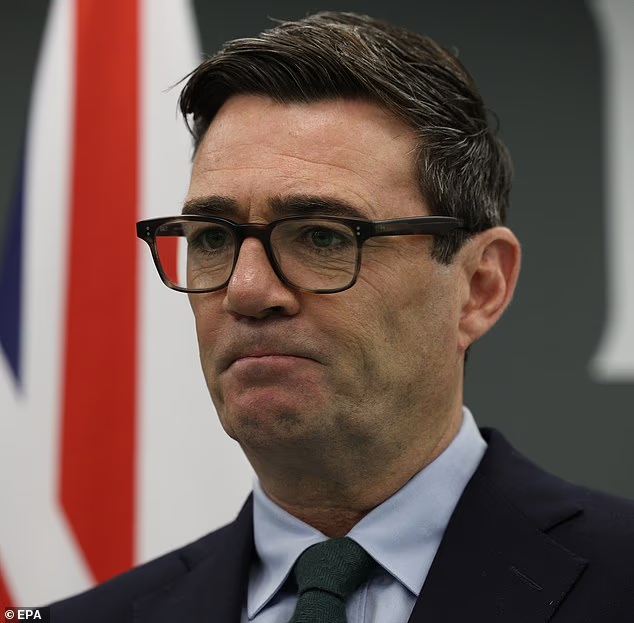
The Government is reportedly unlikely to pursue Andy Burnham’s preferred plans to overhaul stamp duty and council tax because they would require lengthy work and a major revaluation process.
Mr Burnham has previously dismissed the mansion tax as too “symbolic” and criticised it as leaning into “the politics of envy” when it was promoted by former Labour leader Ed Miliband in 2015.
Conservative leader Kemi Badenoch has also attacked the proposal, saying it was another example of Labour’s “politics of envy”.
A Treasury spokesman said tax decisions were “a matter for the chancellor to set out at fiscal events, rather than routinely commenting on rumour, speculation or proposals”.
