


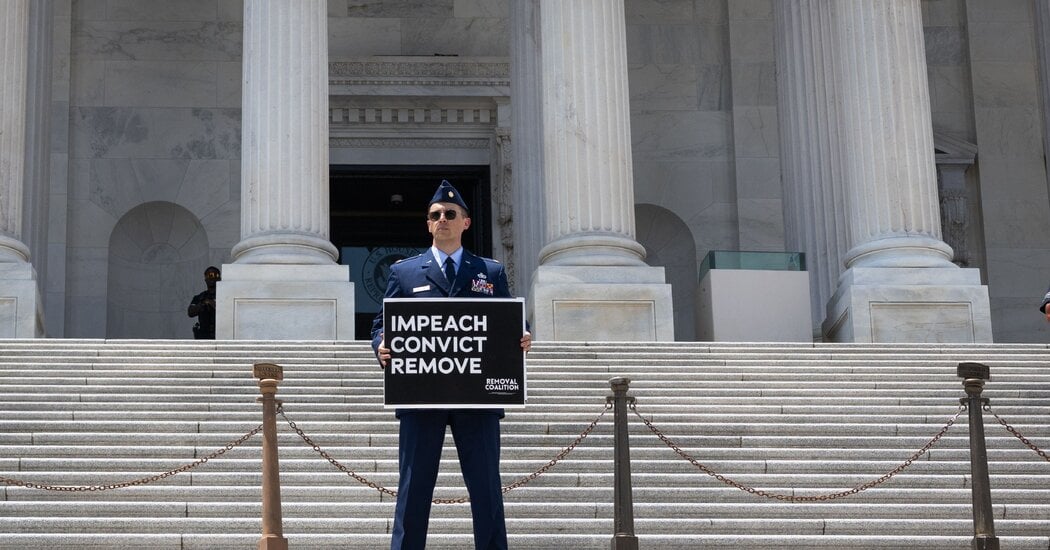
An active-duty Air Force officer accused of making contemptuous statements about President Trump has defended his actions as an expression of his constitutional oath, in a military hearing that could become a rare test of service members’ freedom of speech.
Major Jason Watson made his first comments in court on Friday during an Article 32 hearing, an early stage in the military justice process which will help determine whether he faces a court-martial.
Giving an unsworn statement, Maj Watson told the investigating officer, Major Joshua Wendell, that he had been motivated by duty rather than party politics.
“I spoke to change something I believed was wrong, in the open, under the weight of my own name and my own oath,” he said.
Watson was arrested in uniform at a protest at the Capitol in July. He accused Mr Trump of violating the Constitution, citing the president’s military actions in Iran and Venezuela, his immigration crackdown and the dismantling of parts of the federal government.
He repeated many of his criticisms in a CNN interview in August, saying that Mr Trump had failed the country and that he hoped his protest would encourage other Americans to act.
Prosecutors argued that the officer had breached military regulations and the Constitution through what they described as “vitriolic attacks on the character of the president”. They also allege that he was responsible for an anonymous Substack post from June 2025 which described Mr Trump as “a greedy, unintelligent, narcissistic, pathological liar, traitor, and coward”.
Watson faces 10 alleged violations of the military justice code under Article 88, which covers “contemptuous” words against the president or other senior officials; Article 92, concerning orders and regulations; and Article 133, covering conduct unbecoming of an officer.
If convicted, he could face years in prison, the loss of pay and benefits, and a dishonourable discharge. He has remained in pre-trial confinement since being detained at his base after the CNN interview, according to his lawyer, Christopher Mutimer.
Mr Mutimer told the hearing that Watson had reported for duty after the interview and informed his chain of command that he would not wear his uniform again.
The case centres on the tension between the First Amendment rights of service personnel and the restrictions placed on active-duty officers who publicly dissent or take part in overtly political causes while in uniform.
Prosecutions under Article 88 are exceptionally rare. Daniel Maurer, a retired Army lieutenant colonel and judge advocate, said there had been only two convictions under the provision since the Uniform Code of Military Justice came into force in 1951.
One involved Lieutenant Henry Howe, who was convicted after taking part in a 1965 anti-Vietnam War protest while carrying a sign describing Lyndon B Johnson’s actions as fascist.
The other involved Lieutenant Colonel Stuart Scheller, an active-duty Marine who posted videos in uniform criticising the Biden administration’s handling of the US withdrawal from Afghanistan in 2021.
Scheller’s case was heard by a special court-martial. He resigned from the Marines and, under a plea deal, admitted multiple charges, received a reprimand and forfeited 5,000 dollars in pay.
Watson’s defence team argued that the handling of the Scheller case established a precedent for prosecutions of this kind. Mr Mutimer said Scheller’s alleged violations had been more serious and involved more charges.
“Can this prosecution be squared with the evenhanded administration of justice?” Mr Mutimer asked. He later added: “What he did, in the end, was speak.”
Major Wendell is expected to recommend later this month whether Watson should proceed to court-martial and, if so, whether the case should be heard by a special court-martial, comparable to a civilian misdemeanour court, or a general court-martial, comparable to a felony court.
The hearing lasted about four hours. A member of the public was removed from the courtroom after briefly interrupting the proceedings.
