


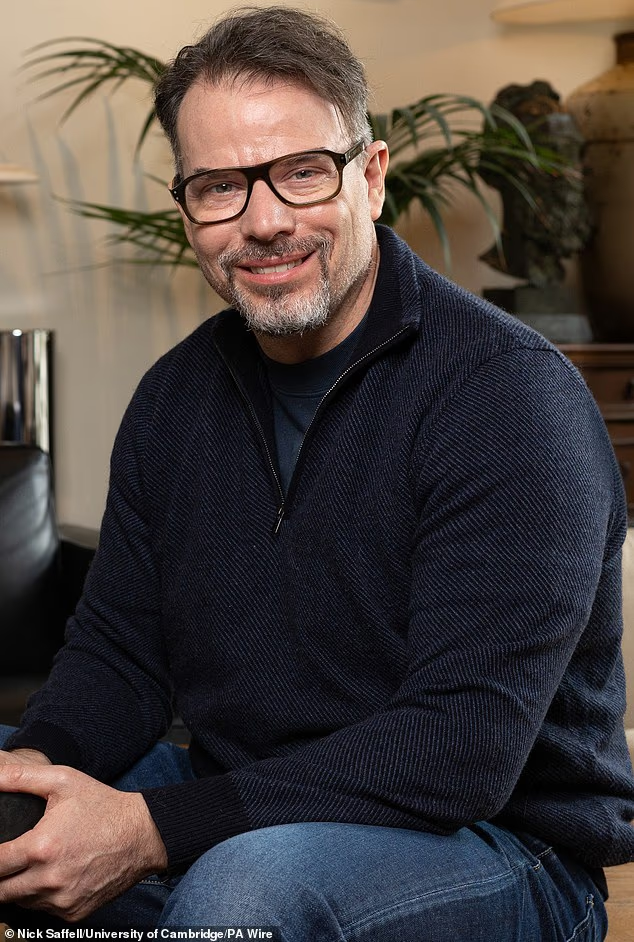
Chris Rokos, one of Britain’s biggest individual taxpayers, is preparing to move his tax residence from the UK to Greece and open an office in Athens, in the latest high-profile departure by a wealthy figure amid mounting concern over Labour’s tax policies.
The founder of Rokos Capital Management, which manages about $22 billion, paid an estimated £330 million in tax in the latest financial year, placing him third in the Sunday Times’ annual ranking of Britain’s biggest taxpayers.
A representative for Rokos Capital Management declined to comment on the reported move. The firm employs more than 370 people across offices including London, New York, Abu Dhabi and Singapore.
Rokos’s decision comes only months after he pledged £190 million to the University of Cambridge. Announced on March 31, 2026, the donation is funding plans for the Rokos School of Government and was described by the university as the biggest individual gift to a British university in modern times.
He has also committed about £175 million to the restoration of Tottenham House, a 200-room stately home near Marlborough in Wiltshire, which he bought in 2018.
The reported move to Athens highlights the widening gap between Britain’s tax regime and incentives offered by countries seeking to attract wealthy foreign residents. Under Greece’s special arrangement, qualifying individuals can pay a flat annual charge of €100,000 on income earned overseas, for up to 15 years.
For a financier whose reported earnings reached £477 million, the difference between that arrangement and UK taxation is substantial. It has raised fresh questions over whether the Treasury risks losing more revenue by driving high earners abroad than it gains through higher rates at home.
Growing concern over Britain’s wealth exodus
Rokos is not the first wealthy resident to leave. German-born investor Christian Angermayer moved to Switzerland after criticising changes to Britain’s tax regime, while Norwegian shipping magnate John Fredriksen closed his Chelsea office and relocated to the United Arab Emirates.
Slavica Ecclestone, formerly married to Formula One tycoon Bernie Ecclestone, is now resident in Monaco. Lady Ballyedmond, the pharmaceutical heiress who was once Northern Ireland’s richest inhabitant, has moved to Italy, while Yorkshire businessman Malcolm Healey is understood to have relocated to the United States.
Lakshmi Mittal, the steel magnate and former Labour donor who spent decades in Britain, also announced his departure earlier this year. His office said it was “sad” that the country had lost families which had contributed significantly to its economy.
The Sunday Times Rich List published in May recorded 157 billionaires in Britain, down from 177 in 2022. Around a third of those appearing among the 350 wealthiest people were no longer resident in the UK for tax purposes.
Warren Stephens, the American investment banker appointed by Donald Trump as US ambassador to Britain, was the only foreign billionaire to join the list last year. In an interview, he questioned why governments would want to drive away people who provide a large share of income-tax receipts.
HM Revenue and Customs figures show that the top 1 per cent of earners, with incomes of at least £207,000, contribute almost 13 per cent of all income-tax receipts. The 11,000 people earning more than £2 million a year paid as much income tax as the ten million lowest earners last year.
Rokos’s own contribution illustrates the scale of the issue. His reported £330 million tax bill was almost half the amount paid by the country’s lowest three million earners combined.
Private banks and advisers have warned that the departures could affect more than tax receipts. Mark Goddard, the UK chief executive of Swiss bank Lombard Odier, said in February that six of eight entrepreneurs at a dinner he hosted were considering leaving the country.
He described the trend as “a quiet but determined exodus”, arguing that departing individuals took with them not only their wealth but also their expertise, investment and willingness to support new businesses.
Technology entrepreneur Herman Narula, founder of the London-based company Improbable, has moved to Dubai after expressing concern about the prospect of an exit tax on business leaders who leave the UK.
The abolition of the non-domicile tax regime in April 2025 has been a particular source of concern among internationally mobile residents. The former system allowed qualifying individuals to limit UK tax on overseas income and gains, although the Government argued that it was unfair and needed reform.
Tax advisers say the changes have made Britain less attractive to wealthy foreigners and could prompt successful British entrepreneurs to leave after selling their businesses, particularly if capital gains or wealth taxes are increased in future.
David Lesperance, a tax and immigration adviser, said all 20 of his UK-based clients with net worths of more than £370 million had relocated over the past two years.
Greece has been among the countries to benefit from the shift, alongside Italy, Portugal, Switzerland, the UAE and Israel. Hedge fund Millennium Capital Management, which manages about $92 billion, has also established an office in Greece.
The attraction of Athens extends beyond tax, according to one London-based hedge fund manager, who cited its proximity to Britain, international schools and improving financial infrastructure.
But once wealthy residents have moved, advisers warn that bringing them back can be difficult. Any future reduction in UK tax rates would have to overcome the practical disruption of relocating families, businesses and investments once again.
Rokos’s move therefore represents more than the loss of one exceptionally large tax payment. It has become a test of whether Britain can continue to present itself as a home for wealth creation while competing with governments offering far more favourable terms to international investors.
