


Gary Lineker has challenged Britain’s super-rich to explain how much wealth they really need after backing calls for a new tax on assets worth more than £10 million.
The former England footballer and Match of the Day presenter joined more than 120 millionaires in signing an open letter to Prime Minister Andy Burnham, urging the Government to introduce an annual 2 per cent levy on extreme wealth.
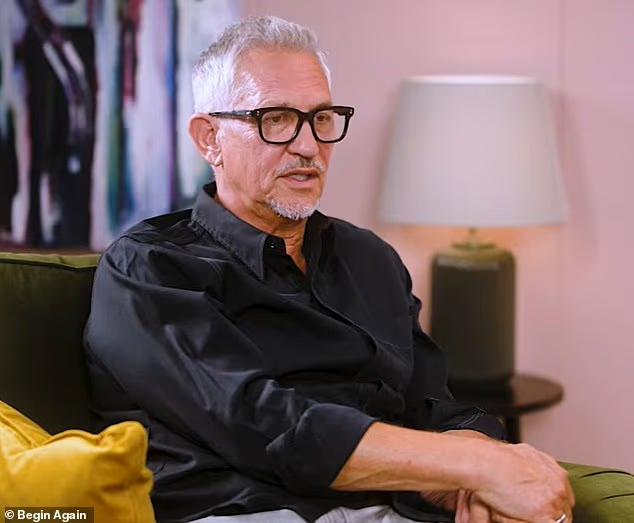
Speaking to Davina McCall on her Begin Again podcast, Lineker said the wealthiest people should contribute more to society and dismissed warnings that billionaires could leave the UK if taxes were increased.
“How much do you actually need?” he asked, arguing that a 0.2 per cent reduction in the wealth of the very richest would make little practical difference to their lives.
Lineker said there was often a competitive element to the accumulation of vast fortunes, describing it as a “my d**k’s bigger than your d**k” contest in which wealthy individuals compare their assets and achievements.
“I think if you can get it as a kind of law that the super wealthy contribute more to society, it would make sense,” he said.
The campaign group Patriotic Millionaires UK says a 2 per cent tax on assets above £10 million could raise about £24 billion a year. A petition based on the group’s “Proud to Pay” letter was published on the UK Parliament website on Wednesday, calling for the proposal to be taken forward.
Gary Lineker’s tax dispute with HMRC
Lineker’s intervention has prompted renewed criticism because of his own lengthy dispute with HM Revenue and Customs.
HMRC pursued him for almost £4.9 million in income tax and National Insurance linked to his television presenting work between 2013 and 2018. The tax authority argued that he should have been treated as an employee of the BBC and BT Sport rather than as a contractor.
He had been paid through Gary Lineker Media, a partnership established in 2012 with his then wife Danielle Bux. The arrangement meant part of his income was paid as dividends, rather than entirely as employment income.
Lineker appealed under rules designed to tackle so-called disguised employment and won at a tax tribunal in 2023. The judge ruled that he was a freelancer with contracts with both broadcasters. HMRC later settled the case after appealing.
Lineker has maintained that all tax due on his income was paid. He was also previously linked to film investment schemes operated by Ingenious Media, which HMRC said used artificial losses to reduce tax bills.
The claims have led to accusations of hypocrisy from Conservative and Reform politicians, who argue that Lineker should simply donate more money to the Treasury if he believes the wealthy ought to pay additional tax.
Andrew Griffith, the Conservative shadow business secretary, accused the broadcaster of preaching while having used “elaborate tax avoidance schemes”. Maxwell Marlow, of the Adam Smith Institute, described the wealth-tax campaign as a public-relations exercise.
Reform Treasury spokesman Robert Jenrick said Lineker could “sign a cheque to the Treasury tomorrow”, while Conservative MP Charlie Dewhirst called his position “gross hypocrisy”.
Lineker, who has described himself as a top-rate taxpayer, said he was content to contribute more if the Government introduced a system that applied to the super-wealthy as a whole.
“I’ve always paid top, top-level tax and for a long, long, long time, and happy to do so,” he told McCall. “If they want us to dip in, I think most of us would like to help in a way.”
