


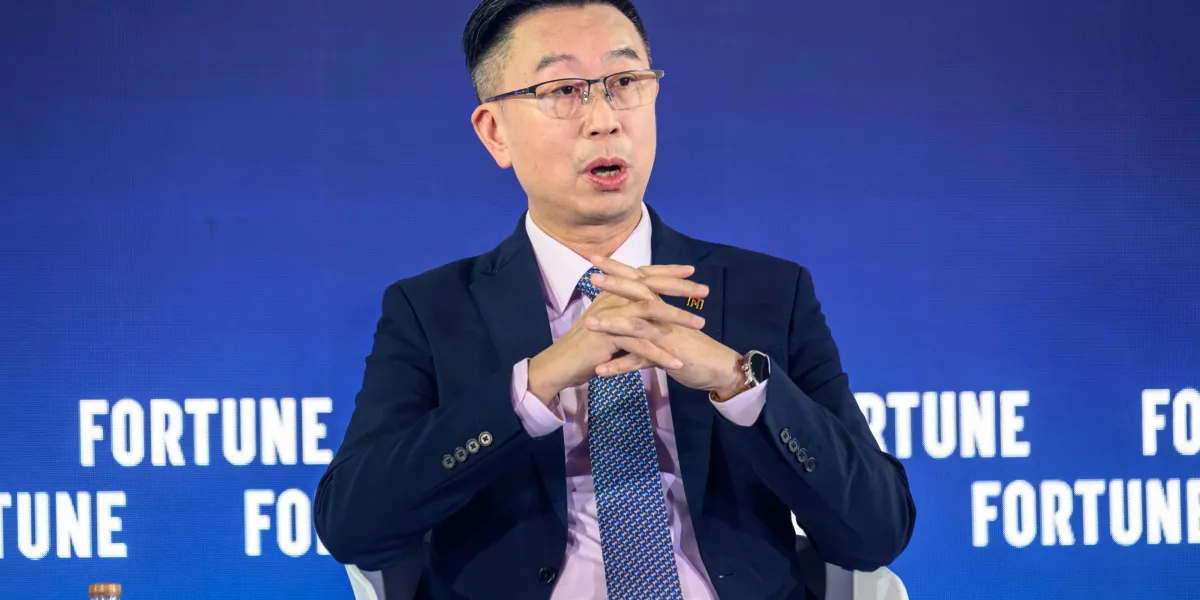
Macau is seeking to shed its image as a casino destination and become a business city, its investment promotion chief told the Fortune Leaders Forum on Tuesday, as the territory prepares to spend 130 billion patacas (£12.3 billion) diversifying its economy.
Alex Che Weng Keong, president of the Commerce and Investment Promotion Institute of the Macao Special Administrative Region, said the city could follow Las Vegas in developing into a global centre for conferences, exhibitions, trade and business exchange.
“The goal is that when people talk about Macao, they won’t just mean the 33.4 square kilometres of the peninsula,” Mr Che said. Instead, he said, the city should increasingly be seen alongside neighbouring Hengqin as a unified “tech city” over the next decade.
Macau business city plan targets technology and health
Gambling still generates about 45 per cent of Macau’s gross domestic product and supplies roughly 80 per cent of government tax revenue. Under the territory’s third five-year plan, covering 2026 to 2030, officials want non-gaming industries to account for about 60 per cent of GDP by the end of the decade.
The Macao government has said the investment programme will be driven by four major infrastructure projects and a government guidance fund. Its priorities include digital technology, biomedicine, integrated circuits and aerospace technology, alongside traditional Chinese medicine, specialised finance, tourism, culture and conventions.
Mr Che said Macau’s status as a separate customs territory, with its own currency, legal system and regulatory framework, could help it attract industries that require more flexible rules and easier movement of talent.
“Emerging industries often need different kinds of regulatory approaches and different ways for talent to move,” he said. Macau could “leverage our position as an independent economy with an independent legislative system and independent regulatory system”.
At the heart of the strategy is the Guangdong-Macao In-Depth Cooperation Zone in Hengqin, a 106-square-kilometre area beside Macau that is being developed as a platform for the territory’s economic expansion.
Mr Che described Hengqin as vital to the future of the Greater Bay Area and a national strategy for strengthening Macau. The zone’s development plan identifies scientific research, advanced manufacturing, traditional Chinese medicine, cultural tourism, conventions, commerce and modern finance as key areas for growth.
The territory is also seeking to use its Portuguese heritage to deepen commercial links beyond mainland China. Portuguese remains an official language in Macau and the territory retains a civil-law legal system, features Mr Che said could make it easier to build partnerships with European and Portuguese-speaking countries.
He pointed to a recent visit by Macau’s chief executive to Portugal, during which he met the president, prime minister, speaker of parliament and head of the supreme court. Once such government-level channels are established, he said, investment and commercial cooperation can follow more readily.
Macau is the smallest of the 11 cities in the Greater Bay Area, which also includes Hong Kong, Shenzhen and Guangzhou. The wider region has about 87 million residents and an economy worth roughly $2 trillion, but speakers at the forum said its strengths had yet to be fully integrated.
Edward Au, southern region managing partner at Deloitte China, said the area contained several world-class centres of innovation but lacked a sufficiently connected innovation network.
He called for a clearer division of roles: Hong Kong, Shenzhen and Guangzhou could lead in open and advanced innovation; Dongguan and Foshan could focus on engineering and manufacturing; while Macau and Hengqin could specialise in traditional Chinese medicine, the wider health sector and data technology.
For Macau, the ambition is to make the shift from a tourism-led economy without abandoning the visitor industry that made it wealthy. Instead, officials hope business travel, technology, healthcare, education and international trade will give the city a broader economic base — and turn its relationship with Hengqin into the foundation of a new urban identity.
