


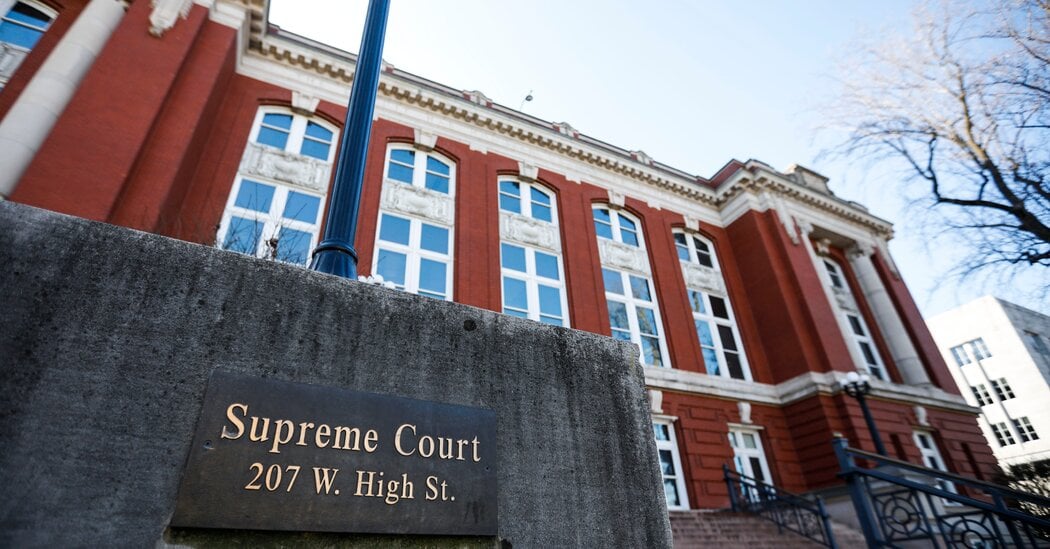
Missouri has asked the US Supreme Court to allow a Republican-backed congressional map to be used in November’s election, after the state’s highest court ruled that the boundaries should be suspended and put to a public vote.
Attorney general Catherine Hanaway, a Republican, filed an emergency application on Friday seeking to overturn the Missouri Supreme Court’s decision of September 3. She argued that changing the map after the August primary would create serious disruption and disenfranchise voters.
The state court found unanimously that opponents of the map had been wrongly prevented from placing a referendum on the November ballot. It ordered officials to use the previous congressional boundaries for the November 3 general election unless voters approve the new map.
Hanaway’s filing said Missouri was “genuinely unsure whether it can switch its governing congressional map in time to run a timely federal election”. It warned that hundreds of thousands of voters could be moved into different districts and asked to choose candidates who had not been selected in their new constituencies.
The emergency appeal also says the ruling could make it impossible for Missouri to meet federal requirements for sending ballots to military personnel and overseas voters. Under the timetable cited by the state, those ballots must begin to be sent by September 19.
Justice Brett Kavanaugh, who handles emergency applications from Missouri, has asked opponents of the new map to respond by noon on Monday. State law sets a Tuesday deadline for changes to be made to the November ballot.
Missouri congressional map at centre of legal dispute
The disputed map was drawn by Missouri’s Republican-led legislature in September 2025 after President Donald Trump urged Republican states to redraw congressional districts to improve the party’s prospects in the 2026 midterm elections.
It divided the Kansas City area among several districts in an effort to make the seat held by Democratic representative Emanuel Cleaver more competitive. The boundaries left the other Democratic-held seat, in the St Louis area, with broadly similar partisan characteristics.
The new map was used in Missouri’s August primary, in which about 1.2 million people voted. The state’s application argues that reverting to the earlier map would undermine the primary results and force candidates to campaign in constituencies different from those in which they were selected.
Opponents gathered more than 300,000 signatures to seek a referendum. Secretary of state Denny Hoskins rejected the petition, arguing that congressional redistricting could not legally be put to voters, but the Missouri Supreme Court ruled that the referendum process did apply.
The court said the 2022 map remained in force for the general election until the new boundaries were approved by voters. Missouri currently has six Republican representatives and two Democrats, and the redrawn districts were intended to help Republicans gain an additional seat as the party seeks to protect its narrow majority in the House.
