


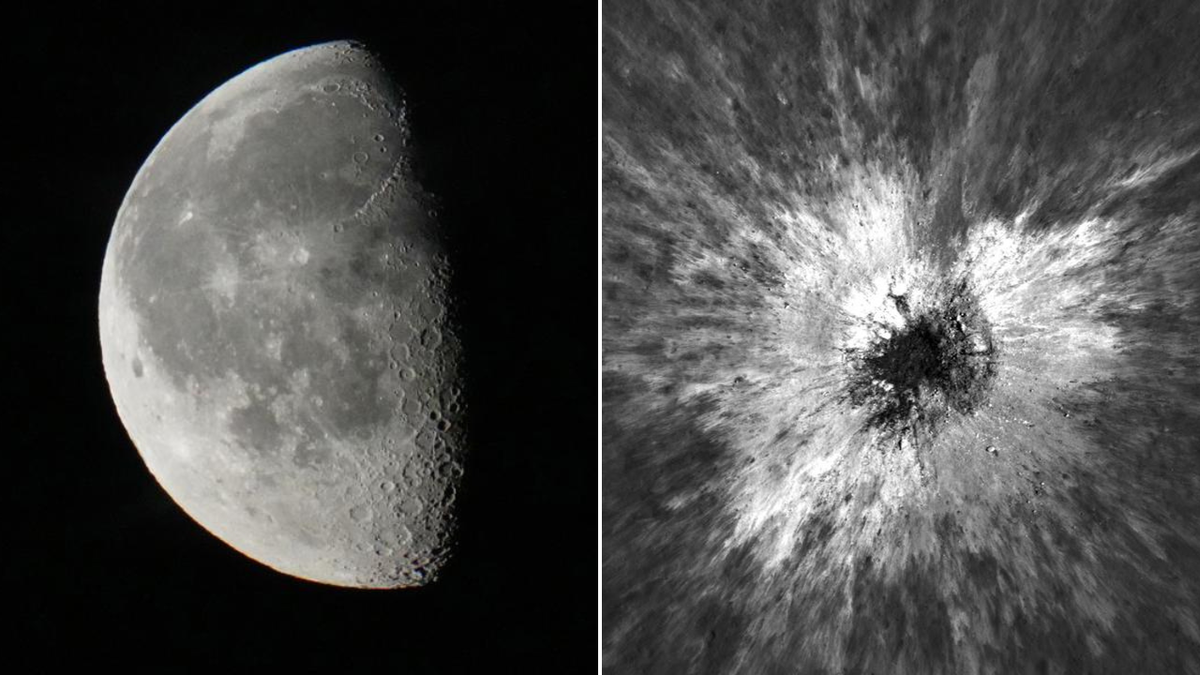
Scientists have identified a lunar impact crater more than twice the width of the Roman Colosseum, created by an asteroid or comet fragment that struck the Moon in 2024 without being detected at the time.
The steep-sided crater measures about 222 metres across and reaches up to 43 metres deep, making it the largest known impact crater formed in recent times anywhere in the Solar System.
NASA’s Lunar Reconnaissance Orbiter spotted the feature on the Moon’s near side in May 2024, shortly after the impact occurred. However, the discovery was not recognised in the spacecraft’s wide-angle imagery until August 2025, amid a large volume of data.
More detailed images were collected last year, with the finding confirmed early this year. The impact was not observed in real time by telescopes on Earth or in space.
The crater, named after the late Thomas McGetchin, a former director of Houston’s Lunar and Planetary Institute, is three times wider than the previous record-holder identified by the Lunar Reconnaissance Orbiter about a decade ago.
Researchers estimate that an event of this scale occurs only once every 132 years. Two studies on the discovery were published on Wednesday in the journal Science Advances.
“This event constitutes a statistically rare, effectively once-in-a-lifetime observation,” the scientists wrote in one of the studies.
The impact disturbed the lunar surface across an area stretching for more than 100 kilometres. Dust and rocky soil were thrown out at a higher angle than expected, said Mark Robinson, chief scientist for the Lunar Reconnaissance Orbiter’s cameras and lead author of one of the studies.
Scientists said the discovery could provide valuable information as NASA prepares to build a base for astronauts on the Moon. The lunar surface has been marked by impacts since ancient times, including some of the largest craters in the Solar System, one of which extends for more than 2,400 kilometres.
