


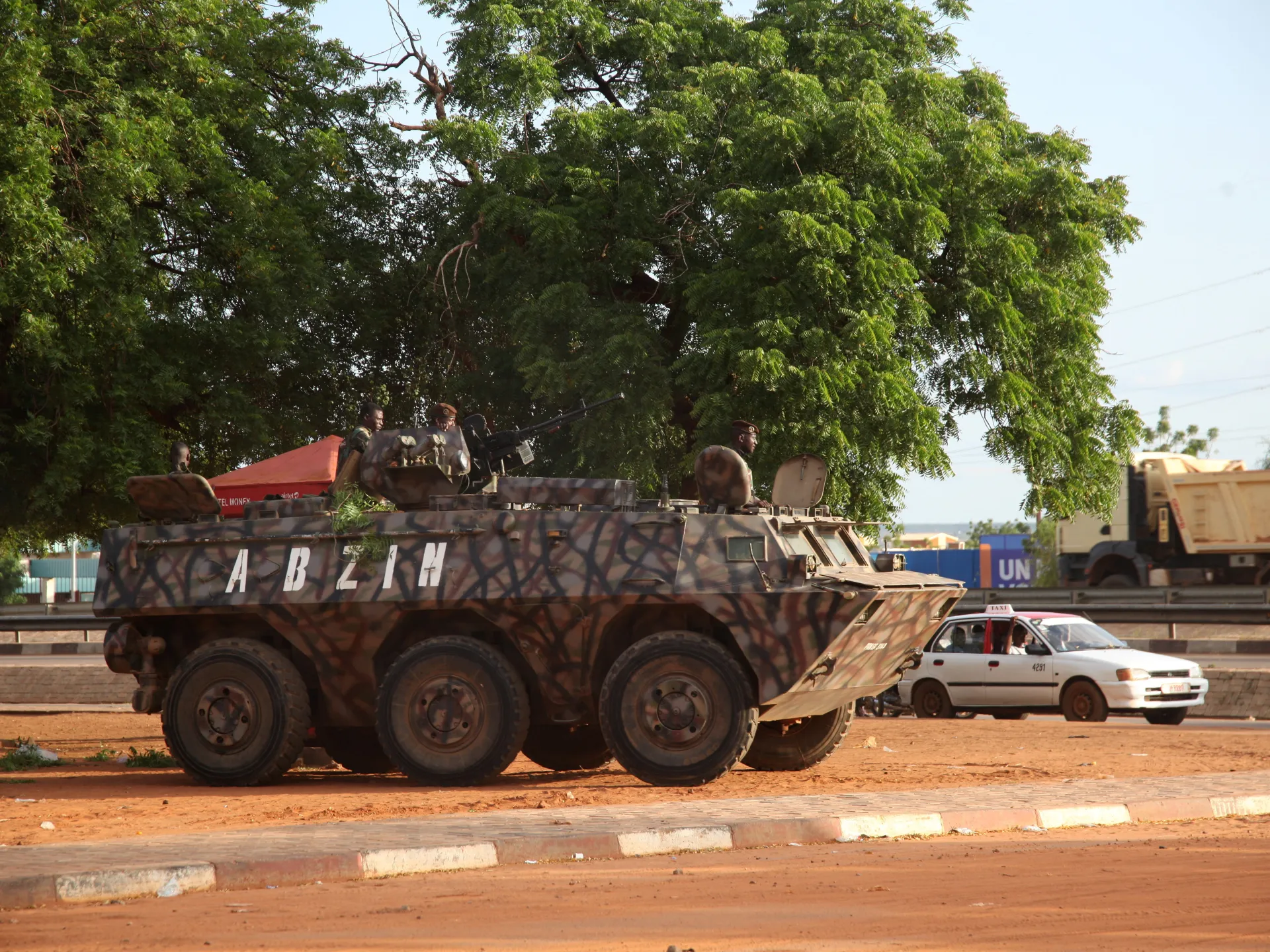
Niger’s failed mutiny has exposed President Abdourahamane Tchiani’s growing reliance on Russia to protect his government, after Russian personnel and equipment helped loyalist forces retake a key airbase in Niamey.
Soldiers from the self-styled Armed Forces for the Restoration of the Homeland launched a coordinated assault on 29 August, targeting Air Base 101 at Niamey’s international airport, the presidential palace and the national broadcaster.
A statement circulated during the fighting falsely claimed that Tchiani had been removed. Presidential guard units held the palace through the night, while about 200 Russian Africa Corps personnel, supported by drones and reportedly reinforced from Mali and Libya, helped recapture the airbase later that day.
At least 27 people were killed and about 100 suspected mutineers were arrested.
Mutiny exposes divisions in Niger’s forces
The attempted coup highlighted tensions between soldiers deployed against armed groups and better-protected units responsible for defending the political leadership in the capital.
Ryan Cummings, head analyst at Signal Risk, said the uprising reflected grievances that had been building within Niger’s military, including heavy casualties inflicted by armed groups that appeared to be as well equipped as government forces.
“The insurrection indicates discord within the Nigerien armed forces,” he said. “This stems from multiple sources. The foremost pertains to significant casualties being inflicted against the country’s military by an array of non-state armed actors which appear to be as well equipped, if not better, than their military counterparts.”
Mr Cummings said low- and middle-ranking officers who led the mutiny faced greater risks and poorer pay than senior forces such as the presidential guard.
“Junior to middle-ranking soldiers are generally deployed to conflict front lines, where they face well-equipped and increasingly professional militant units that are capable of overrunning their positions,” he said.
Senior units, including the presidential guard, are generally stationed in cities such as Niamey and Agadez, where the risk of combat is lower and remuneration is significantly higher, he added.
Russia’s expanding role in Niger
The intervention at Air Base 101 marked a widening of Russia’s role in Niger. Tchiani expelled French and American troops in 2023 and 2024, after which Russia’s Africa Corps entered the country as the military government sought to replace Western support.
The partnership had initially been presented as a means of strengthening Niger’s campaign against armed groups. The mutiny showed that Moscow’s support now also extends to protecting the military government from threats within its own security forces.
That reliance comes as Tchiani faces continuing attacks by armed groups and dissatisfaction among the soldiers fighting them.
Questions over the Sahel alliance
The episode has also raised doubts about the strength of the Alliance of Sahel States, the grouping formed by the military governments of Niger, Mali and Burkina Faso.
Romane Dideberg, a research analyst at Chatham House’s Africa Programme, said the largely delayed response from Niger’s allies was among the most significant aspects of the rebellion.
“As with the April attacks in Mali, the two other Sahelian juntas remained largely unreactive during this existential moment for the Nigerien junta, reacting only once the mutiny was neutralised,” she said.
Ms Dideberg said the delay reflected both shortcomings in the alliance’s security arrangements and sensitive relations between Tchiani and his counterparts in Mali and Burkina Faso. She also said Tchiani was rumoured not to have contacted Mali during the crisis.
She questioned “the effectiveness, but also, to an extent, the sincerity, of the mutual assistance pact”.
Separate allegations have linked French and Emirati interests to the mutiny amid wider friction over Niger’s Trans-Saharan Gas Pipeline project. The claims have not been independently substantiated.
Captain Roger Gabriel, commander of Niger’s elite 1st Parachute Battalion, alleged on state television that associates of deposed president Mohamed Bazoum and officers from Chad, Benin and Ivory Coast were behind the attack. He also claimed that people from the United Arab Emirates had urged him by telephone to join the mutiny.
Hossamaldeen Ibrahim, an Africa analyst at the Bloomsbury Intelligence and Security Institute, said possible Emirati involvement “cannot be dismissed”, citing the UAE’s expanding regional activity. However, the allegations remain unproven.
Tchiani survived the attempt to remove him, but the failed mutiny has laid bare divisions within Niger’s armed forces, demonstrated the extent of Russia’s security role and left questions over whether the country’s regional allies can provide meaningful assistance in a future crisis.
