


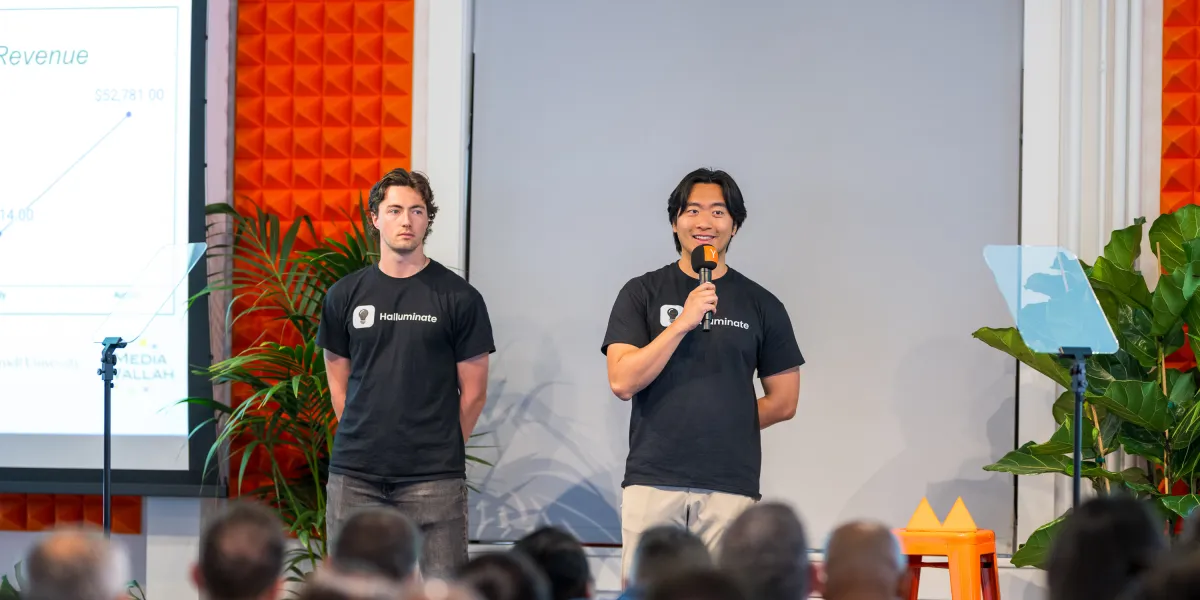
Halluminate, a nine-person San Francisco start-up developing AI training environments for financial work, has raised $30 million in a Series A funding round led by Oak HC/FT.
The investment brings the company’s total funding to $38.5 million. Existing backers including Y Combinator, Orange Collective and Heavybit also participated, alongside individual researchers from Anthropic, OpenAI and Meta, chief executive Jerry Wu said.
Founded in 2024, Halluminate assesses how AI models perform on complex financial tasks before building simulated environments designed to address their weaknesses.
Its work is based on the belief that AI training will become increasingly specialised by industry. Wu said the demands of simulating an investment banker’s work were fundamentally different from those involved in simulating a software engineer’s work, describing Halluminate’s systems as “verticalized data research labs”.
A benchmark released by the company in August required seven leading models to complete a simulated company-acquisition due diligence process. The 88 tasks were based on anonymised private-equity transactions and were written and reviewed by practising deal professionals.
The highest average score was 51%. In one exercise, an AI agent had to redline a statement of work using a 160-file data room, 21 emails across nine threads and four meeting notes, while tracking changing deal terms and preserving provisions that were not meant to change.
Across the assessment, the agents struggled to carry instructions through to a final deliverable. Failures included omitting required changes, applying the wrong analytical method and relying on information that had been superseded.
Halluminate uses such results to identify weaknesses in complex financial workflows and turn them into environments for reinforcement learning. Oak HC/FT general partner Matt Streisfeld said the breadth of financial knowledge work, spanning banking, private equity, consulting and accounting, had helped attract the firm to the company.
“When the agent starts getting into long horizon work,” Streisfeld said, “testing work and specialization will really be key.”
Halluminate’s specialised AI training strategy
For now, Halluminate is focusing on a small group of leading AI model laboratories rather than expanding widely into enterprise customers or other industries. Wu said the company wanted to help frontier labs improve model capabilities while refining its own approach to creating training environments.
According to Wu, four of the five leading closed-source US AI labs are paying customers. He said Halluminate had surpassed a mid-eight-figure annualised revenue run rate, calculated from quarterly revenue for work already delivered and paid for, and was profitable.
The company’s environments must become more demanding as AI models improve. Wu refers to this internal requirement as the “Moore’s law of environments”, estimating that their complexity needs to roughly double every six to eight months to continue challenging frontier models.
That can involve longer sequences of activity, more difficult reasoning problems and larger collections of files. Wu said Halluminate’s intellectual property lay in its ability to keep producing that complexity “generation after generation”.
Demand for reinforcement-learning environments is also emerging through other deals and customer work. Scale AI said in February that nearly half of its new data-training projects involved such environments, while Deeptune raised a $43 million Series A in March before agreeing to be acquired by Mercor four months later.
