


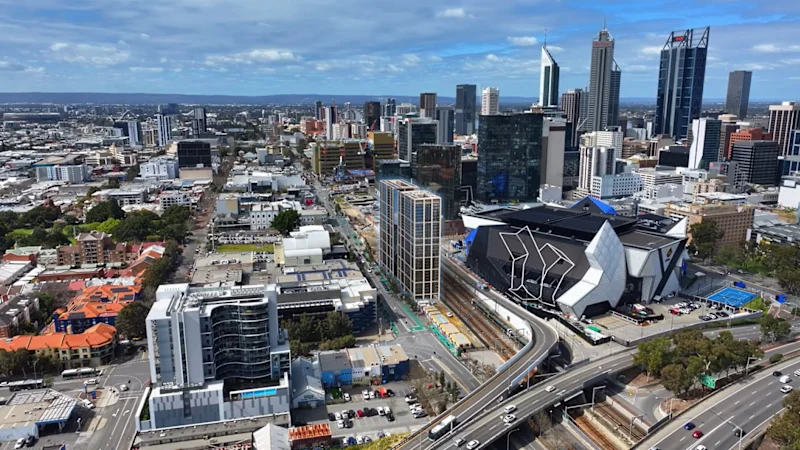
More than 100 social and affordable rental homes are to be built in Perth’s CBD, with a 30-storey development on Roe Street due for completion in 2029.
The project will deliver 174 one- and two-bedroom apartments, including 139 affordable rentals and 35 social homes. It is being presented as one of the biggest social and affordable housing developments in the city centre.
Housing and Works Minister John Carey said the Western Australian Government was “throwing everything” at accelerating the delivery of new housing.
“Never have we seen in our state’s history, so many build-to-rent projects underway, and this is the 21st project,” he said.
Perth CBD development to be sold to community housing provider
The Roe Street building has been designed by Perth-based MJA Studio and will be constructed by ICON Construction. Its design takes inspiration from the area’s Art Deco heritage.
Plans include a high-performance insulated facade, natural cross-ventilation, increased access to winter sunlight and all-electric services. Passive design measures are also intended to reduce energy use and living costs.
Deputy Premier Rita Saffioti said the project would provide homes close to public transport, employment and study opportunities, as well as essential services.
“We’re building one of the biggest social and affordable housing projects in the Perth CBD, delivering quality homes for people who need them most, in a fantastic location,” she said.
The development forms part of what the state government describes as a pipeline of social and affordable housing projects, backed by a record $4.7 billion investment in housing in its latest state budget.
Once construction is complete, the building will be sold to a community housing provider. The provider will manage the facility and select the tenants.
Social housing rents will be set at 25 per cent of a tenant’s income. Affordable rents may either be set at 30 per cent of income or discounted from the market rate, depending on the community housing provider.
Carey said the projects were needed to meet rising demand from single people and couples, arguing that higher-density developments were required rather than relying only on larger family homes.
