


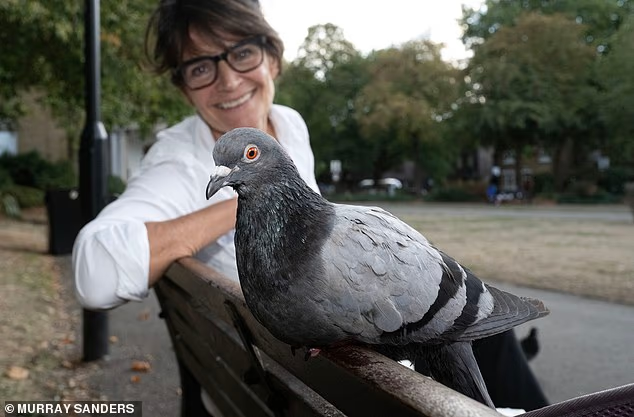
A female pigeon has been rescued from a painful “string foot” injury after human hair became tightly wound around both of her feet in an east London park.
The bird was treated on a park bench by Jacob Peter and Jennie Brennan, co-founders of London Pigeon Rescue (LPR), who carefully removed the hair, applied antiseptic cream and gave her a multi-vitamin before returning her to the flock.
The condition affects tens of thousands of pigeons in Britain, according to the rescuers. Fibres including artificial thread, dental floss and wool can become caught around birds’ toes, but human hair is the most common cause.
As pigeons walk, the fibres tighten like a tourniquet. They can cut into the skin, cause bleeding and infection, restrict circulation and leave feet badly deformed. In severe cases, toes turn black and fall off.
The pigeon found in the park had the condition in both feet. They were red and swollen, with hair embedded deep in the skin and bulging tissue visible around the toes.
“Sometimes, it’s the whole foot. Both feet!” Ms Brennan said. “And then they’re staggering around on stumps.”
While the rest of the flock moved around the grass, the small female appeared unsteady and struggled to walk. She was gently scooped up and wrapped in a green tea towel while a makeshift treatment area was prepared.
Mr Peter arranged antiseptic creams, powders, sterile swabs, tweezers, nail scissors and gloves on the bench before beginning the delicate work.
“It’s OK, darling. This won’t take long. You’re so brave,” he told the bird. “You’re doing so well. I’m going to help you. It will stop the pain.”
He said he always spoke to the birds before treating them. “I always introduce myself before I start and explain what I’m doing because I think it might be calming for them.”
The pigeon remained largely still as he unwound the hair from her feet. Some birds are less fortunate, with strands binding their feet together or trapping them on railings until they starve. Ms Brennan said severely distressed birds could even tear the skin from their feet.
London Pigeon Rescue tackles injuries caused by discarded hair
Mr Peter and Ms Brennan began working together in 2022, after he was employed by a London bird rescue charity and Ms Brennan contacted its hotline about a pigeon in distress.
Ms Brennan, who works as a nanny, began accompanying him in her spare time. She learned how to identify injured birds, prioritise pigeons with damage to both feet, catch them safely and remove the fibres, a process that can take hours.
The pair established London Pigeon Rescue a year later. The group responds to calls from members of the public, raises awareness of string foot and collects funds for medicine, seeds and equipment.
Mr Peter estimates that they have rescued more than 10,000 pigeons. They are among a small number of groups dealing with the problem, alongside organisations including Happy Feet in Glasgow and Manchester Pigeon Rehab.
Much of the hair responsible is believed by the rescuers to come from human grooming. It can be blown out of hairdressers’ and barbers’ doorways, dropped from brushes or shed as people walk along the street.
They are urging people to sweep up loose hair and put it in a bin, saying the injuries are both agonising and preventable.
Ms Brennan also rejects what she describes as widespread hostility towards pigeons. “They are not vermin. They are sentient beings which feel pain and fear and are monogamous – mating for life,” she said.
She said misconceptions about disease had contributed to the birds’ poor reputation. “There’s a deeply ingrained belief that they are super spreaders of disease, which is not true. You’re more likely to catch something from someone on public transport. It’s madness. And very sad.”
The rescuers have faced abuse while working, Ms Brennan said, including an incident in which someone tried to set fire to her bag and physically assaulted her. Other passers-by have shouted that pigeons are “vermin” and “flying rats”.
Despite the hostility, she carries a rescue kit and feeds birds near her home. Birds in particularly poor condition may be taken to her flat in Welwyn Garden City for a few days of care, kept away from her cat and comforted before being returned to their flock.
The rescuers try to release every pigeon because the birds mate throughout the year and may have young to feed. They also face the frustration of treating birds in places where pigeons are later culled.
“I’ll spend two hours sitting on the ground de-stringing a pigeon and the next week they’ll come in and shoot them all. How do you think that feels?” Mr Peter said.
He added: “We are not stupid. We know it’s not something we can solve alone. So we do try to focus on the difference we can make to that one bird – which is enormous – not the flock, as that would just be too depressing.”
Once the hair had been removed, the pigeon’s feet were covered in antiseptic cream. She was named Jane before being handed over for release.
For a few moments, Jane remained close to the rescuers, preening herself and pecking seed from Mr Peter’s hand. She then flew into the lime trees, where she settled with her mate and the rest of the flock.
