


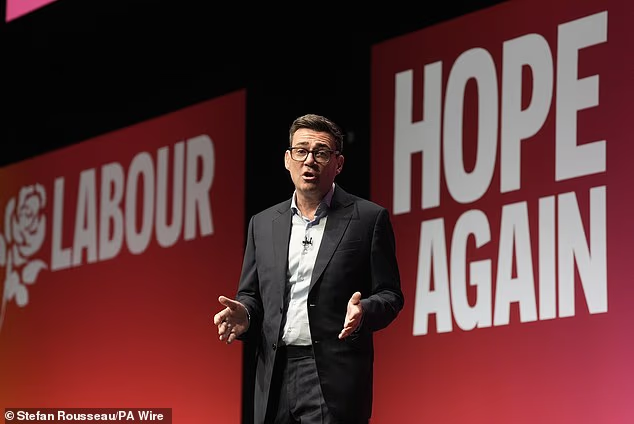
Andy Burnham plans to scrap the state pension triple lock from 2030 to help fund an NHS-style National Care Service, in a major shift announced at Labour’s conference in Liverpool.
The Prime Minister said Labour would honour its manifesto commitment to keep the triple lock unchanged throughout the current Parliament, taking the state pension to a record high. But he said the guarantee would then be replaced with a new formula designed to generate “significant savings” for social care.
Under the proposed system, pensions would continue to rise each year by at least inflation or 2.5 per cent. Mr Burnham also said the state pension would retain its value against earnings over time, so pensioners would share in rising national prosperity.
He said the reform would help finance a National Care Service which would be free at the point of need, with no care charges taken from people’s basic state pension. The service, estimated to cost £18 billion a year, would be introduced in the next Parliament following a review by Louise Casey.
“It will be fully funded, and not through borrowing,” Mr Burnham told delegates. “I won’t pretend some of this won’t be difficult. I accept I may pay a political price.”
He added: “But someone has to go through the pain barrier and rip the plaster off.”
Mr Burnham said he had his father Roy in mind as he argued for what he called a “new settlement” for older people and their families. His mother Eileen and brother John were in the conference hall for the speech, which came weeks after his father’s death.
The announcement immediately prompted criticism from Labour’s trade union allies, with Unite general secretary Sharon Graham accusing the Government of trying to “pick the pocket of pensioners”. She said ministers should consider wealth taxes before changing the triple lock.
“Going to a group of people who are getting around £12,500 a year in order to pay for it to take away their security is wrong,” Ms Graham said. “I think it’s morally wrong.”
There were also signs of concern within the Cabinet. Education Secretary Lucy Powell said Labour was committed to the triple lock until the next election but declined to extend that guarantee beyond the current Parliament.
Housing Secretary Angela Rayner suggested pensioners could accept the change if they could see that it would improve social care. She said people who had paid into the system throughout their working lives would want reassurance that money was being used to deliver better services rather than fill a “black hole”.
Mr Burnham’s plans were also attacked by the Conservatives and Reform. Tory chairman Kevin Hollinrake said the Prime Minister should instead focus on reducing the benefits bill, while Reform Treasury spokesman Robert Jenrick said spending on foreign aid and net zero subsidies should be cut before the triple lock.
Andy Burnham sets out wider plans for state control
The pension announcement formed part of a broader leftward programme in which Mr Burnham promised greater public control of housing, water, energy, transport and care.
He said Britain had been on the wrong path for decades because of “deindustrialisation, deregulation, privatisation, austerity and Brexit”. Comparing his ambitions with the post-war government of Clement Attlee, he promised a new wave of council housebuilding and said Right to Buy rules would be abandoned for new properties.
“Homes. Water. Energy. Transport. Care. Broken up and sold off,” he said, arguing that the country needed more control over essential services.
Mr Burnham also pledged legislation to repeal what he called Margaret Thatcher’s “ideological ban on public ownership of water companies”, alongside a ten-year plan to restore public control. Ministers are considering placing Thames Water into a special administration scheme if a proposed rescue plan fails.
He announced plans for a publicly owned “Great British Grid”, intended to bring UK energy costs down in line with European countries within a decade. Full nationalisation of major utilities is not currently expected because of the cost, but ministers are exploring other forms of intervention, including regional oversight boards led by elected mayors.
The Prime Minister hinted that further tax rises could be needed at the Budget on October 28, saying he had to be honest about what the country could afford. He pledged to follow the Government’s fiscal rules and reduce borrowing and debt.
He rejected outright cuts to benefits, arguing instead that investment in council housing, lower energy bills and employment support could reduce public spending over time.
Mr Burnham also condemned Brexit and indicated that the Government would examine its relationship with the European Union at a summit this autumn, amid speculation that closer ties could feature in the next manifesto.
