


A final round of polling has predicted that Republicans could lose seven Senate races in Tuesday’s midterm elections, with Democrats leading or level in key contests across the country.
The New York Times and Siena Research Institute survey points to potential Republican defeats in Michigan, Texas, Maine, Ohio, Iowa, Kansas and Alaska — a result that would put control of the Senate in play.
In Michigan, Democrat Abdul El Sayed was ahead of Republican Mike Rogers by 53% to 42%. The poll was conducted before Democrat Haley Stevens endorsed Mr Rogers on Sunday.
Texas was also shown as a possible Democratic gain, with James Talarico leading Republican Ken Paxton by 50% to 43% in the race for the state’s Senate seat.
Republican incumbent Susan Collins was behind Democratic challenger Troy Jackson in Maine, where the poll put Mr Jackson ahead by 51% to 45%. Those figures were within the margin of error.
In Ohio, Democrat Sherrod Brown led Republican incumbent John Husted by 49% to 44%. The state has been won by President Donald Trump three times.
The poll also gave Democrats a narrow advantage in Iowa, where Josh Turek led Republican Ashley Hinson by 48% to 47% in the contest for the open Senate seat.
Republican Senator Roger Marshall was behind Democrat Adam Hamilton in Kansas, with Mr Hamilton ahead by 49% to 44%. In Alaska, former Democratic lawmaker Mary Peltola was predicted to defeat Republican incumbent Dan S Sullivan.
Poll response rates raise questions
The polling organisation acknowledged that Democrats had taken part in the surveys at a higher rate than Republicans during this election cycle.
“Across these final battleground polls, registered White Democrats were about 30 percent likelier to take the poll than registered White Republicans,” the Times said.
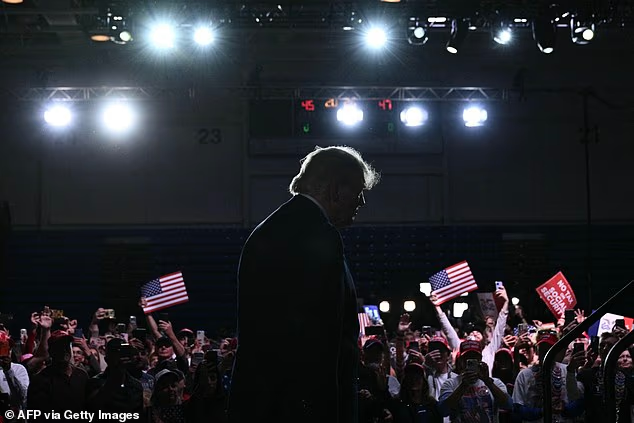
Mr Trump has spent recent days campaigning for Republican candidates, including visits to Kansas and Iowa on Sunday. He is due to hold a rally at the Lincoln Memorial in Washington DC on Monday.
At rallies, the President has urged supporters to behave as if he himself were on the ballot, arguing that his legacy and the remainder of his presidency are at stake.
One Trump political adviser said: “The president can only do so much. If we do fall short in the midterms, it’s not because of the president’s lack of trying or lack of effort.”
Behind the scenes, blame has already begun to circulate. Mr Trump has privately criticised super PAC chief James Blair over campaign spending, while Chief of Staff Susie Wiles has faced leaks suggesting she could be replaced after the election. The President has said there is “zero” chance that he will fire her.
Mr Trump has also publicly blamed Republican Senator John Cornyn and strategist Karl Rove should Mr Paxton lose in Texas. In Michigan last month, he told voters: “You will only have yourselves to blame, and I don’t think there’s any coming back from that either,” if Republicans lost control of Congress.
In Alaska, he has raised the possibility of describing the election as “rigged” because two candidates named Dan Sullivan are on the ballot, including the Republican incumbent.
Republicans currently hold 53 Senate seats. Democrats need to gain at least four to take control of the upper chamber in the next Congress, while they need to flip at least three seats in the House of Representatives.
