


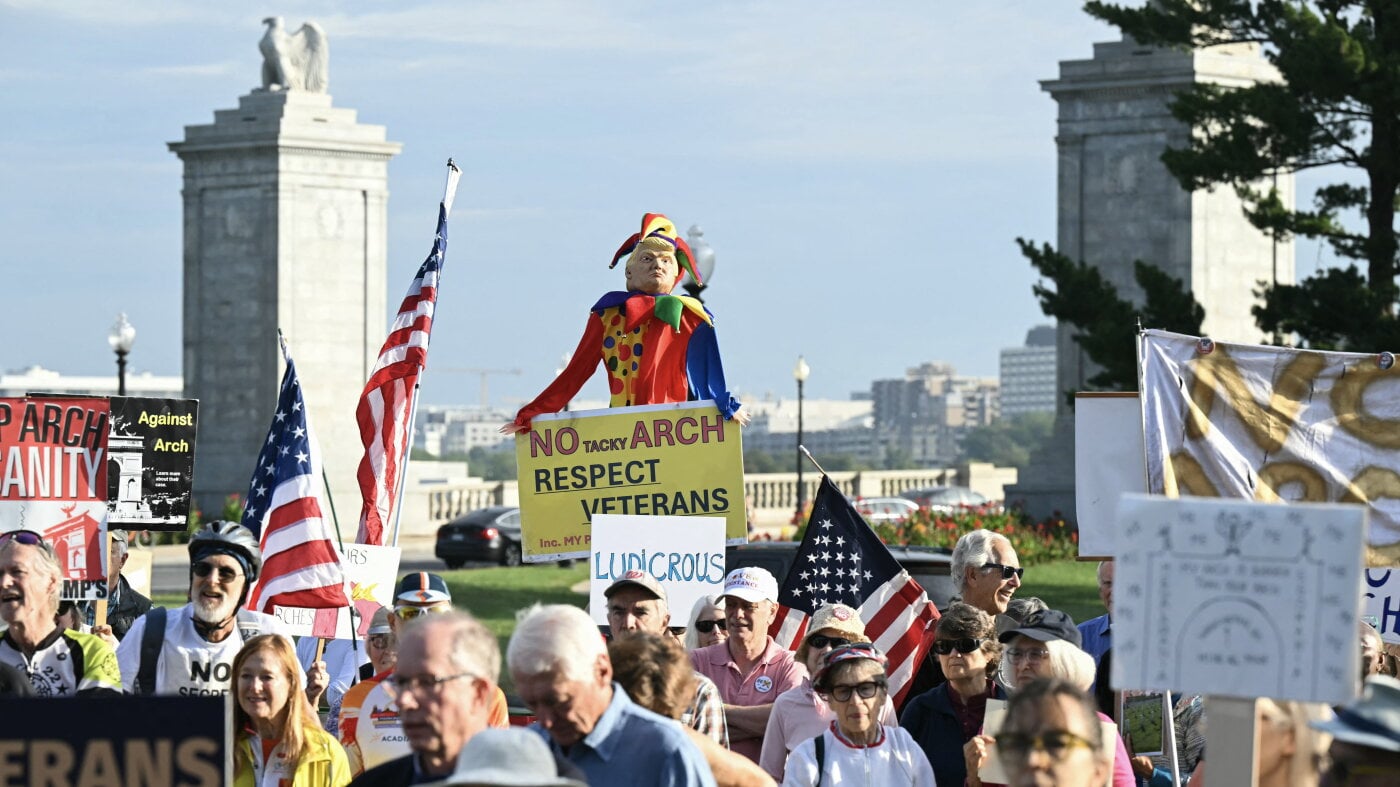
Veterans, activists and lawmakers have staged a protest in Washington against Donald Trump’s proposed 250ft triumphal arch, condemning its cost, scale and planned location beside Arlington National Cemetery.
Dozens of people gathered at Memorial Circle during Thursday’s rush hour for the “Vets over Vanity” demonstration. A tarp mock-up of the structure was displayed, with organisers saying the finished arch would be 32 times taller.
The proposed monument would stand in a traffic circle on the bridge linking the National Mall with Arlington National Cemetery. Critics said it had been advanced without congressional approval and without sufficient consultation with veterans or Gold Star families.
Jon Gundersen, a retired Army veteran and former Foreign Service officer who is among the Vietnam veterans suing the Trump administration, travelled from South Carolina to address the protest.
“It’s the wrong monument, in the wrong place, at the wrong time, dedicated to the wrong man,” he said.
The lawsuit is being led by Public Citizen. Gundersen said the opposition crossed party lines, adding: “Anyone I talk to, whether Republican or Democrat, they say it’s a waste of money and it’s not how you honour vets.”
Speakers voiced particular concern about the arch’s proximity to Arlington’s graves. Senator Tammy Duckworth, a Democrat from Illinois, said she and her husband expected to be buried there one day and argued that funding should instead be directed towards improving services for veterans.
The White House has said the arch would enhance the visitor experience at the cemetery and act as “a visual reminder of the noble sacrifices borne by so many American heroes”. It would also include an observation deck, according to critics.
During a series of speeches lasting about half an hour, protesters chanted “no arch!” and sang We Shall Overcome. Passing cyclists and commuters offered waves and sounded their horns in support.
Aircraft flew overhead every few minutes, highlighting concerns about the structure’s position close to the approach of one of the country’s busiest airport runways. Speakers also questioned the safety implications of Trump’s recent announcement that the site would house military drones and snipers.
“Who are the snipers going to shoot — the families at the graves or the tourists at the Lincoln Memorial?” asked Don Beyer, a Democratic congressman from Virginia.
The White House, Department of the Interior and Federal Aviation Administration have not responded to questions about the proposed military complex. The administration has also not publicly explained how the announcement might affect the federal approval process.
Proposed arch moves towards federal approval
The arch is expected to be considered by the National Capital Planning Commission at its next meeting in early November.
The National Park Service had been consulting outside groups about how to construct it while limiting damage to nearby protected landmarks. However, the Advisory Council on Historic Preservation ended its review in the last week of September, shortly after the announcement about the military complex.
Charles Birnbaum, head of the Cultural Landscape Foundation, said the process had been cut short after only two meetings. The council now plans to send its recommendations directly to Doug Burgum, the Interior Secretary, by 7 October.
Senator Jeff Merkley, a Democrat from Oregon, addressed Thursday’s gathering after a Republican senator blocked Democratic efforts to prevent federal funding for the arch and the demolition of the Kennedy Center.
Protesters said they would continue lobbying members of Congress. Julius D Spain Sr, a member of the Arlington County Board, told the crowd: “And if it is built, if somehow it is built, I will get my chisel and I’ll be right over there with everybody tearing it down.”
Mr Beyer later said a large number of people were prepared to protest as soon as construction began, potentially through demonstrations, tents or hunger strikes.
Congress could still block federal funding for the project. The midterm elections next month could change the balance of power, with a Democratic victory potentially threatening the arch from January.
