


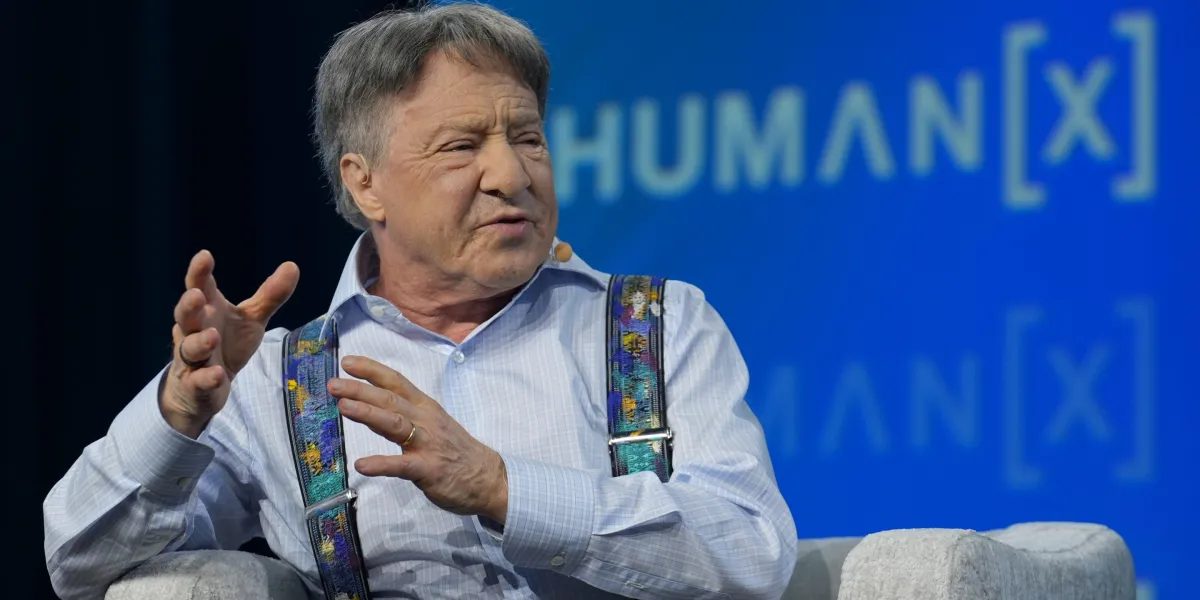
Ray Kurzweil, the computer scientist and Google researcher known for his predictions about artificial intelligence, has joined Silicon Valley start-up Subsense as it develops a brain-computer interface using nanoparticles delivered through the nose.
The appointment as product and vision adviser was announced at Subsense’s headquarters in Palo Alto, California, on Wednesday evening, September 2. Kurzweil will advise on the company’s technology roadmap and its plans to combine artificial intelligence with neural interfaces.
“Ultimately we want to merge [the smartphone] with the brain,” Kurzweil told the event. He said devices such as smartphones currently act as an intermediary between people and AI, slowing access to the technology’s capabilities.
“The whole point of humans is to go to greater frontiers, expand who we are,” he added.
Subsense is developing what it describes as a non-surgical brain-computer interface, although the proposed method would still involve introducing engineered particles into the brain. The particles would be delivered intranasally, in a process likened to using a nasal spray.
Once in place, the particles would be directed by magnetic fields generated by a wearable cap or headset. Subsense says one type could be used to detect neural activity, while another could stimulate targeted areas of the brain.
The company’s technology is based on plasmonic nanoparticles for neural readout and magnetoelectric nanoparticles for stimulation. Its website says early work has included experiments involving mice and laboratory-grown neurons, with further animal testing planned before any human trials.
Subsense has raised $27 million in funding, including an additional $10 million secured in December 2025. Its published development roadmap points to clinical pilot studies between 2027 and 2029, followed by a potential medical product and, later, a consumer version.
The company says its initial focus will be medical applications, including neurological disorders, before considering wider use. Its products have not been authorised, cleared or approved by the US Food and Drug Administration, and its performance claims have not been evaluated by the regulator.
The approach contrasts with systems such as Elon Musk’s Neuralink, which uses surgically implanted electrodes. Neuralink has enabled some people with paralysis to control computers using neural signals, but its implants require an opening to be made in the skull.
Tetiana Aleksandrova, Subsense’s chief executive and co-founder, said: “I believe the brain computer interface eventually may become one of the most intimate technologies that human beings ever created.”
Kurzweil, who received the US National Medal of Technology and Innovation, has spent decades arguing that advances in computing will eventually allow people to overcome the limits of biology. His books include The Age of Intelligent Machines and The Singularity is Near.
