


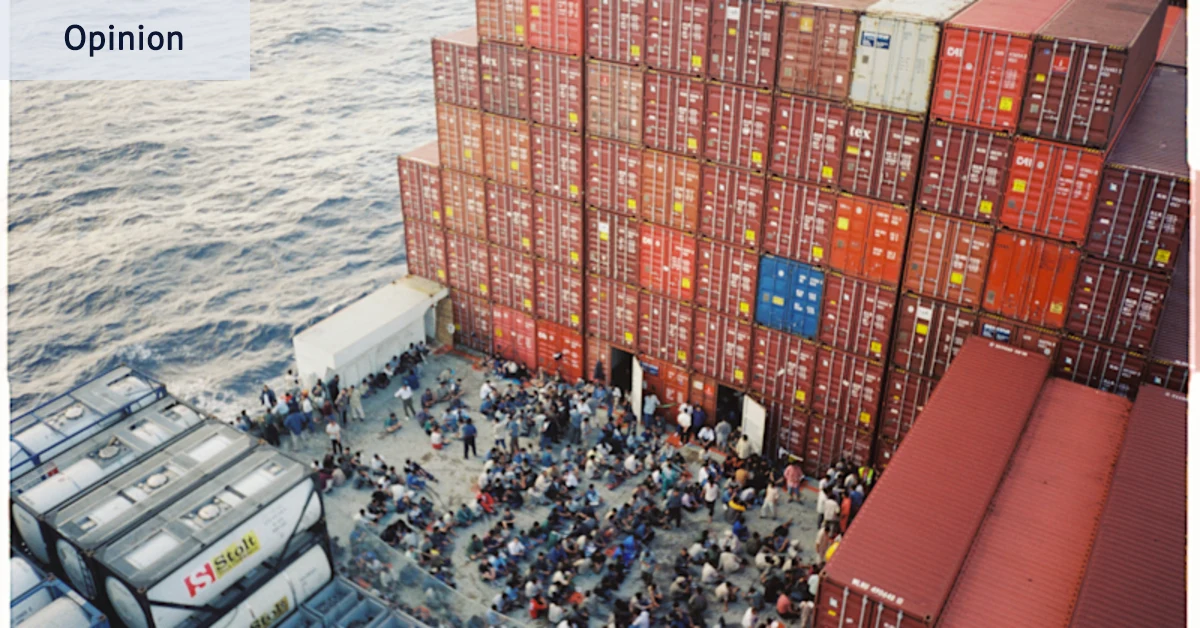
Australia’s refugee resettlement obligations should not be judged by whether new arrivals deliver a lifetime financial return, the chief executive of Settlement Services International has argued, citing the long-term contribution of families rescued by the MV Tampa in 2001.
Violet Roumeliotis said the 150 Hazara men, women and children brought aboard the Norwegian cargo ship after their refugee boat began sinking were eventually offered homes in New Zealand after Australia refused to resettle them.
Many of the children from those families grew up in Auckland, entered professions and trades, raised families and contributed to the country that accepted them, she said.
Her comments followed an argument by Alexander Downer, Australia’s foreign affairs minister at the time of the Tampa incident, that the country’s legal and moral responsibility to refugees should be temporary because of their negative lifetime fiscal contribution.
Mr Downer said: “We do not have an obligation to settle refugees permanently as migrants in our country. Our obligation is to protect them from whoever they are fleeing, not to turn them into migrants.”
Ms Roumeliotis rejected that approach, arguing that the same logic could be applied to an Australian child, who would also have a negative fiscal impact over part of their lifetime. She said no government would sensibly reduce a newborn to a calculation of predicted tax contributions.
Refugee resettlement as nation building
She described permanent resettlement as an act of nation building rooted in Australia’s role in drafting the Universal Declaration of Human Rights and helping establish the 1951 Refugee Convention.
The debate over whether Australia should reduce its humanitarian intake or retain it at 20,000 places had overlooked the distinction between humanitarian resettlement and ordinary migration, she said. Resettlement was a response to persecution and conflict, rather than an arrangement to be assessed solely through an economic model.
Ms Roumeliotis said economics remained relevant because refugees worked, paid taxes, established businesses, raised families and contributed to their communities. But she argued that access to safety should not depend on whether a Treasury forecast indicated a future fiscal gain.
She said temporary protection could leave people in prolonged legal, social and psychological uncertainty, while permanent resettlement offered the possibility of belonging and allowed countries to benefit from the skills and commitment of those they accepted.
Twenty-five years after the Tampa rescue, the experience of the Hazara families showed that turning people away did not eliminate their potential contribution, Ms Roumeliotis said. Instead, future engineers, health professionals, tradespeople and taxpayers went on to strengthen New Zealand.
