


Bank of America will double its artificial intelligence budget next year, but its technology chief has warned that companies should not automatically turn to AI when simpler tools can do the job.
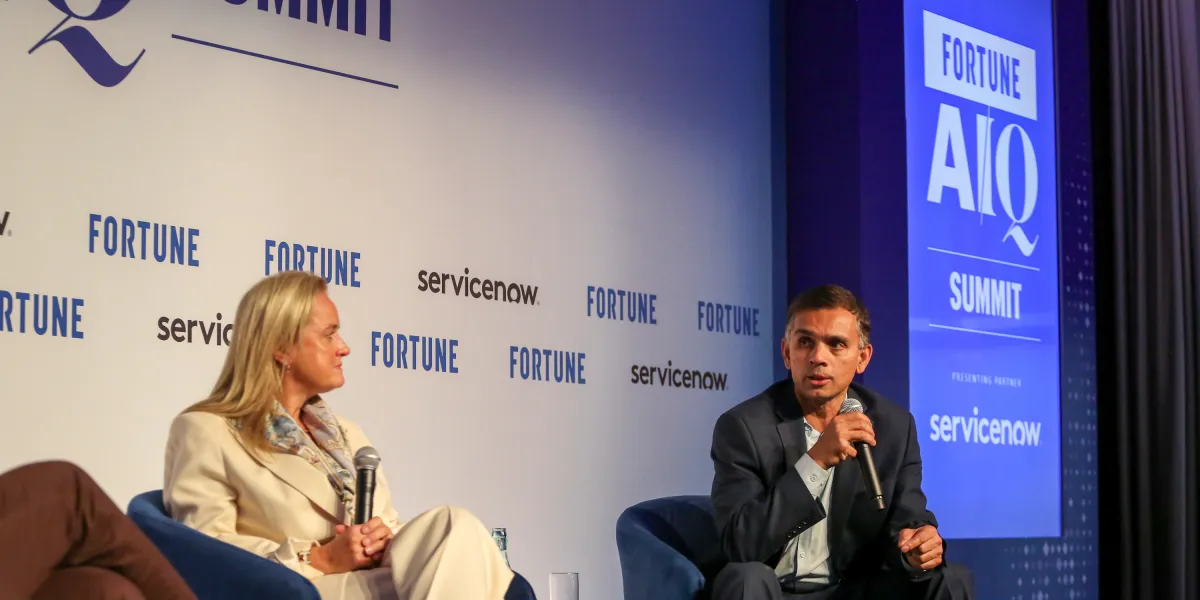
Hari Gopalkrishnan, the bank’s chief technology and information officer, said the principle was particularly important in regulated industries. Speaking at the AIQ Summit in New York, he said: “One of the biggest mistakes we see us and others doing is rush to AI as a solution, when deterministic models do a plenty good job.”
Gopalkrishnan appeared alongside Sally Moore, S&P Global’s chief client officer and co-head of Kensho Data & Platforms.
Bank of America puts controls around AI spending
Gopalkrishnan said Bank of America begins by examining what clients need and mapping the processes behind their requests. In many cases, he said, the answer was not AI at all, with a mobile application or a real-time decision rule proving more suitable.
Every AI proposal is assessed against 16 areas of risk, including privacy, bias, the impact on employees and intellectual property. “We’re not going to implement a chatbot that only answers to certain accents,” he said.
The bank has used AI for more than a decade, initially in fraud models. Its Erica virtual assistant has processed 3.6 billion transactions, Gopalkrishnan said, reducing the need for an additional 11,000 staff to handle calls.
Bank of America chief executive Brian Moynihan said in September that roughly 140 AI applications cost $400 million and produced $800 million in benefit. The bank’s AI spending budget is due to double next year.
That investment is being managed through an internal system known as Orchestra, which directs simpler classification work to approved open-weight models running on the bank’s own GPUs, while sending more complex reasoning to proprietary models. Gopalkrishnan said the approach also helped control token costs.
In wealth management, he said, advisers could now prepare for client meetings in seconds or minutes, compared with the days or weeks previously required.
Bank of America is also taking a measured approach to autonomous agents. “There is so much juice to be squeezed right now with assistive agents that are actually working with humans in the loop,” Gopalkrishnan said.
He said stronger control systems could eventually allow the bank to move further towards autonomy. He also warned that a security failure at a small bank could damage confidence in the financial system as a whole.
S&P Global focuses on trusted data
Moore said S&P Global was reshaping its business while recognising that much of its financial information feeds regulated processes. “Data is the currency within AI,” she said, adding that clients required accuracy, citations, auditability and traceability back to the original source.
S&P Global bought the AI company Kensho in 2018 and has since placed it at the centre of its operations. On 6 July, the company divided its Market Intelligence business into Kensho Data & Platforms and Enterprise Solutions.
Kensho Data & Platforms combines a client-facing data and AI delivery layer with platforms including Capital IQ, Ratings Direct, Visible Alpha and With Intelligence. S&P Global chief executive Martina Cheung said the changes were intended to support revenue growth and improve margins.
Moore, who leads a chief client office established about two years ago, said S&P Global serves 60,000 clients at different stages of AI adoption. The company works with frontier AI laboratories, incorporates its data into large language models and productivity tools, and is developing its own agents.
She cited the example of a major bank with 8,000 bankers that was combining S&P Global content in its own platform. S&P Global said it helped bring the project into production six times faster, while accuracy increased from about 60% to 98%.
The company has also built a credit memo agent designed to keep people involved in the process. Moore said the reliability of such systems depended on confidence in the underlying data.
Like Bank of America, S&P Global said it used different tools according to the task. An application programming interface could handle more straightforward language-model work without incurring heavy token costs, while more complex data retrieval at scale required greater resources.
Gopalkrishnan said the central lesson was that AI was not always the right answer. Moore agreed, arguing that businesses should first establish what they were trying to solve and then consider how the technology could change the process.
