


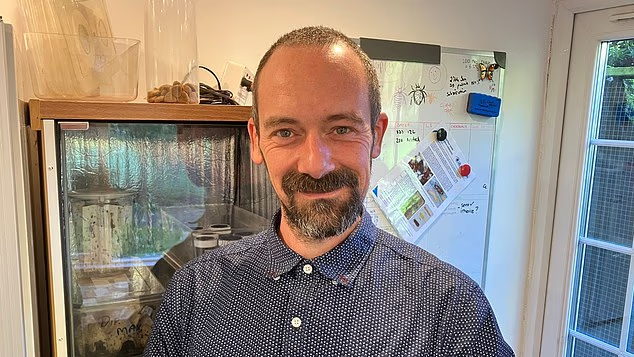
A Gloucestershire entomologist has spent five years sleeping with bedbugs as part of his work testing products designed to control the insects.
Dr Richard Naylor breeds around 60,000 bedbugs at a laboratory in the Forest of Dean and volunteers as the human host needed to assess repellents and other devices.
Twice a week, he straps some of the insects to his arm and allows them to feed while he carries on working. When a product requires a longer trial, he spends the night in one of the laboratory’s test bedrooms with the bugs.
“I must have been bitten millions of times by now, so I stopped reacting a long time ago,” Dr Naylor said. “I get a red patch on my arm after the bugs have fed, but it disappears after about half an hour.”
The insects are kept inside a self-contained laboratory operated by the non-profit Bed Bug Foundation, which Dr Naylor runs from a two-bedroom suite in his garden.
He said the bugs could not be properly tested without a person present to attract them.
“If there is no one sleeping in a bed, the bedbugs just sleep; they just go on standby,” he said. “And so I can’t test anything in the test bedrooms without there being a host in there.”
The facility helps companies assess products before they reach the market. Bedbugs are also bred there and sent overseas, including to canine detection teams trained to identify infestations in hotels.
Dr Naylor said bedbugs had an unusually powerful effect on those who encountered them.
“I don’t know of any other pest that has the same level of emotional and psychological impact on people,” he said, adding that infestations could leave some people with PTSD-type symptoms.
Bedbug infestations rise as insects resist sprays
His unusual testing regime comes amid reports of a sharp increase in bedbug activity and growing concern that the insects are becoming harder to eradicate.
Rentokil said confirmed bedbug activity in the UK rose by 44 per cent year on year between 2023 and 2025. JG Pest Control said it had carried out more than 5,000 bedbug-related visits in the past 12 months.
The insects have been reported in hotels, trains and planes. Six Southeastern services were cancelled last month after suspected bedbugs were found on trains operating between Kent and London, following two earlier incidents involving the drivers’ cabs of the same operator.
A report in the Journal of Pest Science concluded last month that bedbugs had different genetic signatures depending on where they originated. That variation may help them survive attempts to eliminate them and develop stronger resistance to insecticides.
Professor Logan said the insects were spread by people travelling, with bedbugs able to cling to clothing and bags. Hotels, trains, planes and hospitals were particularly vulnerable because of the number of people passing through them.
“But what we’re starting to see now is bedbugs also in places like offices, workplaces and pubs,” Professor Logan said.
An infestation at the Guardian newspaper led to staff being allowed to work remotely and being given home monitors designed to lure bedbugs from their hiding places using chemical attractants. In other London offices, employees have refused to attend work after colleagues disclosed infestations at home.
Professor Logan also said rising temperatures could be contributing to the problem, saying: “Climate change is making it better for them and worse for us.”
Martim Gois, co-founder and chief executive of hospitality company Valpas, said Europe was experiencing “peak bed bug”, with an unprecedented surge being seen in hotel rooms.
The insects can hide in mattress seams, bed frames and upholstered furniture. They may also be carried into homes in luggage, clothing and unwashed second-hand garments.
Hannah Shore, head of sleep science at MattressOnline, said bedbugs could multiply quickly when left untreated in bedding, carpets and curtains.
“Bed bugs are most commonly found in beds due to the easy access to food (blood), but during the day, they walk around in search of food, which may take them further afield,” she said.
“They often attach themselves to suitcases or climb into suitcases, meaning you then take them home with you and, if left untreated, they start a new colony there.”
