


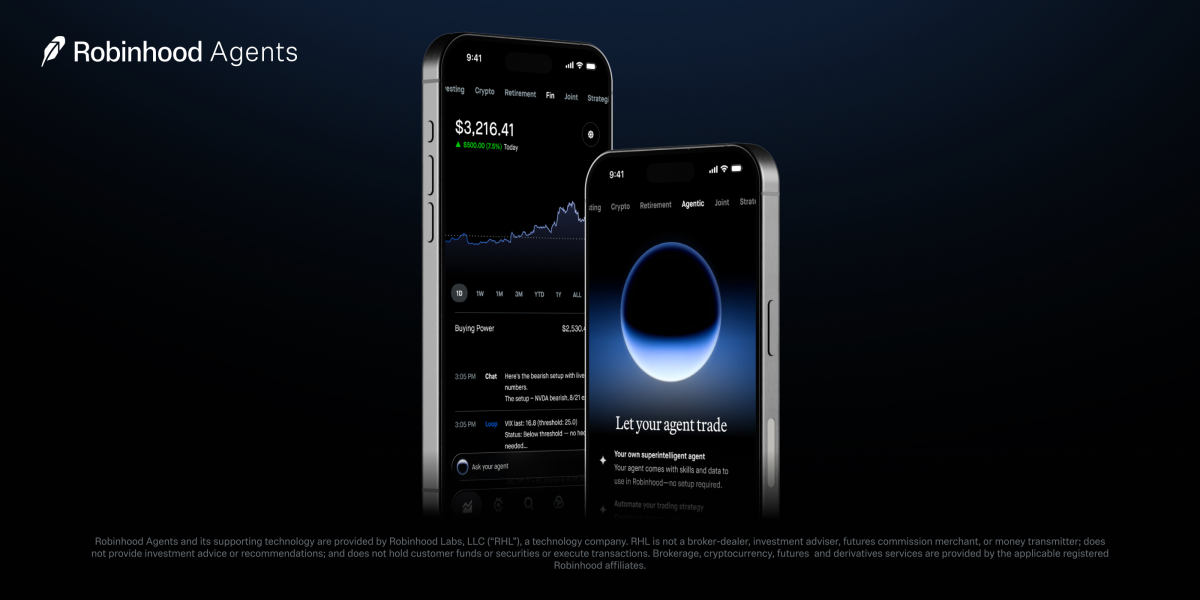
Robinhood trading agents powered by OpenAI and Anthropic are being made available to the platform’s roughly 29 million customers, allowing users to research investments, develop strategies and place trades through plain English instructions.
The launch was announced at Robinhood’s annual HOOD summit and marks the first large-scale release of a non-technical trading agent by a brokerage, according to the company. Customers can choose between models from the two technology firms and instruct them to carry out tasks ranging from individual share purchases to ongoing market strategies.
In a demonstration, users were able to give their agent a name before selecting one of the available OpenAI or Anthropic models. They could then type instructions such as “Buy $200 of Ford stock” and have the agent execute the transaction.
The service is also designed to handle more complicated assignments. Robinhood said users could set up “Loops” to monitor the market at a specified time and trade when certain conditions were met, or to run an overnight strategy while they were asleep.
The company has introduced safeguards intended to limit unexpected activity. Each agent will have a dedicated trading account, while customers can cap the amount it is permitted to trade at any one time.
Users can also require the agent to seek final approval before completing a transaction, rather than allowing it to act automatically. The service will initially include free, time-limited access to data providers including Unusual Whales and the crypto-focused Token Terminal.
Robinhood trading agents raise wider market questions
Robinhood executives said the combination of easy-to-use agents and financial data libraries could give ordinary investors access to tools previously associated with hedge funds, major banks and quantitative trading firms.
“Ownership doesn’t work without markets, and markets don’t work without traders,” Robinhood chief executive Vlad Tenev said. “We’re making Robinhood the best place in the world for active traders by delivering tools once reserved for hedge funds, big banks, and quant firms.”
The company’s rollout follows its release in May of an MCP tool, which allowed technically minded customers to connect their own agents to the Robinhood trading platform. More than 150,000 customers have since opened agentic accounts using that version, Robinhood said.
As of late September, agents were carrying out nearly 30 million transactions a day on Robinhood’s platform, according to the company. The new service could make that type of automated activity accessible to a far larger group of customers.
That prospect could alter trading patterns in ways that are difficult to predict. It may lead to a significant increase in active trading volumes or encourage the development of strategies that would not otherwise be used by individual investors.
There are also potential risks if agents begin responding to the same market signals. If they moved in large numbers into or out of an asset, the result could be greater volatility, while malicious use could contribute to panic, according to scenarios raised around the launch.
Questions also remain over responsibility if an agent makes a damaging trade. Robinhood’s position is that hosting the agents does not amount to providing financial advice, and that their recommendations and actions are comparable to information a customer might receive from the internet or a friend.
The legal position around agent-based trading remains unsettled. It is also unclear how much customers will ultimately pay to use the service, particularly when they employ it for demanding research-intensive strategies.
Robinhood plans to provide its lower-end Luna model free of charge until the end of the year, while use of the OpenAI and Anthropic agents will be charged at standard token rates. Executives said the cost of most transactions should be negligible, although that could change if computing costs rise or customers make extensive use of the tools.
Robinhood is currently the only brokerage offering non-technical trading agents at scale. However, fintech and cryptocurrency companies including eToro, Public and Coinbase already allow customers to connect their own agents through MCP tools.
Those firms are expected to introduce agents directly within their platforms, while traditional brokerages such as Schwab and Fidelity could eventually follow. The longer-term effect on market performance and the way investors build wealth remains uncertain as automated trading becomes more widely available.
