


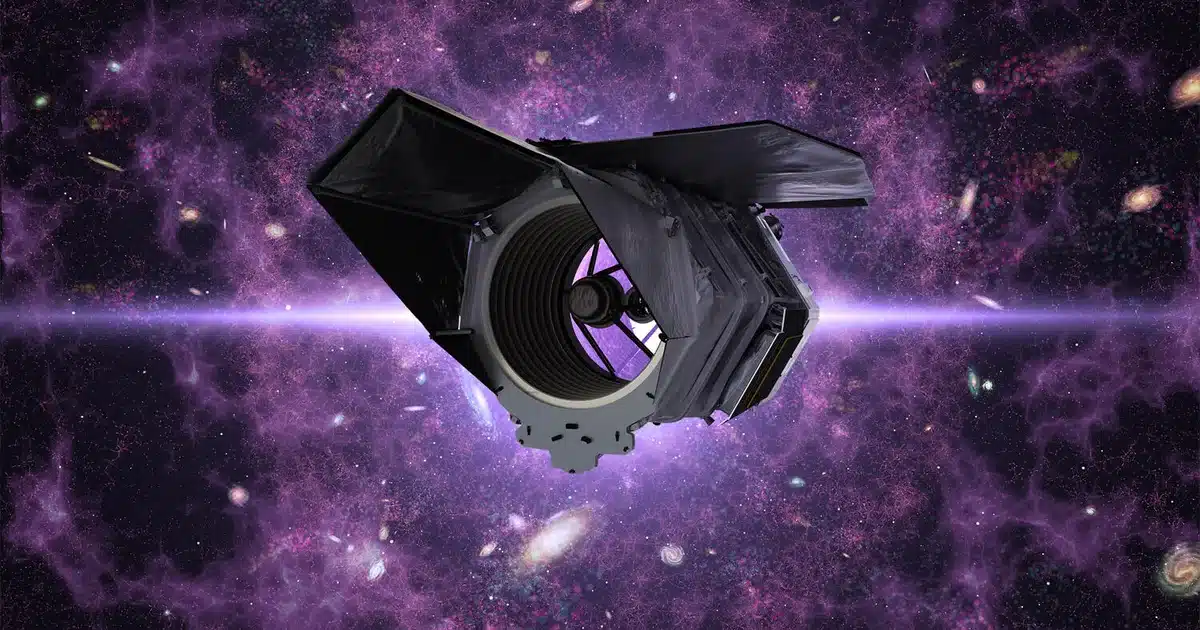
NASA’s Nancy Grace Roman Space Telescope is due to launch from Florida on Sunday, opening a new era of wide-field astronomy with a camera capable of producing images containing almost 300 million pixels.
The £3.3 billion observatory is scheduled to lift off at 7.26am local time on August 30 aboard a SpaceX Falcon Heavy rocket from Launch Complex 39A at the Kennedy Space Centre.
Roman is designed to survey the universe at a speed and scale far beyond that of the Hubble Space Telescope. Its 288-megapixel Wide Field Instrument will capture sharp infrared images across an area at least 100 times larger than Hubble’s field of view.
A single image would contain so much information that displaying it at full resolution would require the equivalent of hundreds of thousands of ultra-high-definition television screens. NASA has compared the area covered by one image with dozens of city blocks.
The telescope is expected to gather around 20 petabytes of data during its five-year primary mission, with its broad surveys set to map billions of galaxies and hundreds of millions of stars. NASA says it will collect data hundreds of times faster than Hubble.
The mission is being launched around nine months earlier than previously expected. It was formally completed late last year at NASA’s Goddard Space Flight Centre in Maryland before being transported to Florida for final checks, fuelling and launch preparations.
After reaching space, Roman will travel to a quasi-halo orbit around the second Sun-Earth Lagrange point, about 930,000 miles from Earth. The region, known as L2, provides a stable operating position and an unobstructed view of the cosmos. The James Webb Space Telescope operates in the same area.
NASA hopes the observatory will help answer some of the most difficult questions in modern cosmology, including the nature of dark matter and dark energy.
Dark matter cannot be seen directly but its gravitational effects help hold galaxies together. Dark energy is the unknown force thought to be driving the accelerating expansion of the universe.
Roman will also investigate the so-called Hubble tension: the continuing disagreement between measurements of the universe’s expansion rate based on its early history and calculations made using nearer, more recent objects.
Julie McEnery, Roman’s senior project scientist, said the discrepancy could point to a serious gap in the standard model of cosmology.
“We’re probably not going to confirm the standard model of how the universe works,” she said. “We’re very likely to demonstrate that our standard model is wrong, and to set ourselves on a path to figuring out how does our universe really work.”
The observatory carries a second instrument, the Coronagraph Instrument, which will test technology for blocking the glare of stars so that planets orbiting them can be photographed directly.
It is intended primarily as a technology demonstration, but could allow researchers to study the reflected light from Jupiter-sized planets and examine the chemical composition of their atmospheres. Scientists hope it may eventually help identify a Jupiter-like world around another star.
Roman is expected to discover more than 100,000 exoplanets, including thousands found through microlensing. The technique detects planets when the gravity of a foreground object briefly magnifies the light from a more distant star.
Its main programme will combine large-scale surveys of galaxies with repeated observations of the same regions of sky. Those time-based surveys should capture transient events such as supernovae and stars being consumed by black holes.
A further survey of the Milky Way’s central bulge will monitor hundreds of millions of stars for evidence of planets in wide orbits. NASA also plans to examine the galactic plane, producing what it describes as the most comprehensive portrait yet of the structure of our galaxy.
The telescope’s primary mirror is 2.4 metres, or 7.9ft, across — the same diameter as Hubble’s. It was originally built for a classified US spy-satellite programme and donated to NASA after that project was cancelled.
Although the mirror was highly polished and precisely manufactured, it had been designed to observe Earth rather than distant astronomical objects. Engineers modified its curvature and other components, while adapting the spacecraft to function in the extreme cold of deep space.
Roman is named after Nancy Grace Roman, NASA’s first chief astronomer and a leading advocate of space-based observatories. Her work helped make Hubble possible, earning her the description “the mother of Hubble”.
NASA expects the observatory to spend three to four months undergoing calibration and system checks after launch before beginning its scientific programme.
Unlike many space missions, Roman’s data will not be kept exclusively by the teams that collect it. NASA says all observing time will be community-directed and the data will be made publicly available without a proprietary-use period, allowing researchers around the world to analyse the telescope’s findings.
