


Russian casualties in Ukraine reached a reported 46,230 killed or wounded in September, the highest monthly total recorded by the Ukrainian military this year, as Moscow’s forces continued efforts to capture territory in the eastern regions of Donetsk and Luhansk.
The figure follows monthly Russian losses of about 40,000 since June and approaches the target of 50,000 casualties a month set by President Volodymyr Zelenskyy in January. Ukraine reported that 2,090 Russian troops were killed or wounded on September 28 alone, its highest daily figure of the war.
The casualty claims have not been independently verified. Ukraine says more than 90 per cent of the losses were caused by first-person-view drones and that it holds video of each casualty.
Despite the reported losses, Russian forces have continued trying to seize the remaining Ukrainian-held areas of Donetsk and Luhansk, where some of the heaviest fighting has taken place.
Ukrainian counteroffensive around Lyman
Ukraine’s Third Army Corps says it has retaken 176 sq km around Lyman in recent weeks during the third phase of its counteroffensive, known as Operation Vivaldi.
Brigadier General Andriy Biletsky, the corps commander, said Ukrainian forces had initially made it appear that an attack was coming from the west, drawing Russian reserves into counterattacks in that direction before Ukraine struck from the north.
Ukrainian forces also used remotely operated Russian armoured personnel carriers packed with explosives against defensive positions, while drone operators targeted Russian ammunition and fuel supplies.
A Ukrainian commander on the Lyman front said the first phase of the operation had destroyed a Russian vanguard. Moscow has denied the reported gains and released videos it says show its forces retaining their positions.
Open-source assessments have generally not reflected Russia’s claims of territorial advances. The Institute for the Study of War has estimated Russia’s net gains this year at 148 sq km, compared with the 5,300 sq km claimed by Moscow.
Russia targets Ukraine’s energy infrastructure
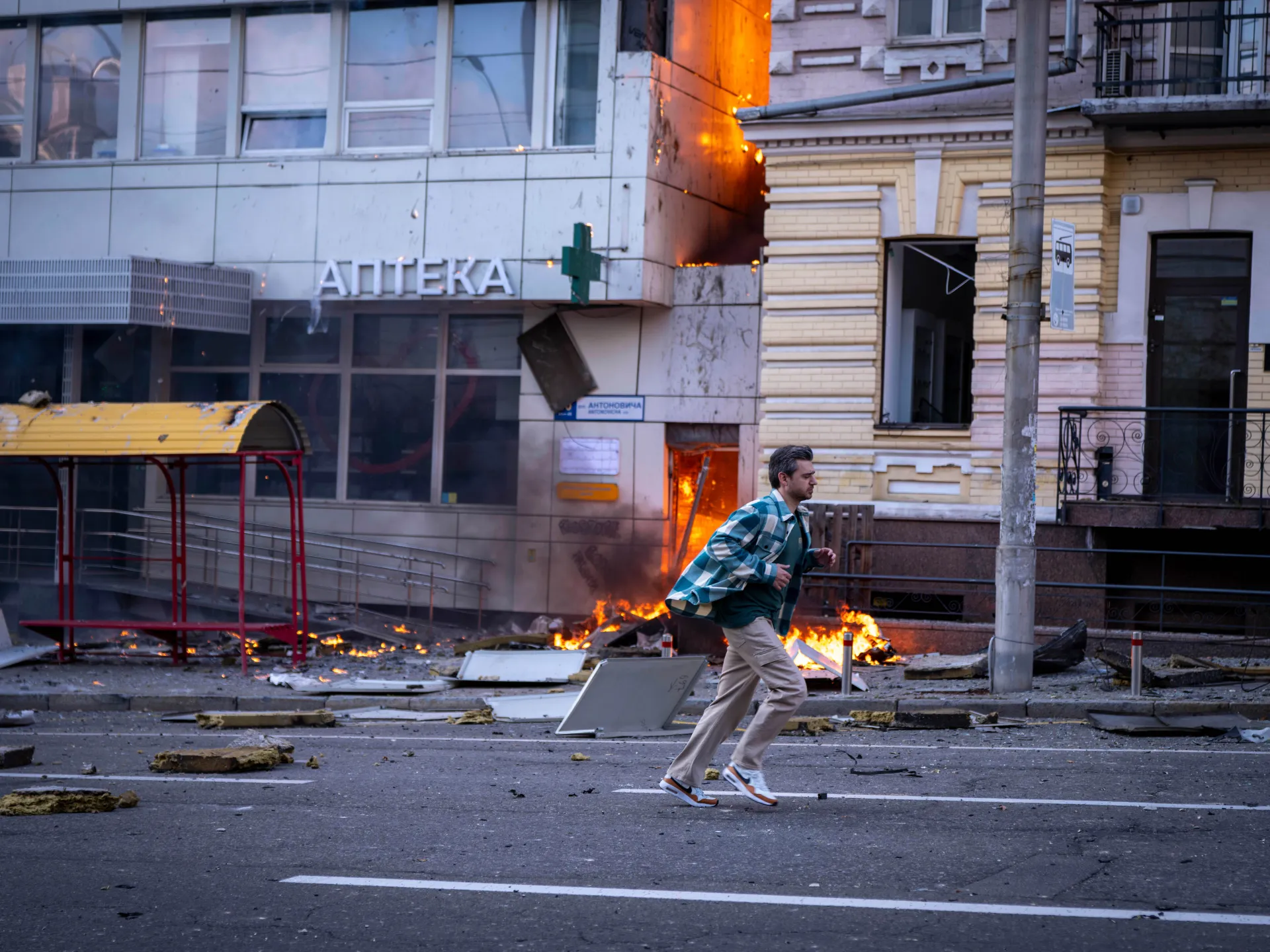
Russia has continued striking Ukrainian cities, with attacks reported against energy infrastructure as well as residential buildings, schools, kindergartens and offices.
Several people were killed on September 28 when a drone destroyed part of the National Academy of Sciences building in Kyiv. Two days later, Russian drones struck a thermal power plant in the Kyiv region, causing power outages, while at least five people were killed across Ukraine.
Prime Minister Sergii Koretskyi said there had been attacks on energy infrastructure every day since the summer, but described the latest assault as the largest combined attack since the end of the previous heating season.
Mr Zelenskyy has warned that Russia intends to intensify attacks on the energy sector before winter. Ukraine’s defence ministry electronics adviser Serhii Beskrestnov said Russia had tested a drone carrying a warhead designed to cut high-voltage pylons, potentially threatening major power lines.
Russian strikes also targeted Ukrainian data centres during September, in what appeared to be an effort to disrupt connectivity and digital commerce.
Ukraine has reported shortages of interceptors used against ballistic missiles. Mr Zelenskyy said several missiles broke through on September 30, and argued that Ukraine could produce interceptors more quickly and cheaply if allies shared the necessary technology.
Jet-powered drones have added to the challenge. Ukraine intercepted 81 per cent of the 1,933 long-range drones launched by Russia in the week to October 1, compared with more than 90 per cent of propeller-driven drones previously.
Mr Zelenskyy said the interception rate for jet-powered Shahed drones was now 55 per cent. Mr Beskrestnov said Russia was also developing radio beacons that could guide drones up to 100km inside Ukrainian territory.
Ukraine strikes Russian oil and defence sites
Ukraine has responded with long-range attacks on Russian refineries and industrial facilities, seeking to restrict fuel supplies and disrupt the country’s war economy.
Ukrainian drones struck the Perm and Novoshakhtinsk refineries on September 25 and the Ilsky refinery the following day. Two days later, attacks were reported against four oil depots in the Krasnodar Krai region.
Other strikes targeted factories involved in Russia’s missile and air-defence production, including the NPP Zavod Iskra plant, the Efremovsky Synthetic Rubber Plant and the Azov Optical-Mechanical Plant.
Both countries have spent beyond their planned defence budgets. Ukraine is seeking an additional 27 billion dollars, including money for advance payments for supplies expected to arrive in the first quarter of 2027.
Russia spent 30 per cent more on the war in the first half of this year than during the same period last year, according to Ukraine’s Foreign Intelligence Service. Leaked Russian government documents reportedly indicate that Moscow plans to increase defence spending by a further 27 per cent next year, to an estimated 204 billion dollars, funded through additional borrowing and cuts to non-military spending.
