


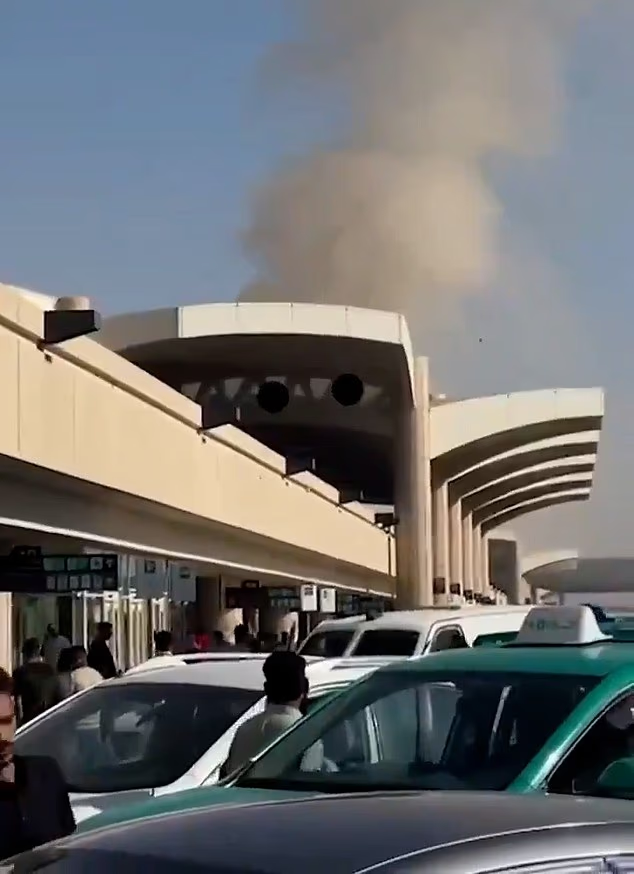
A Houthi missile attack on Riyadh airport has injured people and sparked a fire at a terminal, Saudi officials said, as Donald Trump indicated that the United States could join Saudi Arabia’s military action against the rebels.
The Saudi-led coalition said its air defences intercepted one projectile over the capital. Major General Turki al-Malki, the coalition spokesman, said another projectile struck Terminal 4 at King Khalid International Airport, causing a fire.
He added that a cruise missile had been “intercepted and destroyed” near the airport. The Houthis later claimed responsibility for the latest attack.
The incident came a day after missiles hit a passenger terminal at the airport, killing 13 people and injuring more than 300. Saudi authorities said some of the wounded were in a serious condition.
Flights were suspended and passengers were evacuated after the earlier strike, while operations were again halted following the latest incident. Foreign embassies warned their citizens to avoid the airport.
Trump considers joining Saudi strikes
Mr Trump said Washington would consider taking part in counter-attacks against the Houthis, who are backed by Iran.
Speaking outside the White House, he said: “We may. We’re going to look at it. We just found out about the recent attack, so we’ll make a decision. We move very quickly.”
He described the attacks in Saudi Arabia as “not acceptable” and said he planned to speak to Saudi Crown Prince Mohammed bin Salman.
Asked whether he had changed his mind about joining Saudi strikes on the group, Mr Trump said: “It’s not good… I’m not happy.”
Any direct US military involvement would risk widening the conflict, which has intensified since a four-year, UN-brokered truce in Yemen collapsed in July.
The Houthis warned passengers against using Saudi airports, saying in a statement that airports in the kingdom should be regarded as “potential targets and sites for operations by our forces”.
Military spokesman Yahya Saree urged people to “take our warnings seriously” and said Saudi Arabia bore responsibility for failing to intercept the missiles.
International condemnation
Saudi officials condemned the earlier airport strike as a “full-fledged war crime”. The coalition said the attack had targeted a civilian facility and killed passengers and airport staff.
US Secretary of State Marco Rubio said an unidentified American citizen was among those killed. He wrote that the United States “strongly condemns” the attacks and said they showed “a blatant disregard for innocent civilian life”.
“They must stop now,” Mr Rubio said, adding that Washington stood with Saudi Arabia and its people.
Defence Secretary Wes Streeting described the Houthi attacks as a “dangerous escalation” and said civilian sites in Saudi Arabia were being targeted with increasing frequency.
“This is completely contemptible action and it’s one of the reasons why the UK is providing support to Saudi Arabia in the form of air defences, but also air-to-air refuelling,” he told Sky News.
“We want to see an end to this conflict. It cannot be right that the Houthis are attacking civilian targets in this way.”
European Commission president Ursula von der Leyen also described the attacks as a “dangerous escalation”, saying they were pushing the region into “a spiral of violence”.
She called for an immediate end to attacks on civilians and said the European Union stood in “solidarity with Saudi Arabia”. Israeli Prime Minister Benjamin Netanyahu also condemned the airport strike.
Previous strikes at King Khalid airport
The latest incident followed two attacks earlier in the week that killed four people and damaged a Saudi passenger aircraft.
A missile on Thursday set fire to a Saudia Airlines plane parked at the terminal. The aircraft was believed to have been empty, but one of the airline’s captains was among three Saudi citizens killed in the attack. A Sudanese national died in a separate strike on Wednesday.
Saudia Group said the aircraft was damaged while on the ground and that no passengers were aboard. Debris from an intercepted missile also struck a school and a medical complex in Riyadh, according to Saudi officials.
The deadliest attack killed four Saudi citizens, including the airline captain, as well as nationals of Bangladesh, the United States, Egypt, Jordan, Syria, Palestine and Sudan. Two doctors said pilgrims travelling to Mecca were among the injured.
An eyewitness described seeing people wounded near the gates as passengers ran from the terminal. Health officials activated a mass call-up of doctors to respond to what a medical source called a “serious emergency situation”.
Saudi Arabia has led an international coalition supporting Yemen’s internationally recognised government since 2015. The Houthis say their attacks are retaliation for that support, while Saudi Arabia says it is assisting the government in reclaiming territory.
The rebels have recently seized parts of Yemen’s Red Sea coast, including areas near the Bab el-Mandeb Strait, although Saudi-backed forces have retaken some territory.
Several airlines suspended or cancelled services to Riyadh ahead of major energy and investment conferences due to be held in the capital. Organisers said the events would go ahead and sought to reassure attendees about security.
