


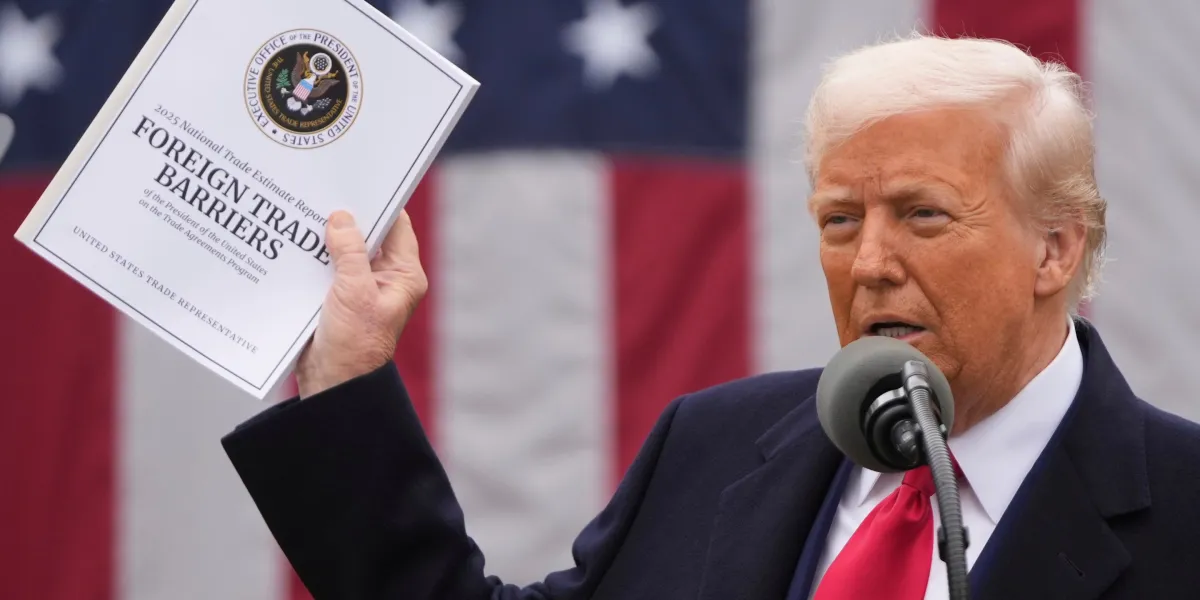
Donald Trump’s tariff policy is fuelling a backlash among workers in key battleground states, with factory closures, redundancies and higher costs threatening to damage Republican candidates in next month’s midterm elections.
The president had promised that taxes on imports would revive American manufacturing. But while the country has added some manufacturing jobs this year, the sector employs fewer people than it did when Mr Trump returned to the White House in January 2025.
In Michigan, former clockmaker Howard Miller employee Bert Vandermeer says the policy has cost him his livelihood. The 62-year-old lost his job as a product designer after the company closed its Zeeland factory, sold its inventory and brand name, and laid off nearly 200 workers after a century in business.
“So much for bringing jobs back,” Mr Vandermeer said. He plans to vote entirely Democrat in the midterms.
Howard Miller had already been struggling as demand for traditional grandfather and mantel clocks declined. It expanded into products including bar carts, cabinets and consoles, but those goods also relied on imported glass and other components.
“I could still have a job, but now I don’t because of tariffs,” Mr Vandermeer said. “It was like taking a knife to the back.”
Tariff backlash spreads across battleground states
Mr Vandermeer lives in Michigan’s 4th Congressional District, where Republican Bill Huizenga is seeking a ninth term. Before Mr Trump introduced his broadest tariffs last year, in what the president called “Liberation Day”, Mr Huizenga backed the policy.
“Is it going to be easy? Not necessarily. Is it the right thing to do? Absolutely it is,” he told reporters at the time.
A spokesman for Mr Huizenga said the congressman saw “a potential role for tariffs” in strengthening domestic manufacturing, while recognising their wider economic effects. His Democratic challenger, state senator Sean McCann, has criticised him for opposing legislation that would have limited tariffs imposed unilaterally by Mr Trump.
Similar concerns are emerging in competitive contests in Kansas, Iowa and Ohio, where Republicans are defending their support for the president’s trade policy as constituents deal with factory redundancies, farm foreclosures and rising prices.
In Iowa, Tracy Chew lost her job at a Case backhoe plant in Burlington in April. Her daughter was also made redundant, followed in the following weeks by her husband and son-in-law.
Ms Chew voted for Mr Trump in 2016, before backing Joe Biden in 2020 and Kamala Harris in 2024. She is leaning towards the Democrats again, saying she felt the president had let her family down.
“I’m furious he isn’t doing enough,” she said. “Tariffs are not targeting the right companies, the right amount.”
Winnebago Industries, which makes recreational vehicles such as campers, cut 200 jobs last year after the cost of imported aluminium, steel and electronics rose by tens of millions of dollars.
“It’s a day to day battle,” said Michael Happe, the company’s chief executive.
The pressure is also being felt in Kansas. Vornado Air, an appliance maker known for its retro-style household fans, made more than 70 factory workers redundant in February after imported parts became more expensive.
“Tariffs impacted virtually everything,” said Cole Hoppock, the company’s chief executive.
Mr Trump has also threatened to bar Canadian aircraft manufacturer Bombardier from selling planes in the United States unless it begins making all of them domestically. Bombardier has said it buys parts from 2,800 companies across 47 states, including Kansas, where it employs more than 1,000 people.
Americans turn against Trump’s trade policy
The political threat comes as public approval of Mr Trump’s approach to trade has fallen. A September poll by the Associated Press-NORC Center for Public Affairs Research found that about three in ten American adults approved of his handling of trade negotiations, down from four in ten in March.
Mr Trump has long argued that other countries take advantage of the United States in trade. Most economists disagree with that assessment and say broad, universal tariffs could cause more harm than benefit.
His policy has also been criticised as inconsistent. He imposed tariffs on Brazil amid political disagreements and raised duties on China to levels that risked recession before retreating. The Supreme Court ruled in February against his use of an emergency declaration to introduce the “Liberation Day” tariffs, leaving the administration to continue adjusting its levies and threats.
Tariffs are not the sole cause of manufacturing job losses, with factories having reduced their workforces for decades. Some Republicans who oppose Mr Trump’s approach are nevertheless expected to remain loyal to the party.
In South Carolina, Bicycle Corporation of America blamed rising prices for imported parts when it closed its factory last year. Koby Bird, who retired from the company’s quality-control department, supports tariffs but was frustrated by the president’s repeated changes.
“It was all over the place,” Mr Bird said. “Businesses couldn’t plan.”
He is still likely to vote Republican, including for Senator Darline Graham, because tariffs are only one issue and he believes Democrats would spend too much money on the wrong priorities.
Ernie Goss, an economist at Creighton University in Nebraska, said manufacturing difficulties might not translate into Democratic victories. Some voters, he said, may still believe “the tariffs in the long run will work”.
Union leaders report growing worker frustration
Wendell Young, a union leader in Pennsylvania, said he had noticed a change among workers in communities affected by factory layoffs.
Last summer, he received a barrage of angry replies after blaming tariffs for Post Holdings’ decision to cut 160 jobs at a pet-food factory in Bloomsburg. One worker wrote: “Keep politics out of this. President Trump isn’t the reason.”
But Mr Young, president of Local 1776 of the United Food and Commercial Workers International Union, said the criticism had since subsided.
“People used to beat me up for not supporting Trump. I haven’t heard that in a year,” he said. “Some of these people are red Republicans and they are shocked. They expected more jobs.”
Post Holdings eventually reduced its headcount by offering severance packages to workers who left. Lower production then affected Trivium Packaging, a local can manufacturer that received fewer orders from Post and other companies, according to Mr Young’s union.
Heather Kingston, a former Trivium employee, said she understood the reasoning behind tariffs but was unconvinced by the results. She left for another company before the redundancies, while her husband remains at Trivium.
“I understand the mindset behind tariffs, but I just don’t know if it’s working,” she said. “There doesn’t seem to be many manufacturing jobs moving into the area.”
Ms Kingston voted for Republican Dan Meuser in the last election but is now having doubts. Mr Meuser’s seat is considered safe, although nearby contests in Pennsylvania’s 7th and 8th districts are more competitive.
The disputes leave Republican candidates attempting to defend a policy that was intended to deliver a manufacturing revival, while voters in industrial communities confront job losses and higher costs.
