


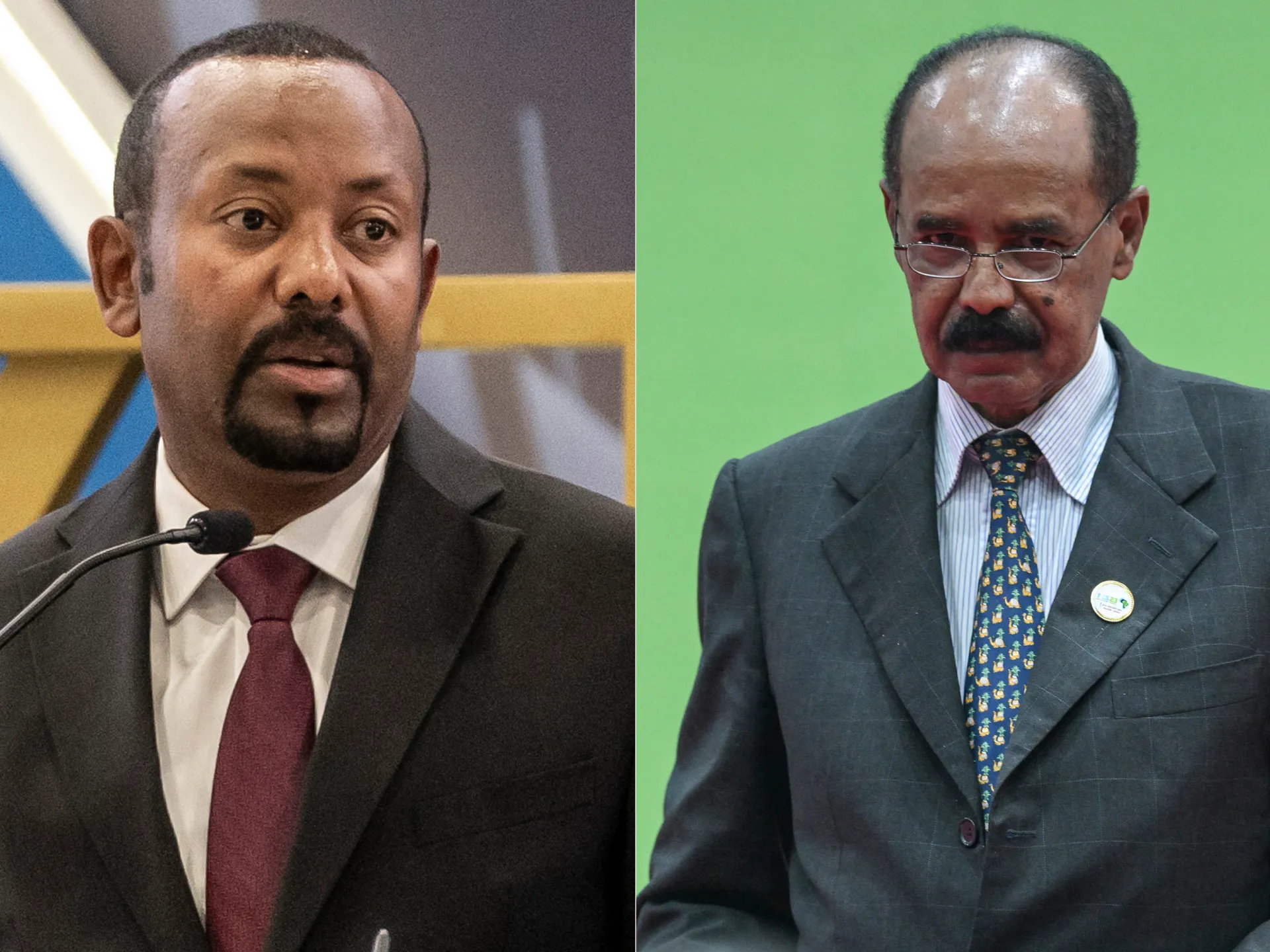
Ethiopia and Eritrea tensions have escalated into a dangerous military confrontation, with both countries accusing the other of aggression as fighting spreads across Ethiopia’s northern Tigray region.
Ethiopia has told the United Nations Security Council that Eritrean troops advanced up to 60km into Tigray, describing the alleged incursion as a violation of its sovereignty. Eritrea has rejected the claim, accusing Addis Ababa of using it to justify an offensive.
In a letter to the council, Ethiopian Foreign Minister Gedion Timothewos called the alleged operation “a blatant act of aggression that engages Ethiopia’s inherent right to self-defence”. He invoked Article 51 of the UN Charter but did not say what measures Ethiopia was taking.
Eritrea’s Foreign Minister Osman Saleh responded by urging the council to condemn what he called Ethiopia’s “deplorable declaration of war” and to take “deterrent measures”. He warned that an Ethiopian offensive would bring “huge devastation to the peoples of both countries and destabilise the whole region”.
Ethiopia and Eritrea tensions deepen as fighting reaches Tigray
The diplomatic dispute comes after a rebel alliance including the Tigray People’s Liberation Front launched attacks on Ethiopian government forces across Tigray, Amhara and Afar on September 23.
The rebels seized Tigray’s capital, Mekelle, and its airport before announcing their withdrawal on October 3. Government-allied forces subsequently entered the city.
Government and allied forces have since reported taking Idaga Hamus and Abiy-Adi, in the Tembien area. Residents also said the two locations had come under government-allied control, although it was unclear who held them immediately before the reported advances.
There have also been reports of Eritrean personnel entering Adigrat, a strategic city about 30km from the Eritrean border. Footage showed government-allied militia members moving through the city, while other images showed Ethiopian military vehicles entering it.
Explosions and alleged drone strikes have been reported near Adigrat. Eritrean involvement in the fighting has not been independently established, although the conflict monitor ACLED reported that Eritrean troops crossed into Ethiopia near Zalambessa and came under Ethiopian drone attack while advancing towards Idaga Hamus.
Addis Ababa accuses Asmara of financing, arming and directing armed groups, as well as deploying troops in Tigray. Eritrea denies the allegations.
The renewed violence threatens the peace agreement signed in November 2022, which ended major hostilities between Prime Minister Abiy Ahmed’s government and Tigray rebels. Eritrea was not a party to that agreement.
Eritrea fought alongside Ethiopian federal forces during the 2020-2022 Tigray war against the TPLF, its longstanding adversary. That conflict followed months of tensions between Mr Abiy’s government and the TPLF, which had dominated Ethiopian politics for almost three decades before he came to power in 2018.
The war killed hundreds of thousands of people and was accompanied by allegations of massacres, sexual violence and widespread hunger. Although Ethiopia and Eritrea briefly became allies, relations have deteriorated since the peace deal.
Dispute over Red Sea access adds to risk of wider war
The confrontation extends beyond the fighting in Tigray. Landlocked Ethiopia has repeatedly said that securing direct access to the Red Sea is essential, while Eritrea fears that Addis Ababa wants to seize its port of Assab.
Mr Abiy reiterated on Monday that Ethiopia must have access to the Red Sea. Analysts say the dispute over the coast is now intertwined with security concerns and the countries’ unresolved hostility.
Hossamaldeen Ibrahim, an analyst at the Bloomsbury Intelligence and Security Institute, said the accounts presented by both sides contained “verifiable elements”. But he warned that each government was treating the other’s narrative as an existential threat.
Professor Matthias Rompel, of the Institute of Sociology at Justus-Liebig University Giessen, said both sides had legitimate security concerns, while stressing that the allegations about Eritrean military incursions and the scale of Asmara’s involvement remained difficult to verify independently.
He said the crisis was no longer solely about Tigray, with Ethiopia’s pursuit of Red Sea access, Eritrea’s concerns over sovereignty and Egypt’s strategic rivalry with Ethiopia over the Nile now connected. The consequences, he warned, could extend to Sudan, Somalia and security in the Red Sea.
Analysts have said the two countries may have moved beyond a war of words. Mr Ibrahim described the situation as a “high-risk phase of limited but direct military confrontation with a real possibility of rapid escalation into interstate war”.
He said the severing of diplomatic ties had removed the “last formal mechanism for crisis management”, while Ethiopian military advances towards the Eritrean border increased the danger of miscalculation.
Tom Gardner, a correspondent for The Economist, said the present crisis should be viewed against decades of hostility between the neighbours. Their alliance during the Tigray war, he said, had been an exception driven by their shared opposition to the TPLF.
Professor Rompel said a wider conflict was not inevitable, but that the room for diplomatic de-escalation was rapidly narrowing. The immediate danger, he said, was that mistrust, military miscalculations and domestic political pressures could set off an escalation neither government could control.
