


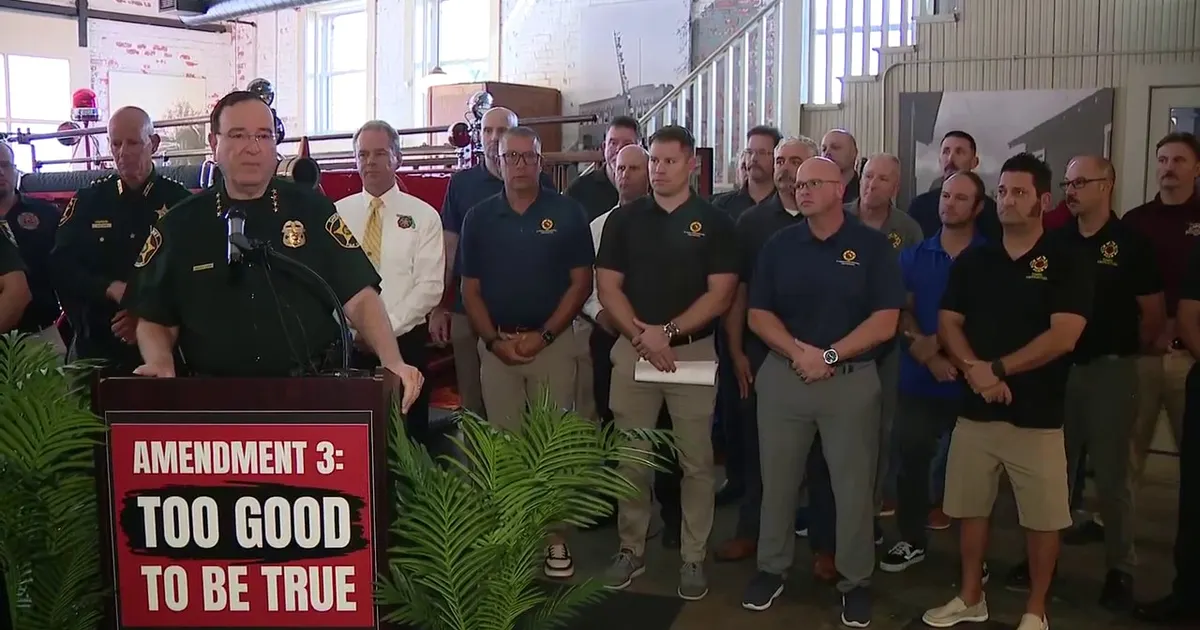
Florida’s top public safety officials have warned that a proposed property tax overhaul could leave local authorities struggling to maintain police, fire and emergency medical services as the state’s population continues to grow.
Polk County Sheriff Grady Judd joined fire chiefs, police chiefs and firefighters at the Tampa Firefighters Museum on Monday to oppose Amendment 3, which voters will consider on November 3. The measure would increase the homestead exemption for non-school property taxes while reducing the revenue available to counties and municipalities.
“Amendment 3 is the wrong solution to the right issue,” Judd said, arguing that Florida should provide relief to homeowners without placing essential services at risk.
Florida Amendment 3 and emergency services
Under the proposal, the homestead exemption would rise from $50,000 to $150,000 in 2027 and to $250,000 in 2028. The measure would also reduce the annual limit on increases in assessed values for non-residential properties from 10% to 5%.
School property taxes would not be affected. However, the changes would reduce the property tax income collected by local governments, which use the money to support services including law enforcement, fire rescue, roads, drainage and emergency preparedness.
The amendment sets out categories for the use of remaining property tax revenue, including public safety, education, infrastructure, natural resources, debt obligations, pensions and government administration. Opponents say it does not guarantee a minimum level of funding for police, firefighters or emergency medical services.
Judd said the proposal offered no clear plan for replacing the lost income. He described it as “too good to be true” and said the effects could extend beyond emergency response to parks, mosquito control, hurricane preparation, social programmes, jails and road repairs.
“You cannot cut billions of dollars out of this state budget and not think fire services, law enforcement services, county jails, parks and recreation, stormwater mitigation, and all other road repairs and local services won’t be affected,” he said.
Firefighters warn of rising costs
Wayne “Bernie” Bernoska, president of Florida Professional Firefighters, said his organisation supported tax relief but insisted that emergency services needed predictable funding to respond when residents called for help.
“The cost of public safety doesn’t disappear just because funding does,” Bernoska said.
Fire Chief Trip Barrs said the cost of protective clothing and other essential equipment had risen by as much as 70% over the past five years. A standard fire engine now costs about $1 million, he said, while growing communities require more personnel, stations and vehicles.
He said local authorities needed to distinguish between unnecessary expenditure and the unavoidable cost of delivering public services, warning that greater efficiency alone could not offset inflation.
Michael Lewis, a trustee for Florida Professional Firefighters, said residents calling 911 were concerned with how quickly assistance arrived rather than with the details of local government budgets.
“We need the funding and equipment to answer your call for help,” Lewis said. “Response times matter because people matter.”
Public safety leaders said smaller communities could face particular difficulties if they were forced to make up the shortfall through cuts or alternative charges. They argued that emergency services could not simply be reduced to balance local budgets.
Supporters say local leaders can find efficiencies
Supporters of Amendment 3 say homeowners need meaningful property tax relief and that local governments should look for savings and alternative ways to fund essential services.
Margy Grant of the Florida Realtors Association said she had confidence elected officials would implement the changes effectively. State Representative Toby Overdorf, a Republican from Stuart who helped advance the measure, said some counties were already considering different ways to fund sheriffs’ offices.
“I think long term, if in fact this does pass, the sheriffs will be just fine,” Overdorf said.
Miami-Dade Sheriff Rosie Cordero-Stutz has also said local governments could identify efficiencies while maintaining public safety. Pinellas County Sheriff Bob Gualtieri, however, has expressed concerns similar to Judd’s about the impact on local budgets.
Judd said Polk County had gained about 150,000 residents in five years, increasing demand on its emergency services. He questioned whether departments would be able to keep pace with further growth if their main source of local revenue was reduced.
He also argued that the amendment could affect renters and first-time buyers. Renters would not receive the larger homestead exemption, while changes to the cost of rental properties could feed through into housing costs. Judd further cited a possible 7% to 9% rise in Florida home values if the measure passed, although the effect would depend on how property owners and the wider housing market responded.
Amendment 3 will take effect on January 1, 2027, if approved by at least 60% of voters. The first increase in the homestead exemption would apply to 2027 taxes, with the full $250,000 exemption due to apply from 2028.
