


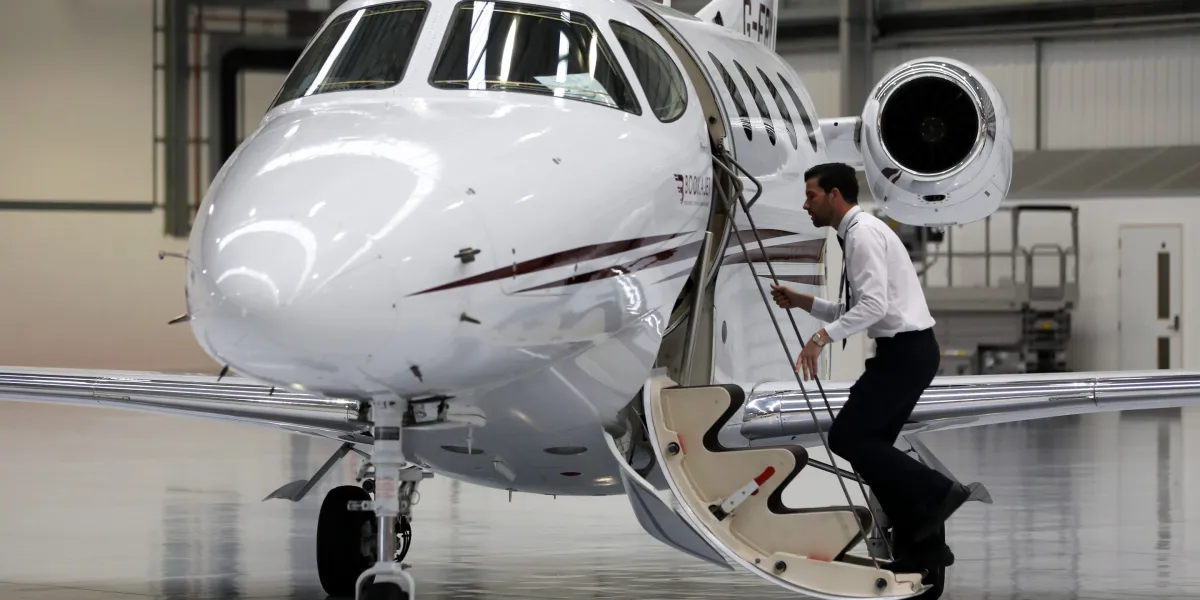
Private jet tax breaks and publicly funded aviation infrastructure amount to a taxpayer subsidy for a tiny group of ultra-wealthy owners, according to a report by the Institute for Policy Studies (IPS).
Commercial passengers pay a 7.5% federal tax on every air fare, while non-commercial private aircraft account for about 7% of flights handled by the Federal Aviation Administration but contribute only 0.6% of the taxes supporting it, figures from the Department of Transportation show.
The IPS estimates that about 256,000 people benefit from the arrangements. Together, the group holds $31 trillion in wealth, it said, while receiving advantages through aircraft tax deductions, state sales-tax exemptions and infrastructure funded by taxpayers.
“Those are the menu of ways in which we all chip in for private jet travel,” said Chuck Collins, co-author of the report and director of the Program on Inequality and the Common Good at IPS. “We all subsidize this tiny segment of the ultra rich and their transportation.”
Private jet purchases bring major tax deductions
Global private jet sales reached $40.3 billion in 2025, according to the report, having risen by almost 24% over five years. IPS said the expansion had been helped by tax advantages despite the pandemic, inflation and high oil prices.
Last year, Donald Trump’s One Big Beautiful Bill Act restored 100% bonus depreciation for qualifying business assets, including private aircraft. Eligible buyers can therefore deduct the full cost of a jet in the year it enters service, rather than spreading the deduction over several years.
Justin Crabbe, chief executive of private jet marketplace Jettly, said some companies were buying aircraft costing $75 million in order to reduce their tax obligations, even when they did not need to fly them.
“We get a lot of people and inquiries [from] people that don’t even need the aircraft,” Mr Crabbe said. He said buyers could place the aircraft into charter service, allowing it to generate revenue and support a claim that it was being used for business.
IPS calculated that the first-year deduction on a $40 million jet could reduce a buyer’s federal tax bill by as much as $14.8 million at a 37% tax rate. The precise benefit would depend on factors including taxable income and the extent of business use, while the report said it could not calculate the total federal revenue lost through the provision.
Eight states, including Alaska, Oregon and New Hampshire, which do not have a general sales tax, and New York and Massachusetts, which do, offer full or near-total sales-tax exemptions on private aircraft purchases, IPS said.
In Massachusetts, the aircraft exemption is expected to cost the state $25.3 million this year, according to the Massachusetts Budget and Policy Center. A bill seeking to repeal it was introduced last year by state senator Michael J Barrett and is being reviewed by the legislature’s revenue committee.
“The bicycle buyers of America are not a powerful lobby, so you have to pay sales tax, and you don’t get to depreciate your bicycle in one year,” Mr Collins said.
Private aviation groups defend favourable treatment
The National Business Aviation Association (NBAA), which represents 10,000 private aviation companies and professionals, and other industry groups argue that tax breaks support jobs. The IPS report said the NBAA and other aviation organisations spent a combined $3.4 million lobbying in 2024 and 2025, as Congress restored the 100% depreciation allowance.
The trade group has also opposed state taxes on private aircraft. In Washington, it campaigned against a 10% luxury tax on aircraft worth more than $500,000 that passed in May 2025. A bill repealing the measure became law before the tax took effect.
During an earlier debate in Massachusetts, the NBAA warned that applying the state’s 6.25% sales tax to aircraft would put it at a competitive disadvantage, potentially driving general aviation to neighbouring states.
A House version of the pending ALERT Act would prevent state and local authorities from using aircraft-tracking data to identify and tax private jets. The Senate version does not contain the provision, with lawmakers seeking to pass the air-safety legislation before the midterm elections.
Taxpayer-funded airports and air traffic systems
The report also examined the role of public spending. Of nearly $7.6 billion in federal Airport Infrastructure Grants awarded by August, about $1.3 billion went to smaller airports with little or no scheduled passenger service, which mostly serve private jets and other general aviation, IPS said.
More than $1.1 billion of the grants funded projects judged to have a strong likelihood of benefiting private aircraft, including hangars and runway improvements.
Private jet owners pay fuel taxes and landing charges, but Mr Crabbe said their aircraft still rely on the same air traffic and airport infrastructure used by commercial airlines. Commercial passengers help fund the system through taxes on their tickets.
“The controller has to work for the same aircraft that’s flying in with 400 people on board [as] it does an aircraft with nobody on board,” Mr Crabbe said, estimating that about half of private flights involve an empty aircraft.
“The taxpayers are paying for these planes to be supported while they’re flying empty more often than not.”
