


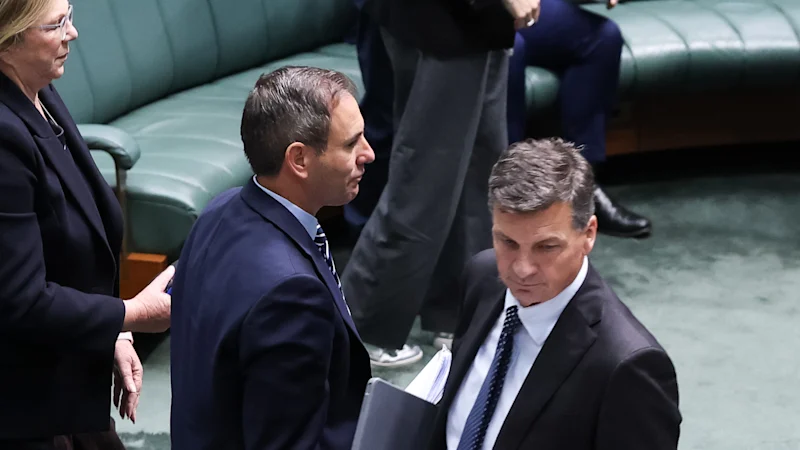
Opposition Leader Angus Taylor has accused the Australian government of facing an $83 billion budget black hole after Treasury forecasts raised fresh doubts about Labor’s promise to return the budget to surplus by the middle of the next decade.
Treasurer Jim Chalmers said he had not “necessarily” abandoned the goal of balancing the budget, despite a long-term economic forecast pointing to higher taxes and debt if productivity remained unchanged.
The dispute follows the release of the Intergenerational Report, which sets out a 40-year projection of Australia’s economic and fiscal outlook. Its publication has intensified a debate over tax policy as Labor and the Coalition prepare for a likely election contest.
The May budget forecast a return to surplus in 2035, based on savings from the National Disability Insurance Scheme, reductions to property and superannuation tax concessions, and increasing income tax receipts as workers move into higher tax brackets.
However, the new report introduced a hypothetical cap on taxation from 2032-33. The cap, set at 24.2 per cent of gross domestic product, assumes future governments would probably reduce income taxes.
Mr Taylor said the difference between the May budget’s 10-year tax projections and the figures implied by the report amounted to an $83 billion gap.
“Four months ago Australians were given one set of budget numbers. The government’s own Intergenerational Report now shows a very different picture,” Mr Taylor said.
He said it was unusual for the report to create uncertainty around the government’s 10-year forecasts by imposing a tax limit six years from now. The previous report, published in 2023, had placed the end of its 10-year forecast at that point instead.
The opposition leader also accused Labor of adopting a position similar to the Coalition’s proposal to address bracket creep by linking tax thresholds to inflation, after previously criticising that policy. Labor had accused Mr Taylor of creating a $12.5 billion budget hole when the Coalition announced its plan in May.
Chalmers defends Labor’s budget position
Mr Chalmers said the government had made difficult decisions to increase taxation on capital, including changes to negative gearing and the capital gains discount, allowing it to reduce its reliance on income tax.
“Governments of both political persuasions, whenever they can afford to do that, return as much bracket creep as they can,” the Treasurer said.
Asked whether Labor had given up on returning the budget to surplus, Mr Chalmers replied: “No, not necessarily.”
He said the government was facing significant fiscal pressures from an ageing population and other economic demands, but maintained that Australia’s budget position was stronger than those of other countries.
The debate comes as Reserve Bank governor Michele Bullock warns that inflation could become entrenched. She described the Intergenerational Report as a call for politicians and business leaders to concentrate on economic growth, while saying unemployment might need to rise to bring inflation under control.
