


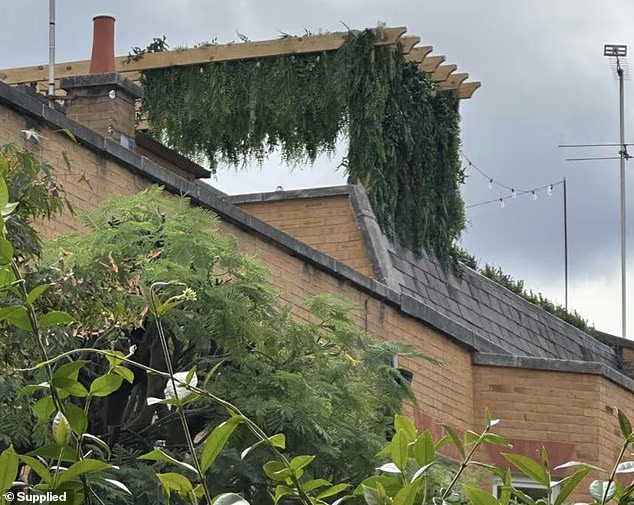
A rooftop pergola installed at the £3 million west London home of planning barrister Charlie Banner KC has triggered a dispute with neighbours, who say the timber structure was erected without permission and blocks light from their properties.
The structure appeared in July above the Victorian mews house in Kensington, shared by Lord Banner, his wife Tetyana Nesterchuk and their two children. Draped with artificial greenery and festoon lights, it was designed to provide shade on the family’s roof terrace.
However, the townhouse is in a conservation area and a complaint was made to the Royal Borough of Kensington and Chelsea. A council planning officer subsequently told the couple the pergola was regarded as “unpermitted” and warned that enforcement action could follow if consent was found to be necessary.
Ms Nesterchuk has since submitted a retrospective planning application. Those close to the family say it was made “out of an abundance of caution and to preserve goodwill”, while the couple and their advisers maintain that the structure did not require planning permission.
Neighbours object to Kensington pergola
One of the most vocal objectors is a first-time mother with a six-month-old baby. In a written objection, she said the pergola “dominates every view across all our floors” and argued that its impact on neighbouring homes and the streetscape should not be overlooked simply because retrospective applications are legally permitted.
She said the wooden structure could be seen from every front window of her three-storey home, blocked morning light and caused the artificial foliage to replace the view of the sky from her baby’s room.
“I was in such a blur after having the baby, but one day noticed they had put up this wooden structure – and it keeps getting bigger with more parts added,” she said.
“You can see it from every front window on all three floors. It’s always there. It blocks light from coming into our rooms, especially in the morning.”
The neighbour also complained that lights attached to the pergola glare against a screen while she is watching television. She said she was concerned the application might be approved because of Lord Banner’s status.
Lord Banner and Ms Nesterchuk deny acting improperly. A source close to the family described the objection as a “revenge operation” containing what they called “demonstrable untruths”, while another source characterised the wider opposition as “vexatious” and “classic nimbyism”.
Other objections submitted to the council described the pergola as “large, dense and visually dominant”, with one resident saying its effect was felt “continuously from inside our home, not only from the street”. Another warned that allowing it to remain would create a “dreadful precedent”.
A further resident raised concerns about the risk of fire spreading between rooftops because of the artificial foliage. The greenery is understood to be made from fire-retardant material.
Supporters say the structure provides shade
The application has also attracted support. At the time of writing, 12 letters backing the pergola had been submitted, including three signed by people described as the occupiers of nearby addresses. One household named in the documents later said it had not sent an objection or support letter and was unaware that the pergola existed.
One supporter told the council that high-quality pergolas on terraces were in the neighbourhood’s interests because they provided much-needed shade during increasingly hot summers.
Another resident said they had inspected the structure and believed it complemented the roof terrace and made it more usable. A third described the greenery as “very attractive and of high quality”, adding that hot summers and future climate predictions created a need for shade.
Planning documents submitted on Ms Nesterchuk’s behalf say the pergola was installed principally to provide shade for the permitted roof terrace.
A source close to the family said the couple’s view, supported by their professional advisers, was that the pergola did not require planning permission, in line with other fencing and shading equipment on nearby roof terraces.
“When the council nonetheless asked that permission be applied for, this was promptly done out of an abundance of caution and to maintain goodwill,” the source said.
The source added that no enforcement action had been taken and claimed there were “by a considerable order of magnitude” more supporters than objectors, while the council considered the application.
The dispute has drawn particular attention because Lord Banner is a leading specialist in planning law. He was voted Britain’s top planning KC in the 2025 and 2026 editions of Planning Magazine’s annual legal survey and has worked on major cases including HS2 and the expansion of Heathrow.
Ms Nesterchuk is a commercial lawyer who was previously named among the UK’s top 100 barristers. The couple have both been sanctioned by the Kremlin over their advocacy for Ukraine.
Lord Banner, a friend of former prime minister Rishi Sunak, entered the House of Lords in 2022 after being nominated by Mr Sunak, with whom he attended Oxford University.
The Royal Borough of Kensington and Chelsea said: “We can confirm an application for retrospective permission has been received and we are currently consulting with neighbouring residents before a decision is made.”
