


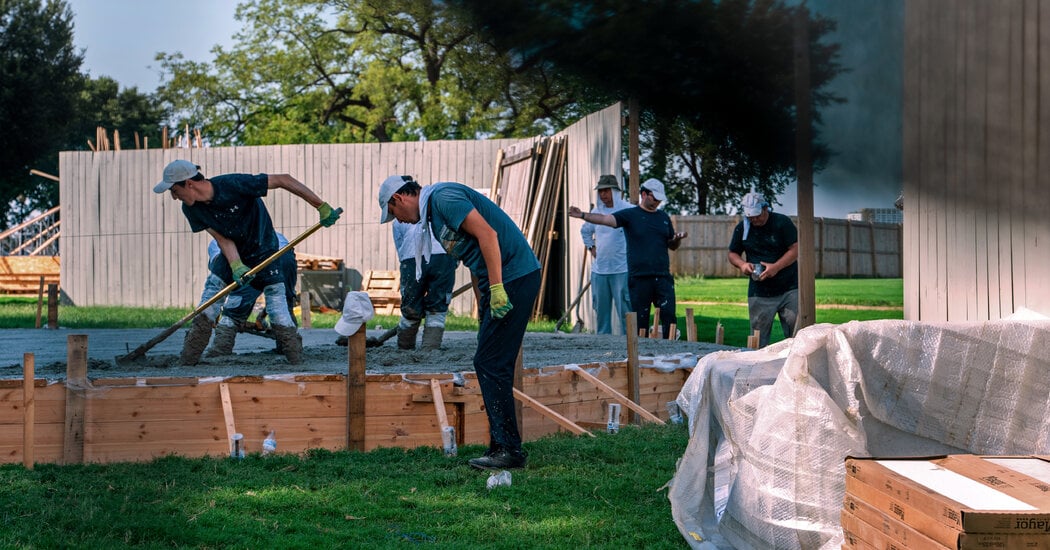
Construction work has begun on two Uzbekistani gazebos at a Washington park earmarked for Donald Trump’s proposed Garden of American Heroes, raising fresh questions over the administration’s claim that the controversial memorial remains only an idea.
Workers were seen smoothing newly poured concrete on Wednesday at West Potomac Park, on the edge of the National Mall, where the government of Uzbekistan has donated the structures, known as aywans.
Uzbekistan’s ambassador in Washington has said the gazebos will become part of the proposed garden, which Mr Trump wants to fill with 250 statues of notable Americans. The project is the subject of a federal lawsuit and still requires design and congressional approval.
The Interior Department, which oversees the park, declined to say whether the installation was temporary or represented the first physical step towards the garden. Its spokeswoman, Katie Martin, said only that the aywans would be “exhibited at West Potomac Park to celebrate the strong bond between the United States and Uzbekistan”.
The Uzbek embassy did not respond to questions about the gift or its intended duration. The uncertainty is significant because the administration has argued in court that the garden cannot yet be challenged, describing it as “only an idea by the executive branch”.
Trump’s Garden of American Heroes faces legal challenge
West Potomac Park lies within the National Mall Reserve, an area subject to some of the strictest controls on new construction in Washington. Congress declared the reserve in 2003 to be a substantially completed work of civic art, and new memorials and structures generally require congressional consent.
Six preservation and cultural organisations sued the administration in June, arguing that the garden cannot proceed without approval from Congress and further review. The National Parks Conservation Association, the DC Preservation League and other groups say the plan would transform protected public space used for recreation.
Federal court records show that judges have been examining what work, planning and communications have already taken place, despite government arguments that no final project has been authorised.
Samuel Bagenstos, a University of Michigan law professor and former Biden administration official, said there was no single rule determining when an agency had moved from considering a proposal to taking formal action. But he said the government could not repeatedly argue that a challenge was premature until the opportunity to intervene had passed.
“It can’t be the case that an agency can say: ‘Look, it’s too soon, it’s too soon, it’s too soon, it’s too soon. It’s too late!’” he said.
The dispute has been sharpened by the administration’s handling of other Washington projects, including the demolition of the White House’s East Wing for a proposed ballroom. Preservation campaigners say that episode has made them less willing to accept assurances that visible work is unrelated to a larger construction plan.
Rebecca Miller, executive director of the DC Preservation League, said: “The public was told that the East Wing would not be touched, and then it was bulldozed. It’s very much a ‘fool me once’ type of attitude now.”
The Trump administration has already secured millions of dollars for the garden through federal cultural agencies, while Congress last year appropriated $40 million for the procurement of statues. Critics argue that funding for statues does not amount to formal authorisation for a memorial complex on the National Mall.
