


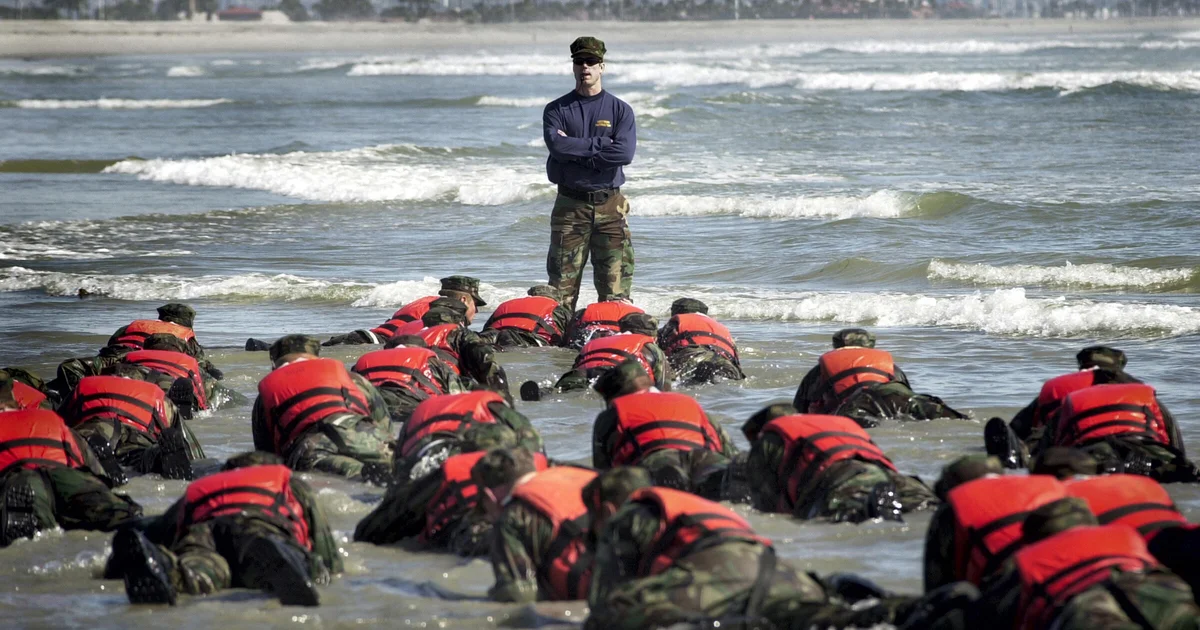
Two women attempting to become US Navy SEALs have advanced further through the training pipeline than any woman before them, but neither completed the course at Naval Amphibious Base Coronado in California.
The candidates, an enlisted sailor and a naval officer, reached the third week of Basic Underwater Demolition/SEAL (BUD/S) training. The officer was moved into the following class before asking to leave, while the enlisted sailor was medically withdrawn during Hell Week.
Their progress marked the furthest point reached by any woman to have attempted the SEAL course since women were allowed to apply for special operations roles in 2016.
The names of the two candidates have not been disclosed for security and privacy reasons.
The demands of Navy SEAL training
Hell Week begins in the fourth week of training and is regarded as one of the most physically and mentally demanding stages of the initial course, which lasts about six months.
Candidates begin in the middle of the night and receive roughly four hours of sleep over five days. They are required to carry logs, launch boats into heavy waves, remain in cold ocean water and run about 200 miles.
Reaching Hell Week is itself a significant achievement. Navy data covering 1998 to 2023 shows that about 45% of candidates are removed from training or moved into a later class during the first three weeks.
Across the full training pipeline, about 68% of candidates were removed or rolled back at some stage. The highest rate of attrition came during the seven-week first phase, which includes Hell Week, when 66% of candidates left or were moved to another class.
Nearly 29% of candidates voluntarily withdrew before Hell Week. A further 21% left during Hell Week because they asked to leave or faced medical or performance issues, meaning almost four in five of those who started it completed the week.
Attrition is lower in the later stages of the course, with 5% leaving during the combat-diving phase and 3% during the land-warfare phase. Fewer than 1% leave during the final six-month SEAL Qualification Training course.
A spokesperson for Naval Special Warfare Command said: “To protect the integrity of NSW Center courses and the privacy of its candidates, we don’t discuss the details of any individual selection or non-selection status or where they are in the training pipeline.”
Women in US special operations
Women have served alongside US special operations forces for decades, including intelligence and supply-drop roles during the Second World War. Restrictions on women’s military assignments were progressively removed before the Pentagon opened all combat positions to women in 2016.
Since then, women have joined infantry, armour and artillery units, although comparatively few have attempted the selection and training programmes for elite special operations roles.
In 2021, a sailor became the first woman to graduate from the Naval Special Warfare training pipeline as a Special Warfare Combat Crewman. SWCC personnel operate high-speed, heavily armed boats used to transport SEALs into and out of hostile territory.
Women have also completed other demanding special operations programmes. In 2020, a National Guard soldier became the second woman to finish the Army’s Special Forces Qualification Course and join a Green Beret team. Fewer than a dozen women have earned the Green Beret, while fewer than a dozen have joined the Army’s 75th Ranger Regiment.
The latest candidates faced criticism on social media from some former SEALs and military-focused accounts as they progressed through the early stages of BUD/S.
Defence Secretary Pete Hegseth has questioned whether women should serve in ground combat and special operations roles, while saying during his confirmation hearing that women would retain access to ground combat positions if standards remained high.
Hailey Gibbons, a former Army Ranger, said standards for special operations had not been lowered to admit women. “When he’s saying that the standards have changed and that people have lowered standards to allow women into their formations, it’s absolutely a lie because no brigade commander would sign off on that,” she said.
