


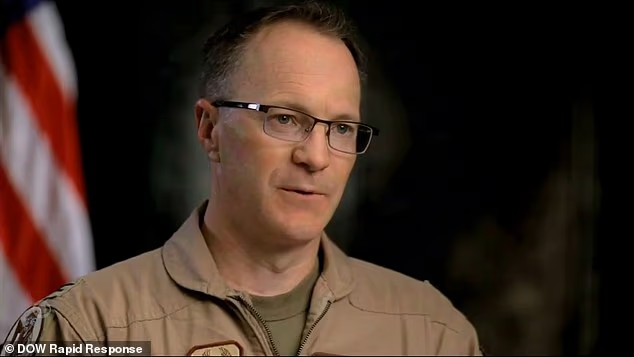
A US Air Force colonel has described surviving 50 hours behind enemy lines in Iran after his F-15E Strike Eagle was shot down and his parachute failed to open properly.
The weapons systems officer, known only by the callsign “Dude 44 Bravo”, was rescued after hiding on a 7,000ft ridgeline while Iranian forces searched for him. He suffered a broken back, arm and shoulder, as well as a sprained ankle.
Bravo was flying in the rear seat of the fighter jet with a pilot known as “Alpha” on April 2, during a mission targeting industrial facilities linked to Iran’s drone and missile programme, according to Admiral Brad Cooper, commander of US Central Command.
As the aircraft flew south of Isfahan, it was hit by a shoulder-fired missile. Bravo compared the impact to “getting hit by a freight train”.
The crew initially tried to save the aircraft, but quickly realised it could not be recovered and ejected. Alpha landed safely, while Bravo discovered that the attack had damaged his parachute.
“At one point, when I looked up and saw no parachute, that was the most terrifying thing I’ve ever seen,” Bravo said, becoming emotional as he recalled the moment.
“So I paused right then and I prayed, ‘Lord your will be done. But I’m getting through this.’”
He fell to the ground at an estimated 70 to 100mph. Despite his injuries, he moved away from the landing site and, after daylight revealed a valley surrounded by cliffs, decided that higher ground offered the best chance of avoiding Iranian forces.
Bravo climbed towards the ridgeline while injured, telling himself to “never let a lack of motivation put you on Iranian TV”. Iranian forces and armed groups were searching the area, with some coming within a few hundred metres of his hiding place, US military sources said.
The rescue mission in Iran
In the United States, Defence Secretary Pete Hegseth was woken after the crash. He said his immediate concerns were whether the crew had survived and whether Iran knew what had happened.
“Whether they’re alive or not, we’re going to get them,” Mr Hegseth said.
US forces rescued Alpha in a daytime operation after six hours, with American helicopters coming under fire. Mr Hegseth described it as “a gun fight all the way in and all the way out”, but the crews were unable to locate Bravo and withdrew.
That night, Bravo sent a message to the United States saying “God is good” and alerted the military that he was injured but moving. A rescue operation could not be launched immediately, leaving him to spend another day exposed to wind and cold in the high mountain desert with almost no food or water.
The CIA mounted a deception campaign to confuse Iranian forces while using classified technology to identify his position. Before the next rescue attempt, US bombers and drones attacked Iranian Revolutionary Guard forces near the ridgeline.
More than 90 US soldiers were then sent into Iran, in what General Dan Caine described as the first American boots on the ground there in 46 years. Several hundred personnel took part from the air, supported by several thousand others.
Rescue aircraft landed on a makeshift desert airstrip while Little Bird helicopters reached Bravo several miles away. He said seeing the rescuers approach was “one of the greatest moments of my life”.
The operation remained dangerous after the landing gear of the rescue planes became stuck in the sand, leaving more than 90 elite service members stranded. A clandestine Air Force unit eventually destroyed the two aircraft, each valued at about 100 million dollars, along with the helicopters to prevent their technology falling into Iranian hands.
Bravo was finally brought to safety around 50 hours after the fighter jet was shot down. After leaving Iran, he called his wife and said he was “really proud of her and grateful for the strength that she showed”.
He said the mission demonstrated “the teamwork, the training, of the faith, of the decisions and the leadership to do something that will live in history as an example of what America’s willing to do, in order to uphold our promise and leave no man behind”.
