


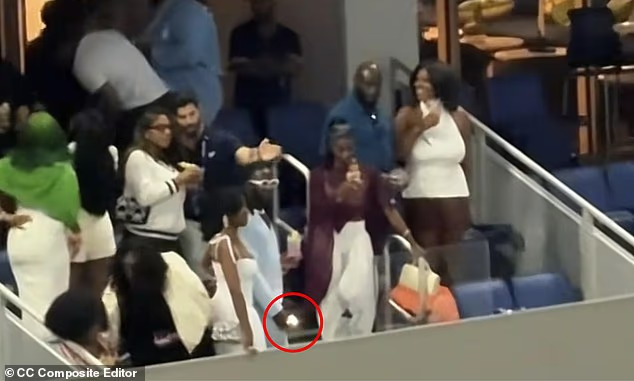
A group of influencers using portable lights for photographs during Naomi Osaka’s match has intensified concerns that the US Open’s growing social-media culture is beginning to disrupt the tennis itself.
Play was briefly interrupted at Arthur Ashe Stadium on Monday night when spectators in a luxury suite moved around and staged an impromptu photoshoot as Osaka prepared to serve against Anastasia Zakharova.
Chair umpire Kader Nouni addressed the group over the stadium loudspeaker, saying: “Guys, please, in the suite behind me, please thank you guys, please take your seat.” The incident was captured by the television cameras, showing people posing while a bright portable light was being used.
The episode prompted a sharp response from American player Jessica Pegula, who said the behaviour appeared disrespectful to athletes competing in one of the sport’s biggest events.
“People are down there trying to perform, and it’s their career and their job. It seems like a bit disrespectful,” Pegula said after her own match on Ashe. “I think it’s gotten a little too much, it feels, this year.”
The controversy comes as the New York tournament continues to promote itself as more than a tennis championship, combining sport with fashion, hospitality, celebrity appearances and digital content.
The United States Tennis Association has approved credentials for close to 100 content creators at this year’s event, almost twice the 54 granted when its creator programme began in 2025. The previous group generated more than 5.5 million social-media engagements, according to the USTA. ([axios.com](https://www.axios.com/2026/09/03/us-open-tennis-influencers-drama))
However, a USTA spokesman confirmed that the people involved in Monday’s incident were not attending on official US Open content-creator credentials.
Brendan McIntyre, the tournament’s head of communications, said the event wanted guests to enjoy themselves without interfering with competition. “These instances happen infrequently, and similar to when crowd noise reaches a certain level, our chair umpires have the ability to address the crowd when they occur,” he said. ([axios.com](https://www.axios.com/2026/09/03/us-open-tennis-influencers-drama))
The US Open later said it had increased signage across the grounds and inside the stadium, while also contacting ticket and suite holders to remind them that noise, flash photography and ring lights could disrupt play.
US Open crowd movement adds to player concerns
Players’ complaints extend beyond influencers. The tournament introduced a “free fan movement” policy in 2024, allowing spectators to reach their seats after games rather than waiting for changeovers or set breaks. The policy has made the lower bowl of Arthur Ashe a constantly moving part of the spectacle.
Pegula said the atmosphere on the main court required players to shut themselves away mentally from the surrounding activity.
“On Ashe, you hear everything,” she said. “Even when there’s dead noise, there’s still a buzz or a chatter or people talking and eating and laughing and all these different kind of emotions. You really have to do a good job of locking yourself in a bubble when you’re out there.”
Frenchman Adrian Mannarino was more direct when discussing the experience on the outdoor courts. “They come in any which way, they move around, they talk,” he said. “It’s the tournament that tolerates this, and I don’t know if it’s the best idea for the game in general. There’s noise coming from everywhere. It’s become a bit of a zoo.”
The US Open has traditionally embraced a louder, more relaxed atmosphere than Wimbledon, and its night sessions have long been part of the tournament’s appeal. But spectators watching Aryna Sabalenka and Carlos Alcaraz this week described an almost continuous hum of conversation, with fans moving through the stands while points were being played.
Flashes were also seen during Sabalenka’s match despite messages around the site asking spectators not to use them. The USTA said chair umpires could intervene when disruptions occurred, placing responsibility for dealing with individual incidents largely in their hands.
The tournament’s push beyond tennis has produced clear gains in reach. The USTA said its 2026 Fan Week generated more than 6.3 million digital visits and 42.3 million page views, while its official social-media channels recorded 711 million interactions. ([usopen.org](https://www.usopen.org/amp/en_US/news/articles/2026-09-01/2026_us_open_fan_week_drives_historic_reach_for_tennis_onsite_and_online.html))
That expansion is central to the US Open’s strategy, but the Osaka incident has exposed the risk of turning the stadium into a backdrop for content rather than a place where matches take priority.
Osaka recovered from the disruption to defeat Zakharova in straight sets and went on to beat Katerina Siniakova in the second round on Thursday. Yet the debate around the tournament’s changing audience is unlikely to disappear while players continue to feel that the noise and movement around the court are becoming part of the contest. ([usopen.org](https://www.usopen.org/amp/en_US/news/articles/2026-09-03/naomi_osaka_bounces_back_past_siniakova_in_round_2_of_2026_us_open.html))
