


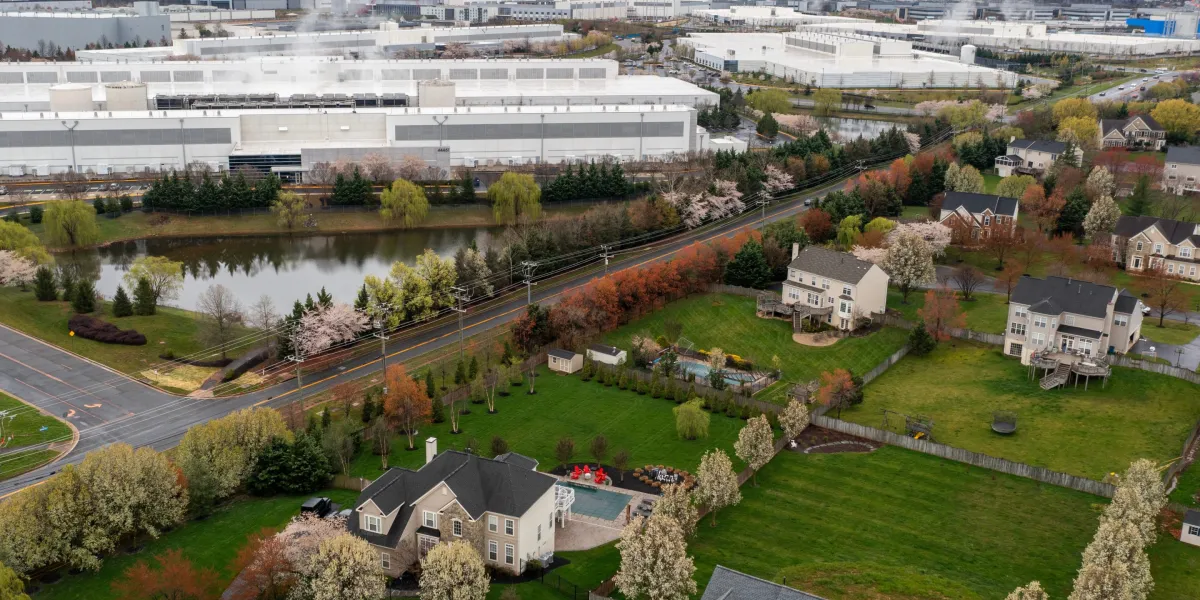
US AI investment has overtaken residential investment in inflation-adjusted terms, marking a significant shift in the forces driving the economy as technology companies accelerate their construction of data centres and other infrastructure.
Real private residential fixed investment stood at $748 billion in the second quarter, according to Bureau of Economic Analysis data. That was 18 per cent below its early 2021 peak.
Over the same period, spending on information processing equipment, including data centres and computer hardware, rose by 51 per cent to $752 billion.
Adam Shapiro, vice-president at the Federal Reserve Bank of San Francisco, described the change as “a pivotal shift in the US economy”, with investment moving “away from residential investment and towards computers”.
The contrast reflects the very different pressures facing the two sectors. Housing investment has been hit by higher borrowing costs since the Federal Reserve began an aggressive campaign of interest rate rises to contain inflation after the Covid-era boom.
The benchmark 30-year mortgage rate is close to 7 per cent, while the yield on the 10-year Treasury bond has reached its highest level since 2007. Higher rates have discouraged prospective buyers and made developers more cautious.
By contrast, spending on AI infrastructure has continued to expand despite the cost of finance. Hyperscalers have invested heavily in data centres and computing capacity, with annual spending by a small group of companies expected to approach $1 trillion.
Some technology companies have begun issuing more debt to supplement their cash reserves. Alphabet, the parent company of Google, reported negative cash flow earlier this year.
Treasury Secretary Scott Bessent has said AI companies appear willing to borrow regardless of the interest rate. “We are also seeing big corporate issuance. And a lot of that corporate issuance, I would say, is almost yield-agnostic, because the build-out for AI, the returns on that, the companies believe they’re going to be so high. They don’t really care what they’re paying,” he said.
AI spending forecast to rise further
Capital expenditure by Alphabet, Amazon, Microsoft, Meta, Oracle and SpaceX is forecast to reach more than $1.3 trillion in 2027, according to S&P Global. That compares with projected spending of $870 billion in 2026 and $470 billion in 2025.
The ratings firm warned that capital expenditure is growing faster than revenue, raising the prospect of overcapacity if demand for AI services fails to match expectations.
S&P Global expects 2028 to be an inflection point, with revenue growth accelerating while capital expenditure levels off. It forecasts that the six companies’ combined operating cash flow will be negative in both 2026 and 2027.
The rapid build-out has also prompted political opposition. A recent NBC News poll found that 64 per cent of registered voters would be less likely to support a candidate who backed the construction of a data centre in their community.
AI-related investment has added to pressure on household budgets through higher electricity bills and increased prices for new smartphones and personal computers, while home ownership remains unaffordable for many Americans.
The supply of existing homes has been restricted by the so-called lock-in effect, as owners with low mortgage rates remain reluctant to move and take on today’s more expensive borrowing costs.
New construction has also weakened. Housing starts fell by 2.6 per cent in August to an annualised rate of 1.275 million, driven by a decline in multi-family projects. Single-family starts increased, but permits fell, pointing to subdued building activity ahead.
The National Association of Home Builders said builder sentiment had dropped to its lowest level in a year. Capital Economics said elevated and rising borrowing costs were holding developers back and that the decline in housing starts had further to run.
